Archaeologists have uncovered a baffling 5,000-year-old burial in a prehistoric kiln pit near Gerstewitz, Germany, raising dark questions about human sacrifice and ancient violence. Found during excavations for the SuedOstLink power line, the remains belong to a young man of the Corded Ware culture, a society known for its strict funerary traditions. Instead of a typical grave, his body was discovered curled inside an abandoned underground combustion chamber, his skull bearing the brutal marks of blunt force trauma.
The discovery was made by experts from the State Office for Heritage Management and Archaeology (LDA ) Saxony-Anhalt. The victim, estimated to be around 25 years old at the time of his death, was placed on his right side facing south - a standard alignment for Corded Ware men. However, his placement in a kiln pit consisting of two connected chambers breaks all community traditions, as these productive spaces were not conventional cemeteries. The man's upper body appeared slightly displaced, suggesting he may have originally been laid upon organic material that has since decayed.
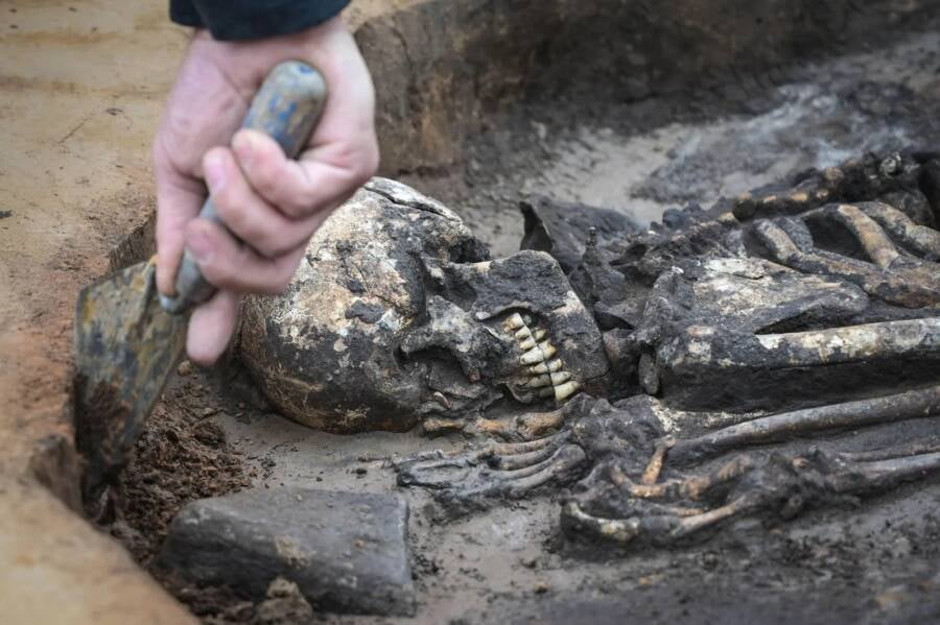
Close-up of the battered skull found in the kiln pit. (Christian Pabst / State Office for Heritage Management and Archaeology Saxony-Anhalt)
Evidence of Extreme Violence and Ritual Offerings
Forensic analysis of the battered skull confirmed multiple bone fractures caused by repeated blows with a blunt object, injuries that occurred around the time of his death. The unusual setting and the violent nature of his demise have led archaeologists to propose three possible scenarios: he was murdered and his body hastily concealed, he was a casualty of a forgotten Copper Age battle, or he was the victim of a deliberate human sacrifice.
While human remains are rarely found in Corded Ware kilns, researchers have occasionally discovered complete cattle skeletons or partially butchered dogs in similar pits, which are widely believed to be sacrificial offerings. The placement of a human body in this specific context makes the theory of human sacrifice difficult to dismiss.
- A Rare Stone Age Burial Found Amongst 140 German Medieval Graves
- Mysterious 5,000-Year-Old Ritual Pits Unveil Dark Neolithic Ceremonies
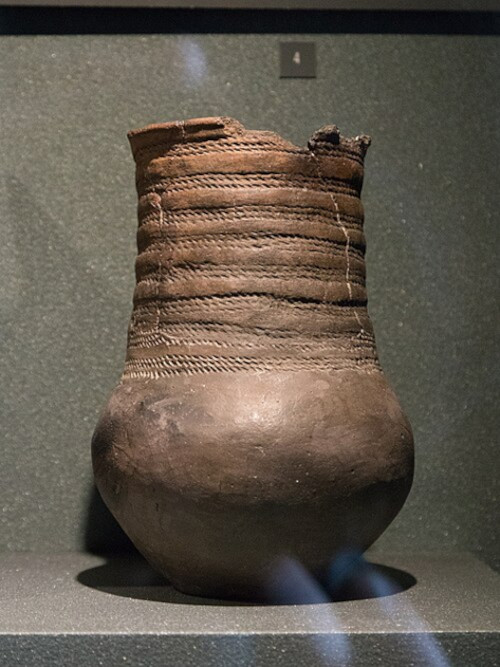
A typical Corded Ware culture beaker of the Eneolithic period. (Zde/CC BY-SA 4.0)
A Landscape Steeped in Ancient Ceremonies
The hill near Gerstewitz has been a site of human activity for roughly 6,000 years, revealing a landscape steeped in complex ritual behavior. Earlier excavations at the site uncovered a massive burial mound from the Baalberge culture (4000–3400 BC) and traces of elaborate ceremonies linked to the older Salzmünde culture (3400–3100 BC). These older ritual pits contained animal and human bones, intact ceramic vessels, and the rubble of burned houses.
Although the Salzmünde culture predates the Corded Ware people by centuries, the continued use of the area for unusual deposits highlights its long-standing significance as a center for symbolic and ceremonial transformation.
- 6,000 Year Old Neolithic Burial Mounds were Later Used for Ritual Sacrifice!
- 4,300-Year-Old Woodhenge in Germany Revealed to the Public for the First Time
Unlocking the Secrets of the Past
To unravel the mystery of this prehistoric death, scientists in Halle are conducting extensive biochemical and genetic studies. Stable isotope analyses of the skeleton’s tooth enamel will reveal the victim’s geographic origin and childhood movements, helping to determine if he belonged to the local community or was a foreign captive. Additionally, ancient DNA extraction will trace his ancestry, while further osteological evaluations will look for signs of malnutrition and occupational stress.
As researchers piece together the evidence, this extraordinary burial continues to provide vital clues about the social complexity, religious practices, and institutionalized violence of early European farming communities during the Late Neolithic and Copper Age.
Top image: Burial of a Corded Ware Culture individual in a kiln pit in Gerstewitz. Source: Christian Pabst / State Office for Heritage Management and Archaeology Saxony-Anhalt
By Gary Manners
References
Killgrove, K. 2026. 5,000-year-old burial of man with battered skull found in kiln in Germany — and he may have been a human sacrifice. Live Science. Available at: https://www.livescience.com/archaeology/5-000-year-old-burial-of-man-with-battered-skull-found-in-kiln-in-germany-and-he-may-have-been-a-human-sacrifice
Radley, D. 2026. 5,000-year-old Corded Ware burial found in kiln pit raises possibility of human sacrifice in Germany. Archaeology News Online Magazine. Available at: https://archaeologymag.com/2026/06/5000-year-old-corded-ware-burial-found-in-germany/
State Office for Heritage Management and Archaeology Saxony-Anhalt. 2026. A dead man found in a kiln pit. Mysterious archaeological find near Gerstewitz, Burgenland district, Saxony-Anhalt. Informationsdienst Wissenschaft (idw ). Available at: https://nachrichten.idw-online.de/2026/06/15/a-dead-man-found-in-a-kiln-pit-mysterious-archaeological-find-near-gerstewitz-burgenland-district-saxony-anhalt