
Revolutionary sediment core analysis from the Roman town of Aldborough in Yorkshire has shattered long-held beliefs about Britain's post-Roman economic collapse, revealing that metal production not only continued after 410 AD but actually expanded during what historians have traditionally called the "Dark Ages." The study, published in the journal Antiquity, provides the first unbroken timeline of British metal production from the 5th century to present day, fundamentally challenging assumptions that industrial-scale commodity production disappeared with Roman withdrawal.

Aerial photograph of Aldborough showing the extent of the walled town and the location of the sediment core (D. Powlesland & V. Herring/Antiquity Publications Ltd).
Revolutionary Archaeology Challenges Historical Assumptions
Researchers from the Universities of Cambridge, Nottingham, and several other UK institutions analyzed a five-meter sediment core extracted from Aldborough, the Roman tribal capital of Isurium Brigantum that served as the administrative center for the Brigantes, Britain's largest tribal confederation. Lead author Professor Christopher Loveluck from Nottingham University explained that this core provided "the first unbroken continuous record and timeline of metal pollution and metal economic history in Britain, from the 5th century to the present day, at the heart of a major metal-producing region."
The innovative methodology bypassed the scarcity of written records by examining metal pollutants deposited in sediment layers over 1,300 years. This environmental approach revealed patterns invisible to traditional historical analysis, demonstrating how archaeological science can illuminate periods where textual evidence remains fragmentary or non-existent.
Professor Loveluck noted that while little was known about post-Roman metal industry, "it was generally assumed that industrial-scale production declined, as no epigraphic evidence for lead exploitation after the 3rd century exists." However, the sediment analysis contradicts these assumptions, showing that "at Aldborough, it is possible metal production expanded steadily using the ores and coal-fuel of the Roman period."
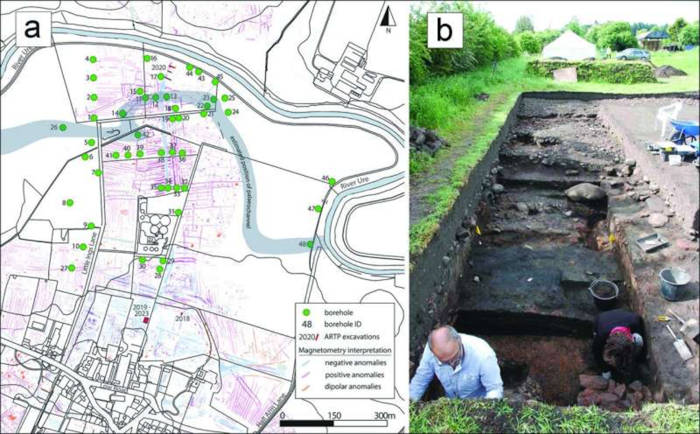
a) Plan showing features detected by geophysical survey and the location of boreholes and excavations undertaken at Aldborough; b) the Roman metal-working complex under excavation in 2021 (R Ferraby & M.J. Millett/Antiquity Publications Ltd).
Economic Continuity Challenges Dark Ages Narrative
The findings indicate that metal production in Britain continued long after the end of Roman administration around 400 AD, not declining until a sudden crash between 550-600 AD. This collapse coincided with devastating plague outbreaks that ravaged Europe during this period, suggesting that disease rather than political upheaval caused economic disruption. Historical sources and DNA evidence confirm that bubonic plague struck Britain during the 6th century, providing a plausible explanation for the production crash.
Crucially, these discoveries prove there was no total economic collapse after Roman departure, contradicting popular beliefs that post-Roman Britain represented a Dark Age where production regressed to pre-Roman levels. Instead, the evidence supports a more nuanced understanding of economic resilience and adaptation among surviving Romano-British communities.
The sediment core reveals multiple fluctuations in metal production corresponding to major historical events throughout the medieval period. Professor Loveluck highlighted how Henry VIII's Dissolution of the Monasteries created dramatic market disruption: "It became uneconomical to make fresh metal because it was ripped off all the monasteries, abbeys and religious houses. Large-scale production resumed in the later 16th century to resource Elizabeth I's Spanish and French wars."
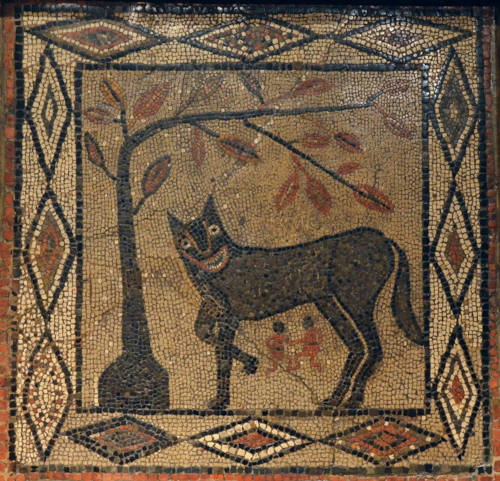
Roman mosaic from Aldborough depicting the she-wolf with Romulus and Remus, demonstrating cultural continuity. (Following Hadrian/CC BY-SA 2.0)
Aldborough: Capital of Roman Northern Britain
Aldborough's significance as a research location stems from its role as Isurium Brigantum, one of only seventeen regional capitals (civitates) in Roman Britain and the administrative center for the Brigantes confederation. The site began as a trading settlement around 70 AD before developing into a planned Roman town by 120 AD, serving as the northernmost major urban center in the Roman Empire.
Archaeological excavations have revealed extensive industrial activity at Aldborough, including large-scale iron-smithing operations using coal as fuel - a sophisticated technology that continued into the post-Roman period. Chemical analysis of soils confirms high levels of iron, arsenic, lead, copper, and zinc, indicating sustained metal production and working activities that persisted long after Roman political control ended.
The choice of Aldborough for this study proved crucial because it represented the heart of Britain's lead-producing region. The Yorkshire Dales constituted one of Europe's largest lead-producing areas from Roman through modern times, with documented production continuing through the medieval period. The site's location near the River Ure provided ideal conditions for sediment accumulation, preserving 1,300 years of environmental evidence in stratified layers.

Brutus of Troy & the Myth of Britain's Trojan Origins recorded webinar, from the Ancient Origins Store
Implications for Understanding Post-Roman Society
The Aldborough study represents a revolutionary advancement in understanding Britain's transition from Roman to post-Roman society, demonstrating that economic and technological knowledge survived political transformation. The research shows that Romano-British communities maintained sophisticated industrial operations, preserving not only basic metalworking skills but complex processes requiring coal fuel and specialized ore selection techniques.
This evidence supports recent archaeological trends that challenge simplistic collapse narratives, instead revealing adaptive societies that creatively responded to changing circumstances. Rather than wholesale abandonment of Roman practices, the findings suggest selective continuity of economically vital technologies within transformed social and political frameworks.
Professor Loveluck emphasized the broader significance:
"The results offer a revolutionary new insight into the economic history of Britain, which contradicts previous thought that all industrial-scale commodity production collapsed at the end of the Roman period."
This research methodology could transform understanding of post-Roman transitions throughout Europe, providing new tools for examining economic continuity where written sources remain inadequate.
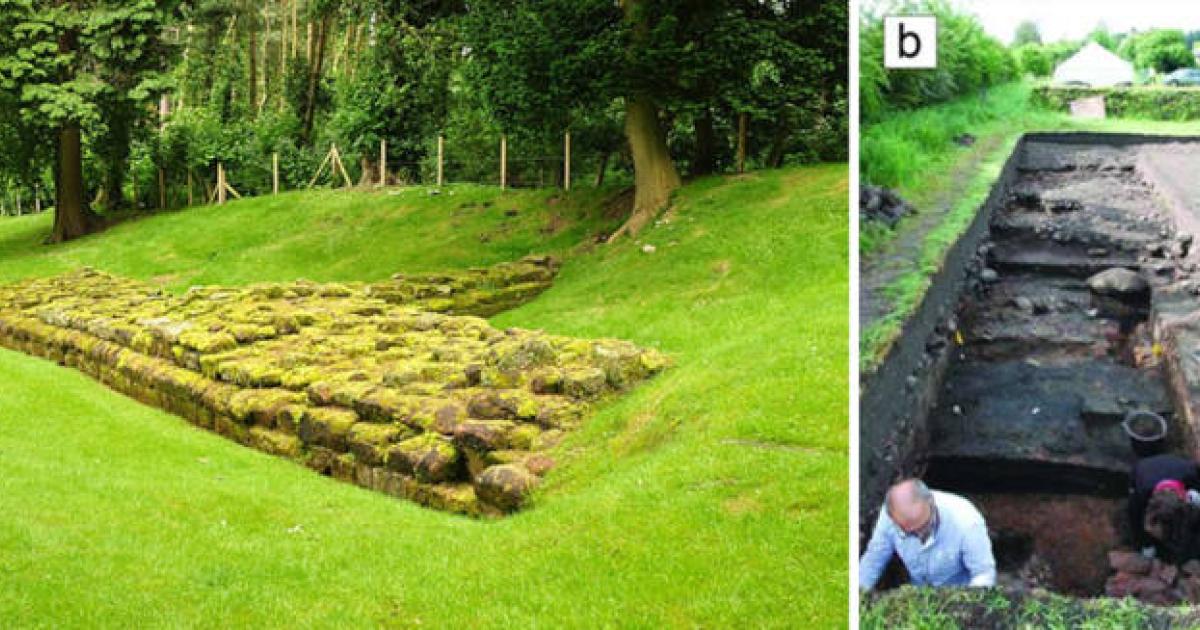
Top image: Left; part of the Roman ruins at Aldborough, Right; excavation of the Roman metal-working complex at Aldborough in 2021. Source: Left; Nilfanion/CC BY-SA 4.0 Right; Antiquity Publications Ltd
By Gary Manners
References
Loveluck, C.P., Millett, M.J., Chenery, S., Chenery, C., Ferraby, R., French, C. 2025. Aldborough and the metals economy of northern England, c. AD 345–1700: a new post-Roman narrative. Antiquity Publications Ltd. Available at: https://doi.org/10.15184/aqy.2025.10175
Phys.org. 2025. Britain's economy did not collapse after the Romans left, sediment core analysis finds. Available at: https://phys.org/news/2025-09-britain-economy-collapse-romans-left.html
University of Cambridge. 2025. Britain's economy boomed after the Romans, Aldborough study reveals. Available at: https://www.cam.ac.uk/research/news/britains-economy-boomed-after-the-romans-aldborough-study-reveals