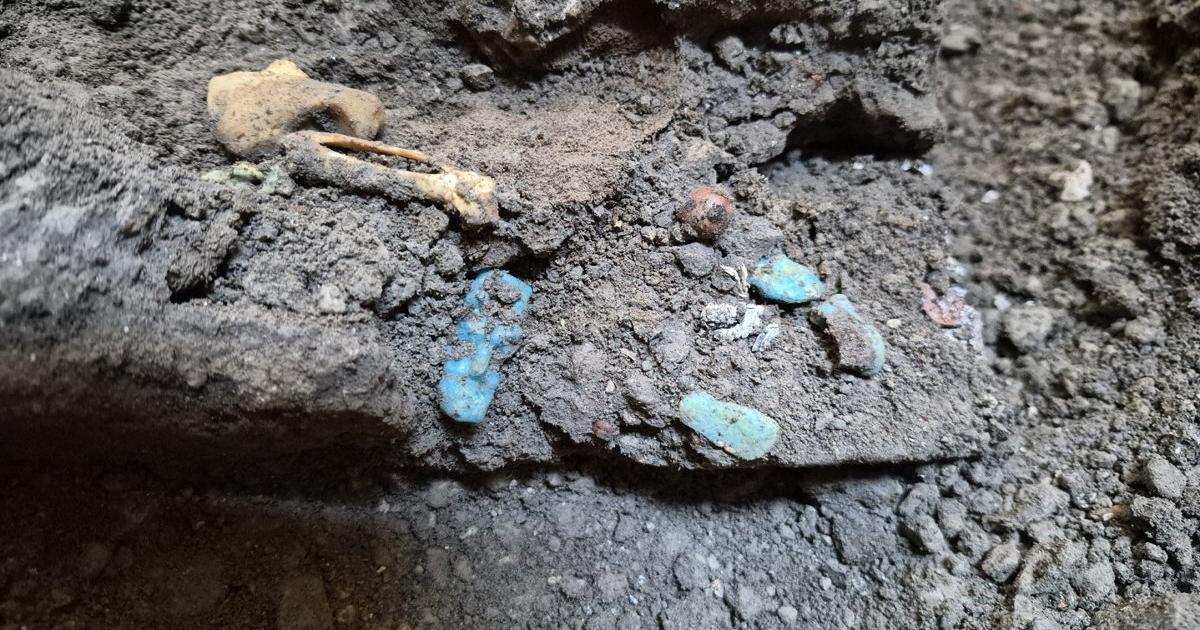

In a house on Via dell'Abbondanza, a cloth bag sat on a middle shelf of a wooden cupboard. Inside were little pendants of faience, bone, glass paste and rock crystal, each pierced so it could hang on a cord. Some show gods, and the excavators recognize Bes and Mercury among them. Others are shaped like hands, feet, pine cones and bunches of grapes. Then Vesuvius erupted in AD 79, and nobody opened that cupboard again.
On Thursday, October 29, 2026, the Pompeii Archaeological Park announced the find in its online E-Journal degli Scavi di Pompei and a press release. The cupboard, or armarium, stood in house IX 11, 7, the house traditionally attributed to a man named Cornelius Maximus. The park's E-Journal counts 24 miniature objects, and Euronews describes a necklace "composed of at least 24 miniature objects." CBS News gives a lower figure of at least 20. But who kept this cupboard, and why did it still hold a child's charms?
A house dug twice
The front of the house is not a new discovery. According to Euronews, its facade was excavated in 1912, but only now have some of the rooms behind it been investigated, as part of a restoration and accessibility project for the neighboring Insula dei Casti Amanti.
Euronews says the facade was "tentatively attributed to a figure named Cornelius Maximus on the basis of inscriptions now no longer visible." The park's own E-Journal article, written in Italian by director Gabriel Zuchtriegel and six colleagues, goes further and calls the attribution highly doubtful (translated from the Italian).
The room that held the cupboard had Fourth Style wall paintings that the excavators attribute to the workshop of painters on Via di Castricio. Euronews reports that these paintings "indicate a certain standard of living, in line with the central position of the house, which overlooks one of the main arteries of the ancient city." Yet the house was not in perfect order in AD 79. At the time of the eruption, Euronews adds, "various works were nevertheless in progress that must have affected liveability considerably."
What was on the shelves
The wooden cupboard rotted away long ago, so the excavators rebuilt its shape from the imprints it left in the deposits. The E-Journal describes how the shelves collapsed inward when the roof fell, so that objects slid and broke on different levels.
For body care, there were tweezers, a coticula (a small palette for mixing pigments), and a glass balsamarium, a little bottle for scented oils. The E-Journal groups these as tools of the mundus muliebris, the Latin term for a woman's toilet set. For light and scent, there was a bronze lamp and an incense burner.
There were also lead weights, kept in a small wooden box of which only faint traces remain. The E-Journal counts eight of them, six with iron handles. Euronews says they were "probably used for a commercial activity," while the park's Italian text is more careful, saying they could be compatible with trade but that their exact purpose still needs to be assessed.
Finally, there was tableware and kitchenware: vases and pots in bronze, glass and ceramic. Euronews describes them as "everyday household objects, but perhaps also heavy with memories, as in the case of an elegant little jug decorated with pine-scale motifs."
Euronews headlines the find as a woman's wardrobe, a reading that rests on the beauty kit. However, CBS News writes of "the owner or owners," so even the number of people is open. Other finds have shown how a middle class Pompeii family furnished its bedroom.
A necklace that rattled
The pendants are the heart of the find. According to Euronews, experts say such necklaces were sometimes regarded as magical objects used in spells and potions. Earlier finds in Pompeii have been read the same way, as with the box of charms once hailed as a sorcerer's kit.
However, the park offers a gentler explanation. Euronews reports that "in reality they are what are known as crepundia, literally 'rattles': necklaces with amulets that were given to children to protect them, but also so that they could be heard when they moved." The word comes from the Latin crepare, which the E-Journal glosses as to resound or to make noise (translated from the Italian).
Why would a grown person still own one? Euronews, summarizing the park, says "It was not unusual for adults to keep them too, often in small boxes or, as in this case, in cloth bags inside wardrobes, apparently as keepsakes of a childhood of which little else remained." The park links this to how often Romans moved. In Euronews's words, "The Roman world was characterised by a high degree of geographic mobility at all levels, from slaves to wealthy merchants, so that many people found themselves living far from relatives and parents and from the places of their childhood."
In the Roman playwright Plautus's comedy Rudens, a young woman named Palaestra is recognized by her family through the childhood objects she has kept. The authors caution, though, that a comic convention should not automatically be taken as a widespread social practice (translated from the Italian).
Thirty-eight coins in a basket
In the cupboard, the excavators found a small clump of coins. Euronews reports that there are 38, all bronze, kept in a cistella, "a small container made of plant material using basketry techniques." The E-Journal suggests they were a small cash reserve, perhaps for daily expenses.
Euronews, again summarizing the park, says "The presence of the coins in particular suggests that the owner or owners did not have time to recover the objects of value, whether economic or emotional."
However, the park sets out three possibilities for what happened next. If the owners escaped, they may never have come back to dig for their belongings, "unlike others whose efforts have left traces revealed by recent excavations." They may have died in the eruption. Or, as Euronews puts it, they may be "among those who, as the historian Tacitus recalls, died without heirs and whose property would have been used for the refounding of Pompeii," a refounding that never happened. The E-Journal itself notes that this reference to Tacitus needs careful historical and legal study before it can be tied to the owners of this cupboard (translated from the Italian).
CBS News, citing the park, says those who died may have numbered about 15 to 20 percent of Pompeii's population. Some left vivid traces, like one family's fight to survive the eruption. Whether the owner of this cupboard was among them is not known. "These are questions destined to remain open," Euronews concludes.
Two small visitors
On a mezzanine in the house, inside an amphora, excavators found the remains of at least two mice. Analyses in the park's laboratory point to the wood mouse, Apodemus sylvaticus. According to Euronews, "The two specimens found at Pompeii were not fully mature, as indicated by the degree of development of their skeletons (117 tiny fragments)."
Similar rodent finds have turned up in the service quarters of the villa at Civita Giuliana and in the sewers of Herculaneum, offering, in Euronews's phrase, "the image of an urban society that also had to contend with unwelcome guests."
The traces of a life
For Zuchtriegel, as quoted by Euronews, Pompeii is a place where "the most ordinary objects restore the human dimension of the past." He added, "The value of this discovery lies in the possibility of reading together the different traces of a life: personal habits, work, memories."
"We cannot reconstruct with certainty the identity of the person who lived in the house, but these fragments bring us closer to their everyday life," Euronews quotes him as saying. CBS News prints a slightly different translation that refers to "those who lived in the house."
A pair of tweezers, a lamp, a jug, a basket of coins, and a bag of charms that may once have hung around a child's neck. Who that child grew up to be is still unknown.
How we label claims
Established: the house's location, the 1912 facade excavation, the reconstructed cupboard and its contents, the 24 pendants, the 38 bronze coins and the two young wood mice. Established: the park's identification of the pendants as crepundia. Disputed: that the house belonged to Cornelius Maximus, an attribution resting on inscriptions no longer visible that the park's article calls highly doubtful. Disputed: that the cupboard belonged to a woman, which the beauty kit suggests but no source confirms. Disputed: that the weights were for trade, which the E-Journal leaves open. Disputed: that the necklace was a childhood keepsake, which the park proposes with caution. Disputed: that the owner had no time to take the coins, since the park also allows escape without return. Disputed: the estimate that 15 to 20 percent of Pompeii's people died. Unverified: what became of the owner.
Pendants of the crepundia necklace and traces of the cloth bag that held them, photographed as they were found in house IX 11, 7, Pompeii. Image: Su concessione del Ministero della Cultura, Parco Archeologico di Pompei.
By Aris Manus
Sources
- Gabriel Zuchtriegel, Chiara Comegna, Saverio De Rosa, Domenico Esposito, Younes Naime, Giuseppe Scarpati and Ausilia Trapani, Lo scavo di una domus nell'insula IX 11: il rinvenimento di un armarium con crepundia, E-Journal degli Scavi di Pompei 2026.11, Parco Archeologico di Pompei, October 29, 2026 (Italian)
- Fortunato Pinto, In Pompeii, a woman's wardrobe resurfaces with beauty items and jewels, Euronews, October 29, 2026
- Kerry Breen, Ancient cosmetics, coins, mouse skeletons found in Pompeii home shed light on life before deadly eruption, CBS News, October 29, 2026