

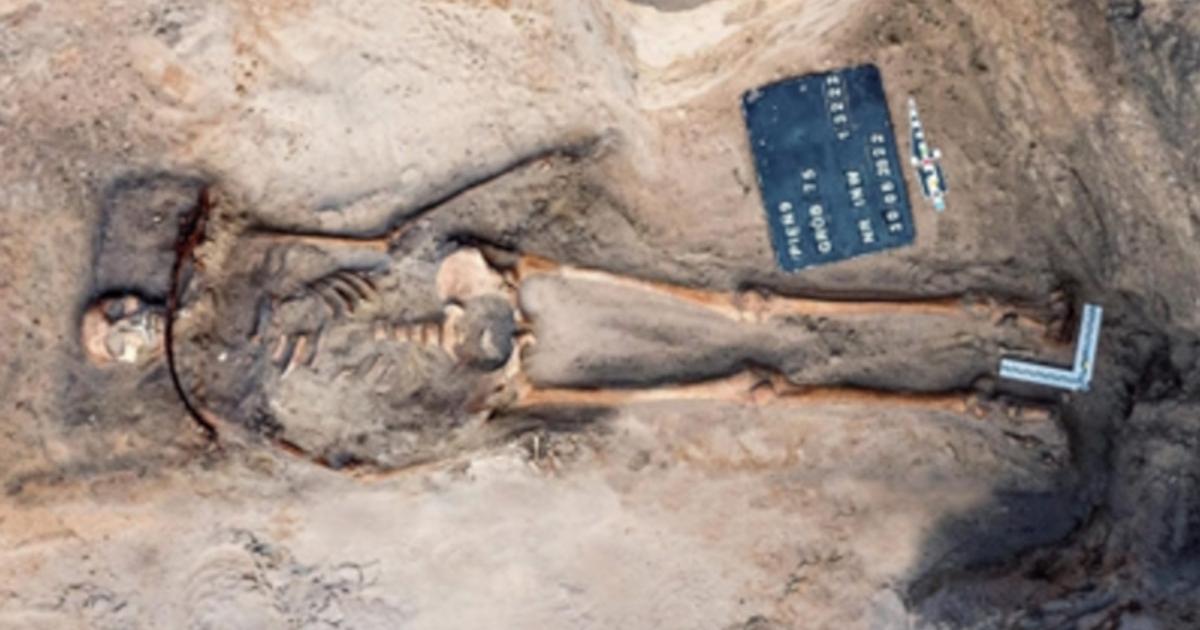

A young woman that died in 17th-century Poland and was buried with a sickle across her neck and a padlock around her toe probably grew up locally, belonged to a family with considerable wealth and had had a diet low in animal protein. These are the conclusions of a recent multidisciplinary study.
According to Phys.org, researchers used DNA analysis, stable isotope analysis, textile analysis and archaeological excavation of her tomb to reconstruct how this woman lived until approximately 17 to 19 years of age. They also revealed that the famous ‘vampire burial’ was altered after initial burial, while the body was still partly held together by soft tissue. Yet the reason she inspired such fear remains a mystery.
- Face of the 'Vampire' Woman: A Reconstruction of Pień's Mysterious Burial
- Child’s Anti-Vampire Burial Found in Chełm, Poland
Two Barriers Against the Restless Dead
In 2022, at Pień in the north-central region of Poland, archaeologists excavated Grave 75 containing a woman with a triangular iron padlock affixed to her left big toe and a curved iron sickle laid on her neck, with the edge of the sickle pointing at her throat. Other examples of vampire graves in Poland have similar restraints, however this is the first example of a grave containing a sickle and padlock together suggesting it was deemed a particularly dangerous corpse to deal with.
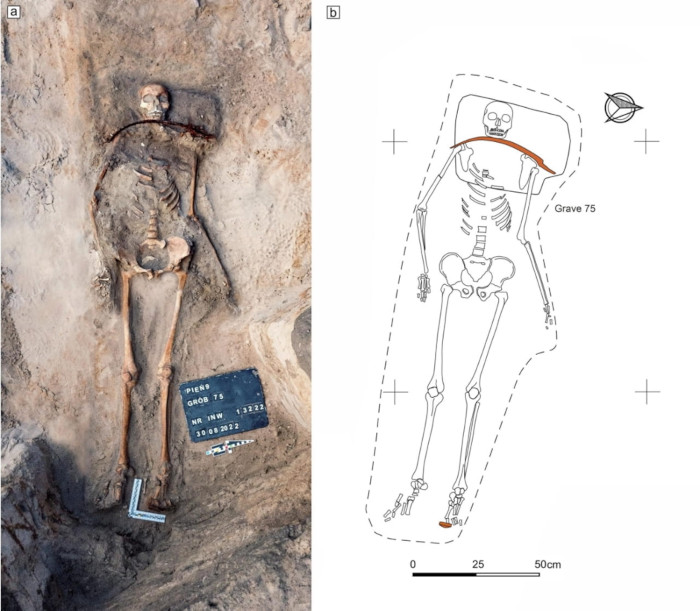
Grave 75 in situ and in horizontal projection, showing the sickle at the neck and padlock at the left foot. (Image Source: Poliński et al., 2026/CC BY 4.0)
The term "vampiric" encompasses a large variety of burial styles and the use of this term can fail to include the broader context of the underlying belief systems in use. In the early modern period, there was a widespread fear that revenants (the undead) would return from their graves and cause harm through the spread of illness, misfortune, or violence to others. To combat this, communities used several methods to keep revenants under control, such as iron blades, locks, and stones placed on their bodies.
These practices are also found in Bulgaria and were even present in Greek antiquity through placing heavy stones on the burials of the deceased. However, there is little evidence to conclude that these individuals held beliefs similar to the literary depictions of Dracula as depicted in later literature and films, and the ‘vampire graves’ is just modern tag.
- Researchers suggest cholera may be behind 17th century vampire graves
- Bulgarian archaeologists unearth second ‘vampire’ grave
Gold Threads, Poor Diet
The discovery of fine textile fragments found beside the skull has changed the interpretation of this woman as an outcast without a defined place in society. The woven silk galloon that was found was not only made of silk, but with threads of ‘pure silver and gold-gilded wire’. In other words, the materials were so expensive that they indicate that this woman was likely born into a well-to-do family. Researchers state that even the materials used in burial garments for royals at the time are often not made from such fine threads.
But even though she came from a very wealthy background, it appears her wealth did not guarantee her protection from being treated with suspicion after death.
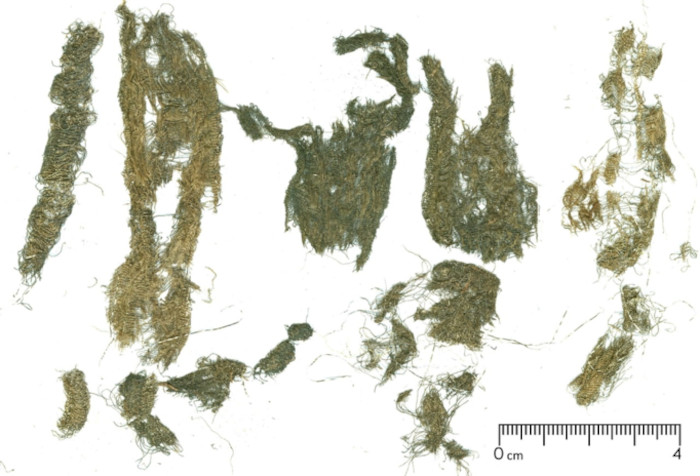
Fragments of the decorative woven galloon associated with the woman’s headwear. (Poliński et al., 2026/CC BY 4.0)
Chemical signatures in her teeth suggest that she grew up in or near the Pień region, though similar isotope values occur elsewhere in Central Europe. Her mitochondrial DNA belonged to haplogroup J1c2c1, a maternal line found across Europe, but it cannot by itself establish that she was a Scandinavian outsider. Carbon and nitrogen isotope results nevertheless place her among cemetery adults who consumed little animal protein. As with other ancient DNA and isotope studies, the combined evidence reveals mobility and diet more reliably than social identity.
A Grave Reopened Before Decay
The disturbed earth surrounding the bones suggests the grave was reopened while the body was still decomposing. Although this young woman's left arm was displaced, the skeleton was still substantially articulated, indicating soft connective tissue was still present between the bones at the time the grave was reopened.
While the original burial was likely when the padlock was placed, the sickle was probably added later, perhaps during the second intervention. The spike and sharp edges of the sickle also support this.
'Copper-green' staining on the palate and neck bones may indicate contact with copper or copper-based material, either directly or indirectly. The copper-bearing material entered the mouth or nose after death, but its identity and precise timing remain unresolved. No further information is available about the source of this material.
The new paper, however, found no skeletal trauma or disease that could explain her death, and CNN’s report stresses that her ancestry evidence is limited to a short maternally inherited sequence. Her cause of death is still unknown. So too is the event that led someone to reopen her grave.
Fear at the Edge of the Village
The cemetery is located outside of the main village near a crossroads and it is not recorded on any historical maps that have survived. This cemetery doesn't have crosses or other religious items commonly associated with Roman Catholic burials indicating that it may have some relationship with Protestantism, but we cannot determine a specific denomination from the available evidence.
As a result of excavations that have occurred at Pień, there were more than 100 graves found, with many of those graves containing atypical internments. Therefore, Pień serves as a valuable case study illustrating how societies treat those they deem problematic or dangerous. Similar finds throughout Europe (for instance, a child buried with the skull placed face-down in Chełm) illustrate how societies attempted to manage the uncertainty surrounding the dead through various means.
In Poland-Lithuania in the 17th Century, war, starvation, plague, and harsh weather constantly pressurized local populations to evaluate their neighbors. An unexpected death could lead to someone being classified as a suspect, regardless of whether they had good fortune because they wore nice clothing. An example of this was grave 75 which holds a remarkable example of this dichotomy where an affluent teenager was mourned, feared, reburied, and shackled. Science can now recover parts of her biography, but not the accusation that followed her into the earth.
Top image: Three stages in the excavation of Grave 75 at Pień, showing the disturbed grave and sickle across the woman’s neck. Source: Poliński et al., 2026, CC BY 4.0.
By Gary Manners
References
Hunt, K. 21 August 2026. Scientists aim to unravel the secrets of a young woman’s ‘vampire’ burial. Available at: https://www.cnn.com/2026/08/21/science/vampire-burial-young-woman-poland
Mondal, S. 25 August 2026. Archaeologists investigate a feared young woman's 17th century vampiric grave in Poland. Available at: https://phys.org/news/2026-08-archaeologists-young-woman-17th-century.html
Poliński, D., et al. 30 July 2026. A unique, non-normative burial of a young adult female from a 17th-century cemetery in Pień, north-central Poland. A multidisciplinary approach. Journal of Archaeological Science: Reports 74, 105967. Available at: https://doi.org/10.1016/j.jasrep.2026.105967
The WNET Group. 30 October 2024. Field of Vampires. Secrets of the Dead, PBS. Available at: https://www.pbs.org/wnet/secrets/preview-field-of-vampires-n0hzfq/8114/






















