
The mystery surrounding the Pilate ring may have been solved with just a single Greek letter. A recent paper proposes that the inscription on the ring is Latin written in Greek characters meaning “For Pilate.” This finding does not support the notion that the ring belongs to a governor but rather suggests that it was simply a tool used by a person of lesser rank who was engaged in some business connected with Pontius Pilate’s administration.
The new study, researched and written by UCLA academic Catherine E. Bonesho has recently been published in Palestine Exploration Quarterly.
A Ring with a Puzzling Name
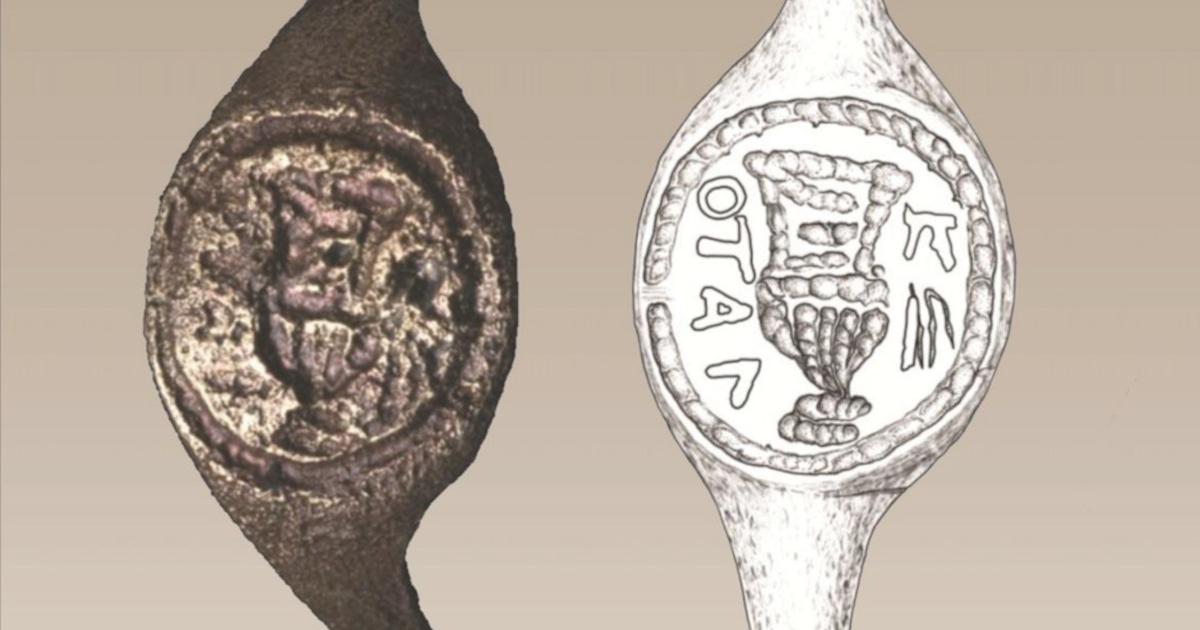
The ring was found in the course of Gideon Foerster’s excavations in Herodium in 1968-1969, the palace that Herod the Great built near Bethlehem. It was cleaned and submitted to sophisticated imaging techniques that revealed a vessel (probably a krater) bearing the inscription ΠΙΛΑΤΟ. The first report about the findings, published in 2018, noted a possible link with Pontius Pilate but argued that the ring in question could hardly belong to the affluent Roman governor as it was too crude and imperfect for someone of his high office.
- A Ring Unearthed 50 Years Ago Likely Belonged To Pontius Pilate Who Condemned Jesus To Death
- Herodium, King Herod’s Palace, Is Set to Reveal New Marvels
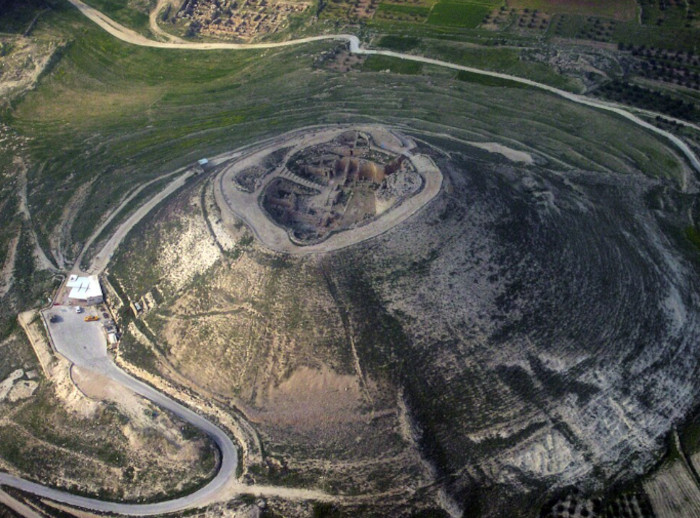
Aerial view of Herodium, where the Pilate ring was excavated. (Image source: Asaf T./Public Domain)
Following the death of King Herod, his Herodium fortress continued to exist during the Roman Empire as an important regional administrative center or toparchy. It witnessed a major transformation of its function as illustrated by its monumental remains, such as the entrance to a palace and some later tunnel constructions made by the insurgents. The ring was discovered in the fill associated with the Jewish revolt around 70 AD but it could have found itself there many years before.
Why the Final ‘O’ Matters
If ΠΙΛΑΤΟ was common Greek, it would probably have ended differently, e.g. ΠΙΛΑΤΟΥ for "belonging to Pilate", or ΠΙΛΑΤΩ meaning "to Pilate" or "for Pilate". According to a 2023 paper, the letters may have been interpreted as two abbreviations totally unrelated to the governor. By contrast, Bonesho interprets them as the Latin dative PILATO, written letter by letter in Greek script by someone with limited command of Latin.
- Archaeologists Unearth Huge Entryway with Frescoes and Rebel Tunnels in Herod’s Palace
- 2500-Year-Old Signet Ring from Tradeswomen Uncovered in Jerusalem

Catherine E. Bonesho, author of the new Pilate ring study. (Image source: Courtesy of Catherine Bonesho/UCLA Newsroom)
The important term in this process is the final omicron, which corresponds to a short o “The mixing up of omicron and omega for long and short ‘o’ vowels in transliterating Latin into Greek is common among early Latin language learners,” Bonesho explained to UCLA Newsroom. Another possibility is that the layout was intentional because the item was engraved prior to applying its design, which required manipulation of the letters.
A Seal for Pilate, Not Pilate’s Jewel
The dative PILATO could even signify the place of delivery of goods, documents, or containers: “to Pilate” or “for Pilate.” The ancient signet rings authorized messages and were used to mark sealed cargos, thus, the ring of Pilate could be helpful for clerks, messengers, and warehouse workers. The ring made of thin copper alloy and made carelessly would be suited to its everyday function better than ceremonial jewelery of an provincial governor.
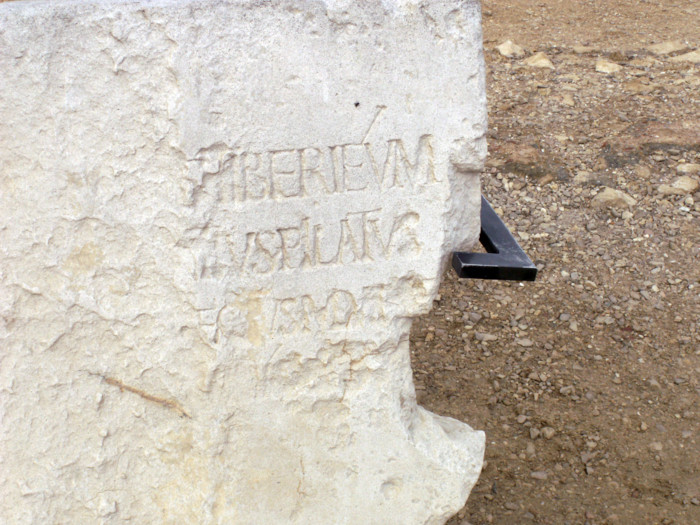
The Pilate Stone names Pontius Pilate and his office in a Latin dedicatory inscription from Caesarea Maritima. (Marion Doss/CC BY-SA 2.0)
The proposition does not establish evidence that Pilate existed or wore the ring. The name and titles are already inscribed on the Latin Pilate Stone from Caesarea Maritima, as well as in numerous written works. The ring does help illustrate one way in which authority spread beyond prestigious public buildings to the day-to-day work done in Roman Judea, including areas affected by the Second Temple and subsequent revolt.
The Forgotten Worker Behind Roman Rule
Bonesho hypothesizes cautiously that the owner of the ring was someone forced into servitude or at least a person who had previously experienced slavery that served an aristocrat connected with the Roman administration in Judea. Such an individual may have sealed a number of tax documents, records of property, supplies, etc., for Pilate's office, possibly upon the order of an official from the Herodium. This hypothesis is supported by the observation that it has not been uncommon for the local provincial governments to rely on people of low status and, not only on Roman army and senior officials.
While this interpretation is not definitive, since the badly preserved Pilate's ring does not allow identifying its carrier with any degree of certainty, it does explain the ring's cheap metal, strange imagery, odd lettering, and location in a single, coherent way. That one small “O” may therefore reveal less about Pilate’s hand than about the overlooked hands that kept Roman rule working.
Top image: Photo and drawing of the 2,000-year-old copper-alloy Pilate ring excavated at Herodium. Source: C. Amit/IAA Photographic Department (photo); J. Rodman (drawing); both courtesy of Roi Porat, via UCLA Newsroom.
By Gary Manners
References
Amorai-Stark, S., Hershkovitz, M., Foerster, G., Kalman, Y., Chachy, R. and Porat, R. 2018. An Inscribed Copper-Alloy Finger Ring from Herodium Depicting a Krater. Israel Exploration Journal, 68(2), pp. 208–220. Available at: https://www.jstor.org/stable/26740648
Bonesho, C. E. 2026. The Pilate Ring: A Reconsideration. Palestine Exploration Quarterly. Available at: https://doi.org/10.1080/00310328.2026.2695544
Brenner, S. 2026. What’s in an ‘O’? New UCLA research may unlock mystery of ring tied to Pontius Pilate. Available at: https://newsroom.ucla.edu/releases/research-may-unlock-mystery-ring-tied-to-pontius-pilate
Cargill, R. 2020. Was Pontius Pilate’s Ring Discovered at Herodium? Available at: https://www.biblicalarchaeology.org/daily/biblical-artifacts/inscriptions/pontius-pilate-ring-herodium/
Eck, W. and Ecker, A. 2023. Not a “Signet Ring” of Pontius Pilatus. ‘Atiqot, 110. Available at: https://doi.org/10.70967/2948-040X.1083