

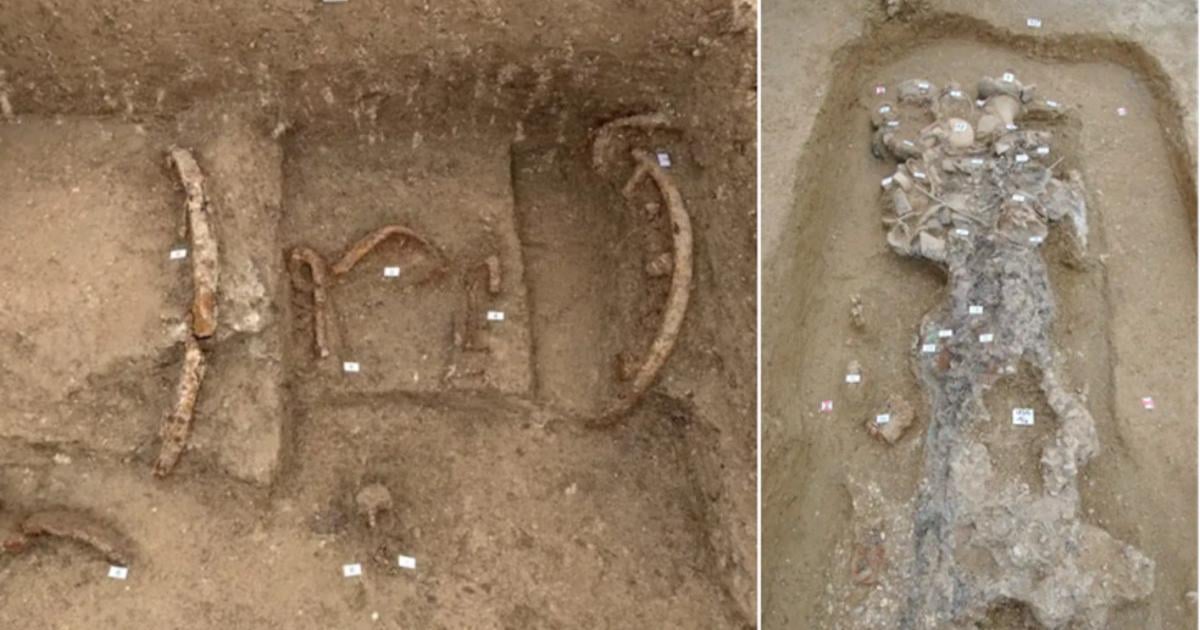

The discovery of an incredible 6th-century BC burial complex in Sirolo, central Italy has shed fresh light on the aristocratic Picene class of ancient Italy. The recent excavation has led not only to the discovery of the princely burial tomb containing a chariot, but also a well-preserved lady's burial, which itself is quite revealing, providing unprecedented evidence of their funerary rituals, social hierarchy, and far-reaching trade networks across the ancient Mediterranean.
The site is close to the famous I Pini necropolis and the tomb of "Queen" Sirolo, one of the richest Picene burials from the Adriatic Iron Age. The excavation was carried out by ArcheoLab with support from the Italian Ministry of Culture and under the aegis of Superintendence of Archaeology, Fine Arts, and Landscape in the province of Ancona.
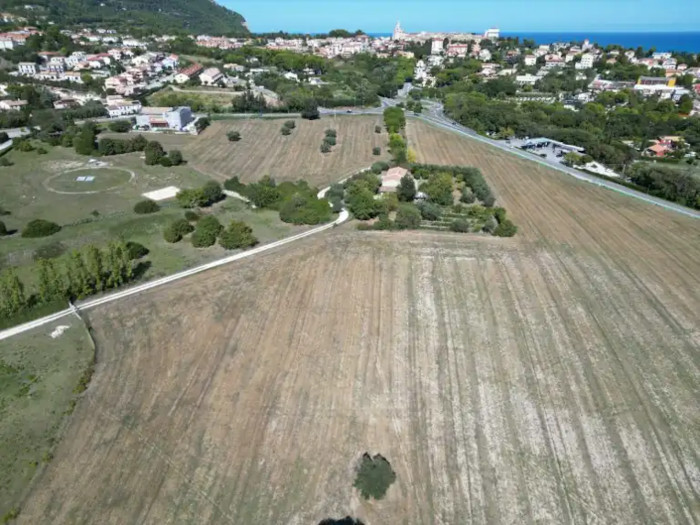
View of the area where the necropolis is located near Sirolo, central Italy, where the 6th-century BC Picene funerary complex was uncovered. (Soprintendenza ABAP Ancona Pesaro Urbino)
A Chariot Burial at the Heart of the Monument
At the center of the newly identified funerary circle, archaeologists discovered a large male burial containing the remains of a currus, a two-wheeled chariot likely placed intact inside the grave pit. In the context of pre-Roman Italy, chariots in tombs are universally interpreted as markers of elite rank and authority rather than everyday transport vehicles.
- Picene Prince’s Tomb Reveals a Chariot and 150 Other 7th Century BC Artifacts
- Untouched 2,600-Year-Old Fully Intact Etruscan Tomb Uncovered in Italy
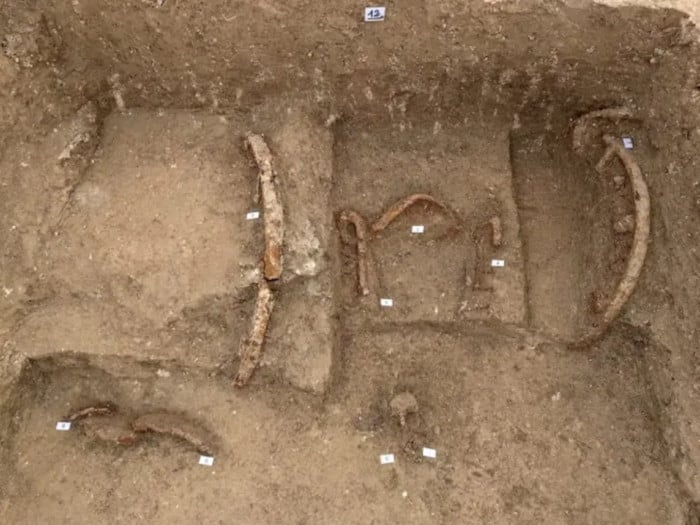
The chariot at the center of the newly uncovered 6th-century BC Picene funerary complex. (Soprintendenza ABAP Ancona Pesaro Urbino)
The prince's grave goods included a rich array of weaponry, comprising a bronze helmet, an axe, and other offensive weapons. The artifacts currently undergoing restoration are expected to reveal new forms of authority display previously undocumented in Picene archaeology. These objects were crucial in a society without written records, as they communicated the deceased's social standing, political power, and external contacts.
Sealed Vessels and Evidence of Funerary Banquets
One of the most surprising elements of the burial is a group of large bronze sheet containers found inside the chariot tomb. These vessels were still sealed with ceramic lids and contained organic material, animal bone remains, and ceramic fragments. Researchers believe these containers preserve traces of the funeral banquet held during the burial or food offerings intended for the deceased in the afterlife.
The presence of banquet equipment in elite graves highlights the importance of commensality—eating, drinking, and display—in Picene aristocratic rituals. A high-ranking individual was not only a warrior but also a host and leader who participated in aristocratic customs shared across central Italy.
The architecture of the monument itself is also highly unusual. Unlike other large funerary circles in the Piceno region, which are typically bounded by a V-shaped annular ditch, the Sirolo complex was enclosed by a circular wooden palisade. This boundary was identified through a regular sequence of post holes containing small ritual deposits of selected ceramic fragments, representing an architectural solution previously unrecorded in the region.
- Pre-Roman Prince’s Tomb Packed With Treasures Found in Italy
- 2,700-Year-Old Iron Age Pit Tomb Necropolis Unearthed in Italy
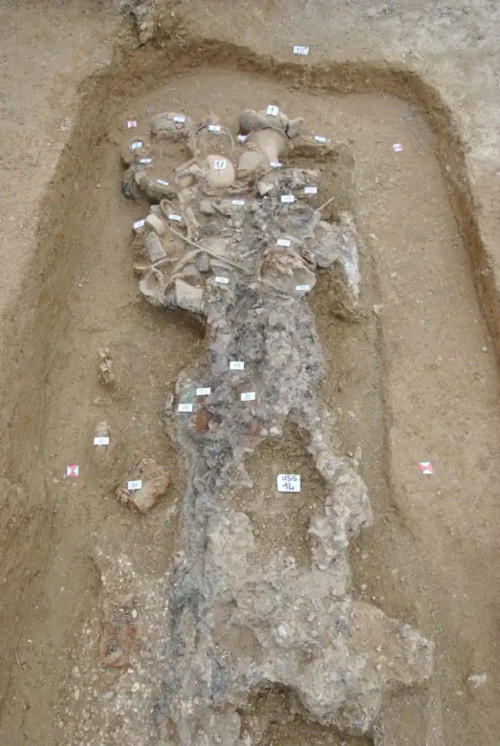
The female burial uncovered beside the central princely chariot tomb in the 6th-century BC Picene funerary complex near Sirolo, central Italy. (Soprintendenza ABAP Ancona Pesaro Urbino)
A Well-Preserved Noblewoman and Wider Context
Next to the princely tomb, archaeologists uncovered a remarkably well-preserved female burial. The grave contained delicate organic materials, including traces of textiles, decorations, and footwear with metal elements still in their original positions. Numerous fibulae were placed on the body to secure garments and a shroud, while a large fibula with an amber core, found beyond the woman's head, may have belonged to an elaborate headdress or hairstyle.
This female burial indicates that prestige among Picene women was powerfully represented through clothing, ornaments, amber, and carefully staged funerary displays, consistent with rich female graves found elsewhere in the Picene world.
The discovery of this complex finally allows archaeologists to contextualize a warrior's tomb found nearby in 2020. That burial, containing a high-status military kit and a rare Greco-Etruscan folding stool (diphros), is now understood to be part of this larger aristocratic family cemetery organized around the princely chariot burial.
"For the first time, we can observe not a single tomb, but an entire aristocratic group, with hierarchical and symbolic relationships that open up new perspectives on the structure of the elites who led the great Picene center that developed in the area of present-day Conero," emphasized archaeologist Stefano Finocchi, the excavation’s scientific director. The monumentality of the complex and the quality of the grave goods highlight the extensive networks connecting the central Adriatic to the major centers of pre-Roman Italy.
Top image: The princely chariot tomb at the center of the newly uncovered 6th-century BC Picene funerary complex near Sirolo, central Italy. Source: Soprintendenza ABAP Ancona Pesaro Urbino
By Gary Manners
References
Arkeonews. 2026. 2,600-Year-Old Picene Prince’s Tomb with Chariot and Sealed Bronze Vessels Found in Central Italy. Available at: https://arkeonews.net/2600-year-old-picene-princes-tomb-with-chariot-and-sealed-bronze-vessels-found-in-central-italy/
Finestre sull'Arte. 2026. Sirolo: A burial complex featuring a princely tomb and the remains of a chariot has been discovered in the Picene necropolis. Available at: https://www.finestresullarte.info/en/archaeology/sirolo-a-burial-complex-featuring-a-princely-tomb-and-the-remains-of-a-chariot-has-been-discovered-in-the-picene-necropolis
HeritageDaily. 2026. Elite chariot burial and noblewoman’s tomb unearthed. Available at: https://www.heritagedaily.com/2026/07/elite-chariot-burial-and-noblewomans-tomb-unearthed/158492
La Brújula Verde. 2026. Tomb of a 6th-Century BC Picene Prince Found in Central Italy with a Two-Wheeled Chariot and Large Still-Sealed Containers. Available at: https://www.labrujulaverde.com/en/2026/07/tomb-of-a-6th-century-bc-picene-prince-found-in-central-italy-with-a-two-wheeled-chariot-and-large-still-sealed-containers/
The History Blog. 2026. 6th c. B.C. Picene princely and noblewoman burials found. Available at: http://www.thehistoryblog.com/archives/date/2026/07/02





















