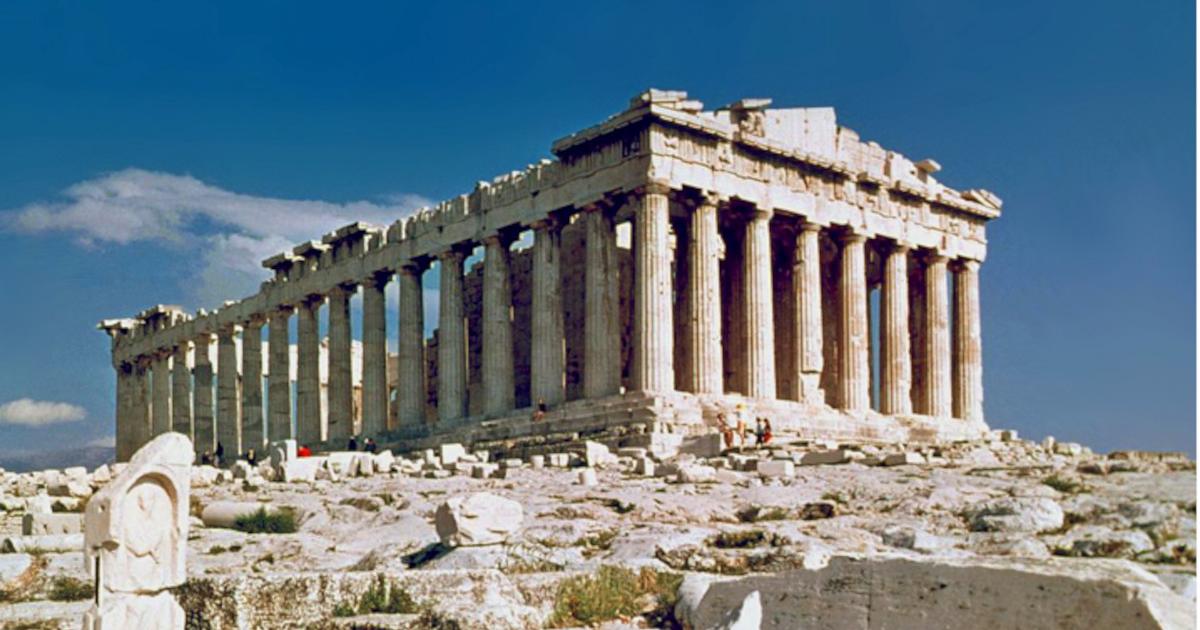

For generations, the Parthenon has been celebrated as a masterpiece that appears straight because its builders subtly made it curved. According to a new analysis this widely accepted notion of the reason for the building's straight appearance fails the mathematical test. What the research disputes is not the fact that the building has different forms, but that its appearance was an intentional design trick.
The argument can be traced back to the Roman author Vitruvius, who talked about Greek architecture several centuries after the Parthenon was finished. Vitruvius said that if the platform was horizontal, it would look as if it was sagging, so the builders elevated the middle section of the stylobate, which is the flat part of the base of the temple. Later authors recognized the same reasons for the slight bulging of the columns, called entasis, and for the thicker corner columns.
- The Acropolis Of Athens: A Golden Age Legacy
- The Parthenon: An Epic Monument Or a Mystery in Measurements?

Historical photograph showing the curvature of the Parthenon’s stylobate, photographed by G. Fougeres in 1910. (Public domain)
What the mathematics found
Alain Goriely, a mathematician at the University of Oxford, has revisited the claim using nineteenth-century surveys, modern measurements and models of human visual perception. His open-access study in Royal Society Open Science examines at least 12 proposed “optical corrections.” It concludes that the supposed illusions are either unsupported by experimental evidence or too small to matter under ordinary viewing conditions.
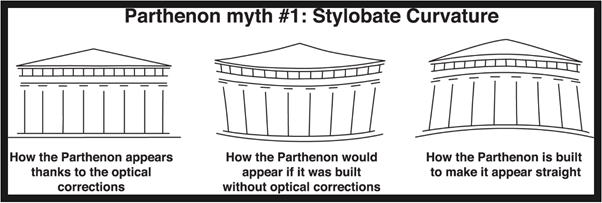
Popular Stylobate curvature explanation. (Goriely - Figure adapted from Fletcher)
Goriely states:
“The myth of the Parthenon follows a typical line of reasoning: in the absence of refinements, the Parthenon would look like it is sagging as in the central figure (grossly exaggerated for the purpose of the argument). But, the ancient Greeks, in their great wisdom, built the Parthenon with upward curvature (right) so that it would appear straight (left). All three statements are incorrect.”
It is true that the stylobate is raised approximately six centimeters in its center, although people do not interpret a straight horizontal line as bent when looking at it without the assistance of distracting arrangements found in laboratory illusions Goriely explained. So, from some angles, one can even see the Parthenon’s intentionally added curvature. The columns should also be noted; their greatest amount of bulge is 18 millimeters, which, according to Goriely, is below human perception levels at usual distances.
- Mystery of Parthenon’s Dazzling Ancient Lighting System Has Been Solved
- Greek Acropolis Built by Ancient Engineers to Resist Earthquakes
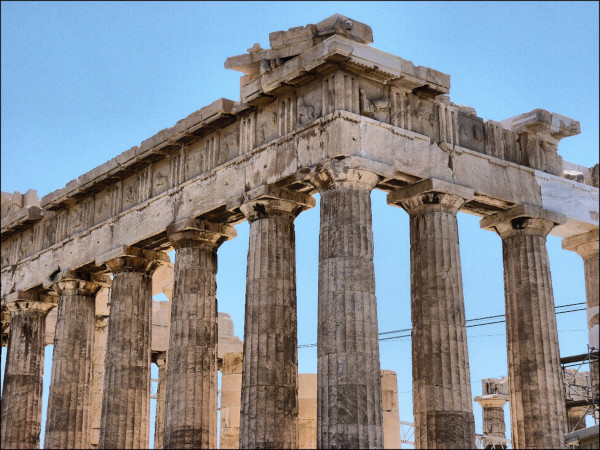
Doric columns of the Parthenon. (Patano/CC BY-SA 3.0)
Real refinements, uncertain purpose
Goriely’s conclusion is more measured than the headline “myth debunked” might suggest. The ancient builders clearly introduced deliberate variations, including curvature, inward-leaning columns and changing spaces between columns. These are not random errors, and they are not all visible from the same viewpoint. As the study puts it, “there is insufficient historical evidence and no scientific evidence that the Parthenon’s refinements were optical corrections.”
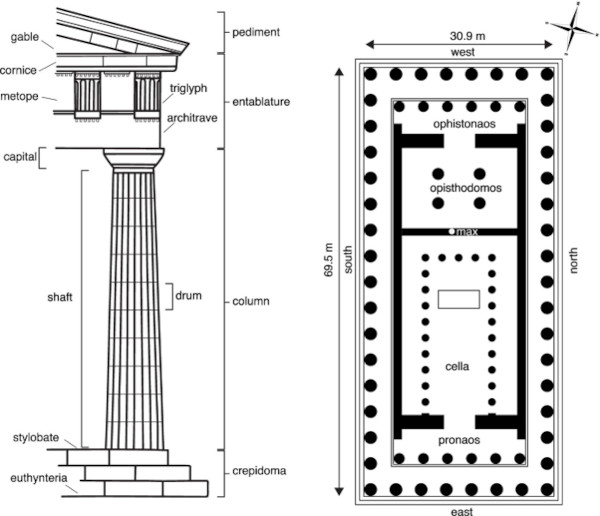
Left: the classical architectural elements of a Doric temple. Right: plan of the Parthenon. (Goriely/Royal Society Open Science)
That leaves the central historical question of the reasons behind these design decisions open. The stylobate curve could have simplified water removal from the building, while swelling of the columns could have simply matched with the general doctrine of aesthetics at the time. Ancient Greeks had an inclination for organic forms that imparted liveliness to material even if they were geometrically incorrect. The Ancient Origins account of the Parthenon in Athens and the sacred space of the Acropolis offers useful context for the building’s religious and social importance.
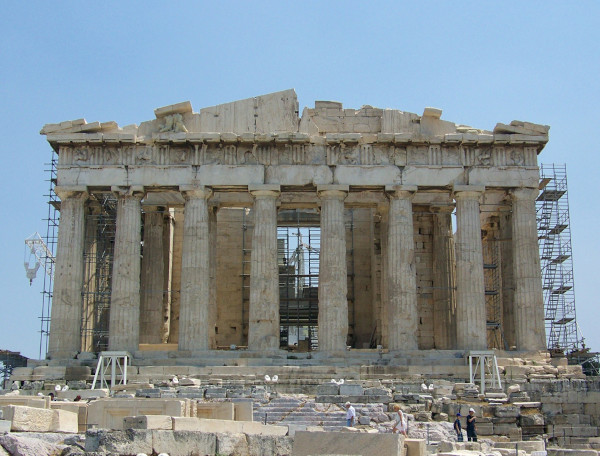
The Parthenon western façade during restoration, shown in uncorrected perspective. (Eusebius/ CC BY 3.0)
A myth under new scrutiny
The study also explains the reason behind the durability of optical correction stories. Vitruvius offered ancient explanations which seemed to have been the most valuable source, whereas it was confirmed by 19th-century engineers that the edifice had been refined. Thus, we have the two facts melted into one story that become repeated in several architectural books, films and tourist brochures.
Goriely does not claim to have solved the design philosophy of the Parthenon. Rather, he states that remarkable explanations can be substantiated by both historical evidence and vision science evidence. The result is a more intriguing mystery: not why the Greeks corrected illusions, but why they invested so much labor in refinements whose purpose may have been practical, symbolic or aesthetic. New work on the lost temples of the Acropolis and the engineering of the Greek Acropolis shows how many questions remain around the monument.
Top image: The Parthenon on the Acropolis in Athens. Source: Steve Swayne/ CC BY 2.0
By Gary Manners
References
Arnold, P. 2026. Mathematician challenges a 2,000-year-old legend about the Parthenon’s optical illusions. Available at: https://phys.org/news/2026-09-mathematician-year-legend-parthenon-optical.html
Goriely, A. 2026. The illusion of illusions: there are no optical corrections in the Parthenon. Available at: https://royalsocietypublishing.org/rsos/article/13/9/rsos260999/483304/The-illusion-of-illusions-there-are-no-optical