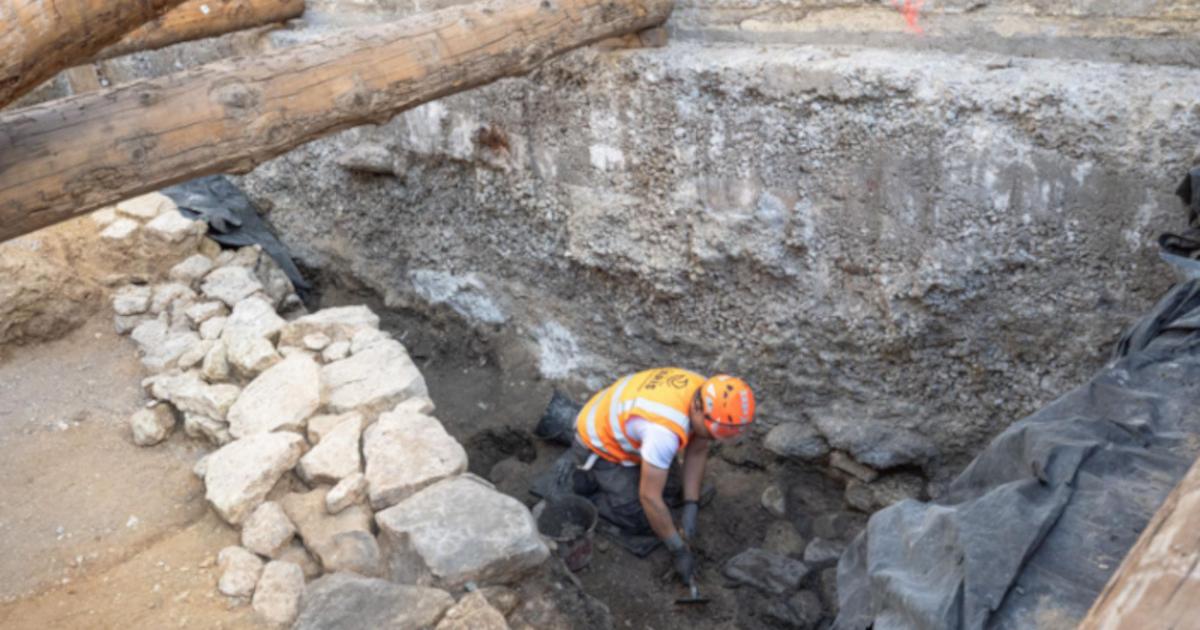

France's Culture Ministry announced the find and called it a major breakthrough in archaeology. The structure pairs stone blocks with horizontal timber beams, a method used in late Iron Age fortifications across Gaul, as at Manching in Bavaria. Excavators also found a platform made of sand and gravel that is two meters thick, presumably brought there to raise the area above the water level.
Carbon-14 dating of the wood gave a large period ranging from 200 BC to 10 BC, which is a wide window, but includes 52 BC, the year when Caesar’s lieutenant Titus Labienus marched on Lutetia and the Parisii burnt their own settlement rather than let it fall to Rome.
"We may be looking at one of the most important remains ever discovered for understanding Gallic Lutetia," said Culture Minister Catherine Pégard. "Scientific caution still requires that we verify its function and its chronology."
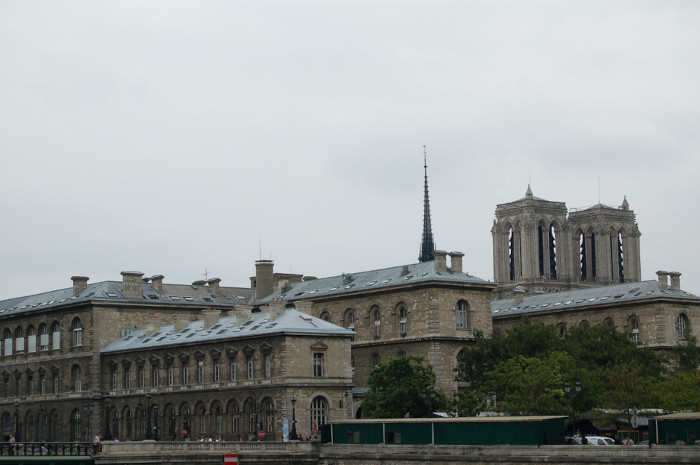
The Hôtel-Dieu hospital on the Île de la Cité, with Notre-Dame Cathedral rising behind it. The Gallic rampart was found four meters beneath one of its courtyards. (Hadonos/CC BY-SA 3.0)
Caesar's Island, and the Case for Nanterre
In the seventh book of Caesar's Gallic Wars, Lutetia is mentioned to have been a Parisii stronghold located on an island in the Seine River, linked through bridges. Such a sparse description has allowed for several maps to be produced. For much of the twentieth century, the Île de la Cité was the preferred location prospect due to the fact that the Roman town that took over the Gaulish one grew up around it. However, there has not been much evidence coming from the island to corroborate the theory.
Nanterre, a suburb to the west, built a serious counter-claim after excavations between 1994 and 2005 uncovered a large Gallo-Roman necropolis in a bend of the Seine.
"For centuries, the location of Lutetia has been debated," said Stéphane Deschamps, regional curator of archaeology at the DRAC Île-de-France. "Lacking tangible evidence on the Île de la Cité, some had even suggested a location in Nanterre. Today, with this wall and its context, we may hold the key to the mystery."
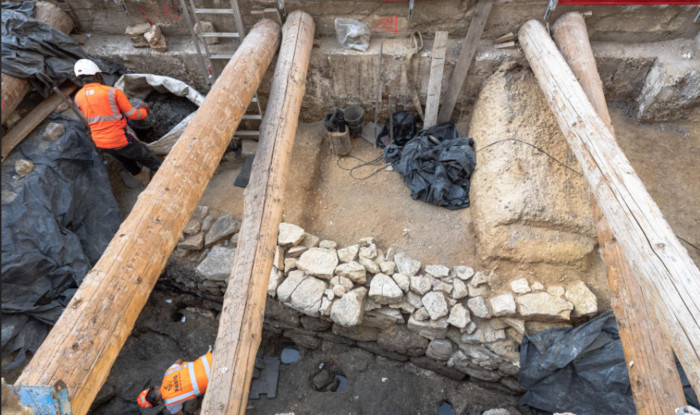
Iron Age wall excavated at Hôtel-Dieu, Paris 2026. (© Hamid Azmoun/Inrap)
Fire, a Spearhead, and a Question of Dates
The evidence of burning distinguishes the Hôtel-Dieu find from standard Roman-era discoveries. The outer side of the wall shows signs of fire damage, a wooden structure in front of it was ruined, and many seeds were carbonized where they fell. What’s more, at the base of the wall lay a Gallic iron javelin head.
None of these finds prove that the Parisii set the fire there in 52 BC. The abandonment layer is found between the end of prehistory and the beginning of the Roman period. Although the findings are a convergence of clues which point in the right direction, they are not definitive proof.
"All of our predecessors dreamed of finding traces of Gallic presence on the Île de la Cité," said Dorothée Chaoui-Derieux, coordinator of archaeological operations in Paris for the ministry. "We're fortunate to be in the right place at the right time."
In 53 BC Caesar summoned an assembly of Gaulish peoples at Lutetia; the following year the Parisii joined the wider revolt, and the fighting that followed ended in Roman victory.
- The Battle of Alesia: Rome Vs. Gaul, Caesar Vs. Vercingetorix
- Beneath Notre Dame: 'Dig of the Century' Unearths 1,700 Years of Paris
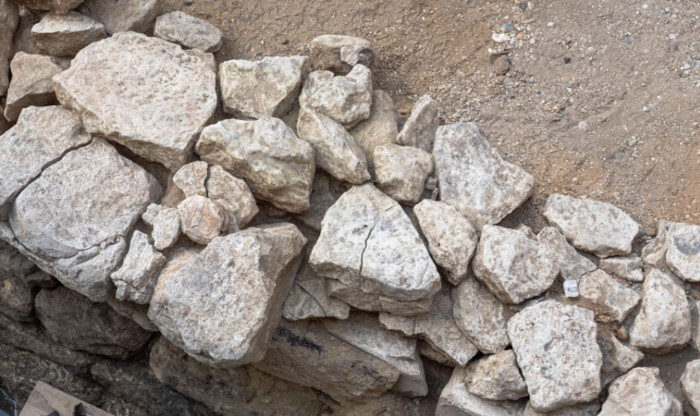
Fire cracked stones of the Iron Age wall excavated at Hôtel-Dieu, Paris, 2026. (© Hamid Azmoun/Inrap)
A Fragile Wall
Standing at no more than a meter, the rampart is in poor condition as the stones were cracked due to the heat of the fire and much of the timber has been charred through. A mold will be taken from it in the next couple of weeks in order to recreate part of the rampart from the original facing stones for display in a Paris museum.
The excavations began in February and were supposed to finish by December, but this declaration of exceptional significance has postponed it until the beginning of 2027, so further investigation can be done. The director of excavations David Couturier and colleagues are now determining whether the wall functioned only as a defensive structure, or also as a retaining wall, and if older strata exist below the site.
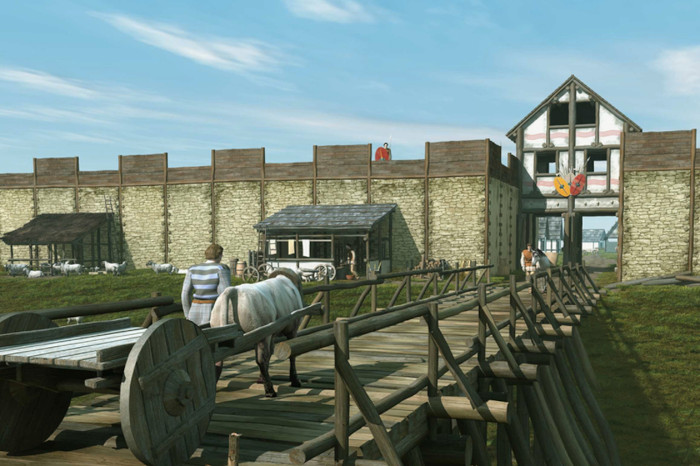
A reconstruction of a late Iron Age murus gallicus of the type the Parisii would have built, showing the stone face and timber lacing described by Caesar. (Basel Archaeology/CC0)
"Beneath our feet, thanks to the trowels of our colleagues, this wall built in the Gallic tradition is gradually revealing its secrets," said Paris mayor Emmanuel Grégoire, who inspected the wall on Wednesday.
Paris has a habit of surrendering its deepest history in ordinary places, from the Roman arena in the Latin Quarter to the burials under a suburban cellar floor and the tunnels that draw visitors underground by the thousand. Now a hospital courtyard has added a chapter older than any of them.
For now, the case rests on burnt wood and a date range that is imprecise. Further excavation will decide whether this is the rampart Caesar's readers have been imagining since the first century BC.
Top image: Iron Age wall excavated at l’Hôtel-Dieu AP-HP à Paris 4e, 2026. Source: © Hamid Azmoun/Inrap
By Gary Manners
References
Agence France-Presse. 2026. Ancient wall discovered in Paris, possibly confirming site of ancient Lutetia. Available at: https://www.lemonde.fr/en/history/article/2026/09/23/archaeological-breakthrough-could-confirm-origins-of-paris_6757849_157.html
Inrap. 2026. Le rempart de la Lutèce gauloise retrouvé sous l'Hôtel-Dieu AP-HP à Paris. Available at: https://www.inrap.fr/le-rempart-de-la-lutece-gauloise-retrouve-sous-l-hotel-dieu-ap-hp-paris-20946
Ministère de la Culture. 2026. Découverte archéologique : le rempart de la Lutèce gauloise retrouvé sous l'Hôtel Dieu AP-HP à Paris. Available at: https://www.culture.gouv.fr/presse/communiques-de-presse/decouverte-archeologique-le-rempart-de-la-lutece-gauloise-retrouve-sous-l-hotel-dieu-ap-hp-a-paris
Neyret, E. 2026. Archéologie : pourquoi la découverte du rempart de la Lutèce gauloise, sur l'île de la Cité, à Paris, est exceptionnelle. Available at: https://www.historia.fr/archeologie/civilisations-anciennes/archeologie-pourquoi-la-decouverte-du-rempart-de-la-lutece-gauloise-sur-lile-de-la-cite-a-paris-est-exceptionnelle-2253129
Scott, A. 2026. Charred 2,000-Year-Old Wall Found Beneath Paris May Reveal the Location of Ancient Lutetia. Available at: https://www.discovermagazine.com/charred-2-000-year-old-wall-found-beneath-paris-may-reveal-the-location-of-ancient-lutetia-49716
The History Blog. 2026. Ancient wall may be earliest Gallic remains of Paris. Available at: http://www.thehistoryblog.com/archives/76998
Zinin, A. 2026. Archaeological 'breakthrough' could confirm origins of Paris. Available at: https://phys.org/news/2026-09-archaeological-breakthrough-paris.html