About 20,000 years ago, when Europe was frozen in the final chill of the Ice Age, mysterious giants periodically washed up on the Atlantic shores of modern northern Spain and southwestern France. They were not gods or monsters but whales—giant, oil-filled corpses drawn onto the beaches by the tides and slain by accident, not human hand. But it was Homo sapiens, men, who fashioned these beachcombed titans into instruments of survival.
A recent research by Jean-Marc Pétillon (CNRS) and Krista McGrath (ICTA-UAB), published in Nature Communications, reports the first known evidence of humans manufacturing tools from whale bones.
During the time range of 14,000 to 20,000 years ago, Bay of Biscay Paleolithic hunter-gatherers collected cetaceans' remains to produce intricately manufactured projectile points and foreshafts—employed for the hunting of reindeer and bison in the past. These discoveries, based on 26 rock shelter and cave locations, turn on their heads old ideas regarding early human subsistence to portray not only opportunism but deep ecological wisdom.
The Whale as Workshop
Although whale hunting is not likely to have taken place during this period—assuming the absence of seafaring and the enormity of the animals—there is strong evidence in favor of scavenging beached whales. ZooMS (Zooarchaeology by Mass Spectrometry) analysis of 173 bone specimens (83 tools and 90 fragments) proved that 131 belonged to whales, including sperm whales, gray whales, blue whales, fin whales, and either right or bowhead whales.
“Our study reveals that the bones came from at least five species of large whales, the oldest of which date to approximately 19,000–20,000 years ago. These represent some of the earliest known evidence of humans using whale remains as tools”, Pétillon, senior author of the research, in a press release.
- World’s First Perfectly Preserved Ice Age Bear Found in Russia
- Next Ice Age Due in 11,000 Years – if Global Warming Doesn’t Stop It
Most impressive, perhaps, was the preference for sperm whale bones on a strategic level, particularly for spear points. Sperm whales possess lengthy, straight jawbones—ideal raw material. More than 40% of projectile points and 73% of foreshafts were fashioned from sperm whale bones.
Most impressive, perhaps, was the preference for sperm whale bones on a strategic level, particularly for spear points. Sperm whales possess lengthy, straight jawbones—ideal raw material. More than 40% of projectile points and 73% of foreshafts were fashioned from sperm whale bones.
These early artisans were not indiscriminate, not just accepting whatever washed up on shore, but perhaps preferring bone which was more easily shaped, lighter to transport, or more resistant to the rigors of the battlefield.
“What was more surprising to me—as an archaeologist more accustomed to terrestrial faunas—was that these whale species remained the same despite the great environmental difference between the Late Pleistocene and today,” Pétillon tells Popular Science’s Laura Baisas. “In the same period, continental faunas are very different: the ungulates hunted include reindeer, saiga antelopes, bison, etc., all disappeared from Western Europe today.”

a) worked objects; b) unworked bone fragments, including a fin whale bone, Santa Catalina. (Uko Gorter/CC0-1.0)
The equipment lacks any sign of marine wear—implying that the bones were harvested not from deep-sea kills, but from stranded animals. The coast, punctuated by high cliffs and recessed inlets, would have made such strandings unusual but essential windfalls. Pétillon hypothesizes information about a beaching whale could have circulated quickly—by smell and human networks—causing seasonal changes in group migrations to capitalize on the enormous resource.
Bones and Behavior: Tracking Ecology Through Tools
In addition to cultural cleverness, the tools provide an unusual window on old ocean life. Stable isotope measurements (δ13C and δ15N) on the bones indicate surprisingly close modern whale diets in contrast to the Ice Age environment. Gray whales, for example, were already showing benthic feeding behavior, while sperm whales' high nitrogen content indicated their squid-rich diet.
What was different, though, was the weather: the Bay of Biscay at that time was more like today's Arctic sea, suggesting that whales migrated differently and maybe in greater numbers.
A majority of the tools dated between 17,500 and 16,000 years ago, representing the zenith of whale bone tool usage. However, the oldest dateable specimen—made of gray whale bone—extends the practice back to 20,200 years ago, representing the earliest known whale bone toolmaking in science.
The find also puts whales into the larger picture of Europe's Magdalenian culture, renowned for its cave paintings and advanced bone tools. These individuals were hardly isolated beachcombers but had sophisticated exchange networks that took finished tools into the interior and perhaps exchanged whale-based materials between regions.

Assemblage of unworked fragments of whale bone from Santa Catalina. (Natural Earth Data)
That the utilization of whale bone appears to decline after 16,000 years ago is a mystery—perhaps because of changing traditions, sunken coastal settlements, or breakdowns in exchange routes.
Echoes on the Tides of Time
These fossilized whale-bone implements are not simply curiosities of archaeology. They are witnesses to an alliance that stretches across tens of millennia: humans aligning with the cycles of the sea, answering its gifts, and deciphering its signs. In contrast to industrial whaling of recent centuries, this was coastal communion, forged through opportunism, respect, and practical brilliance.
- The Little Ice Age and Its Giant Impact on Human History
- Fossilized Fur Ball Turns out to be Frozen Ice Age Squirrel!
It's easy to imagine the Magdalenians as inland mammoth hunters. But these discoveries contradict that idea. They were familiar with the shore. They were familiar with the whales. And when luck—or bad luck—threw a leviathan onto their shores, they did not just see meat, but meaning, and made the carcass into tools for survival.
“The news of a stranding travels fast first, because it smells a lot [from a] long distance away, so people would concentrate from quite far,” Pétillon tells New Scientist’s Sophie Berdugo. “So, it might not have been the main driver of people going to the seashore, but when that happened, it probably had an influence on the movement of the people who probably changed their planned pattern of movement to go there.”
As contemporary conservationists struggle to restore what has been destroyed over hundreds of years of exploitation, maybe we can turn to the Paleolithic for inspiration: not in conquest, but in living with.
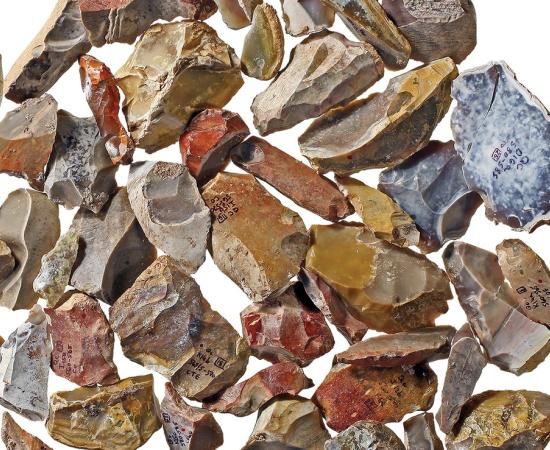
Top image: Paleolithic Tools and Bones Source: Harrygouvas at Greek Wikipedia/ Attribution
References
Kuta, S. 2025. Scientists Discover the Oldest Known Tools Made From Whale Bones, Crafted in Western Europe 20,000 Years Ago. Available at: https://www.smithsonianmag.com/smart-news/scientists-discover-the-oldest-known-tools-made-from-whale-bones-crafted-in-western-europe-20000-years-ago-180986696/.
McGrath, K., van der Sluis, L.G., Lefebvre, A. et al. 2025. Late Paleolithic whale bone tools reveal human and whale ecology in the Bay of Biscay. Nature Communications, 16. Available at: https://doi.org/10.1038/s41467-025-59486-8.