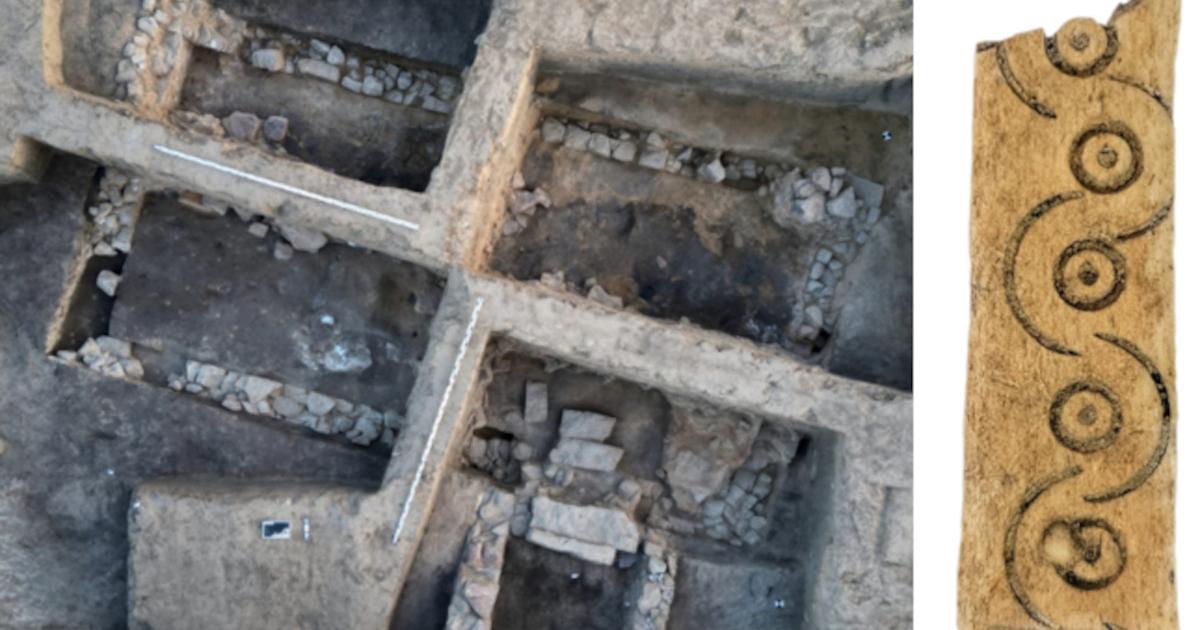

Archaeologists working on a forgotten royal residence in eastern Germany have uncovered a second stone building beside the palace, a find that shows the site's monumental core was far grander than anyone expected. The structure, about nine by five meters and fitted with a cellar and remarkably intact entrance stairs, was found beside the Ottonian palatium on the hill known as the Kleine Klaus, just outside Lutherstadt Eisleben in Saxony-Anhalt. Its finds date it securely to the 10th century, making it one of the earliest secular stone buildings in the region. Together with the church and the palace, it formed a stone ensemble that could be seen from far across the countryside.
- The Enigmatic Erdstall Tunnels of Europe: Purpose - Unknown
- Medieval "Earth Tunnel" Found in German Tomb Hints at Secret Rituals
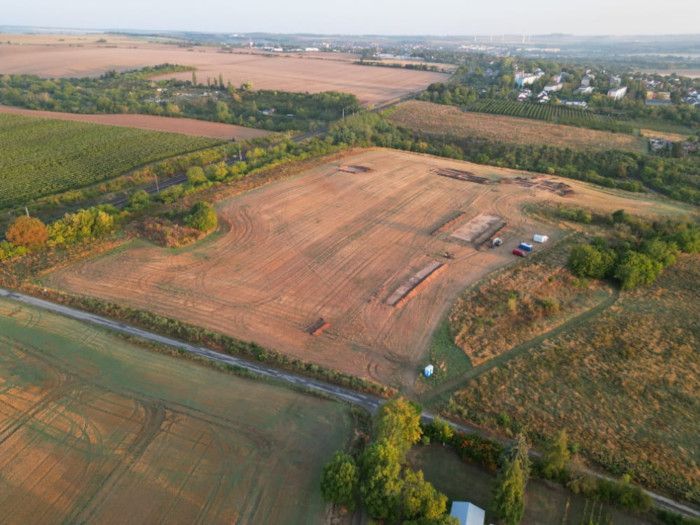
View from the southeast across the 2026 excavation area. (© State Office for Heritage Management and Archaeology Saxony-Anhalt/Johannes Groß)
A Royal Residence Rediscovered
The hill had all but slipped from memory before excavations between 2020 and 2023 brought the Ottonian royal palace of Helfta back to light. Teams uncovered the Radegundis church, founded by Otto the Great before 969, together with the stone palace that served as the king's hall and residence. The site had deeper roots still: a ninth-century document, the Hersfeld tithe register, names the hill as Helphideburc, while medieval records describe the later complex as a curtis imperialis, an imperial court. Recorded stays by Otto the Great, his son Otto II and Bishop Thietmar of Merseburg underline its standing.
The current campaign opened on 31 August 2026 under Prof. Dr. Felix Biermann of the State Office for Heritage Management and Archaeology Saxony-Anhalt, and runs until 24 October. Around 20 volunteers work alongside the professional team, while Saxony-Anhalt funds tourist facilities that the town of Eisleben is developing around the site.
- Huge 1,000-Year-Old Church Built by Otto the Great Found In Germany
- New Discoveries in Otto the Great's Tomb Restoration
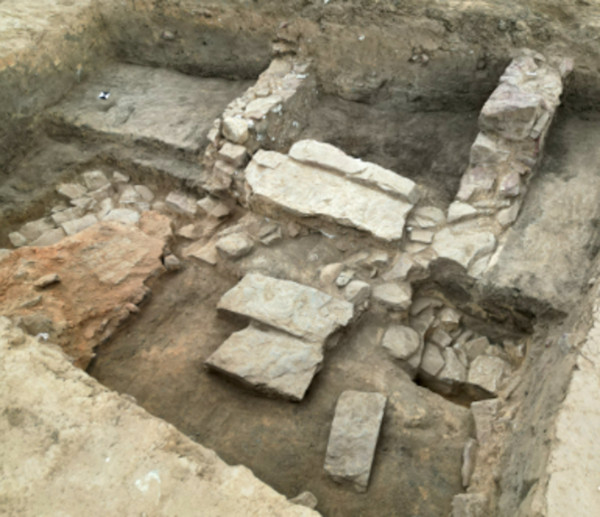
Entrance area with staircase of the 10th-century building. (© State Office for Heritage Management and Archaeology Saxony-Anhalt/Johannes Groß)
A Guest House, or a Count's Seat?
Nothing about the new building is humble. Its footprint, cellar and surviving steps place it firmly in the 10th century, right beside the palace itself. What it was used for remains open: the excavators suggest it may have been a guest house for the noble companions who travelled with the ruler, or the seat of a count who governed the palace while the king was away. A stone-reinforced terrace uncovered on the palace's eastern side, facing the courtyard between palace and church, belongs to the same world of display and may have served as a platform for open-air assemblies. The state heritage office described the ensemble of church, palace and new building as "an impressive demonstration of the king's claim and power".
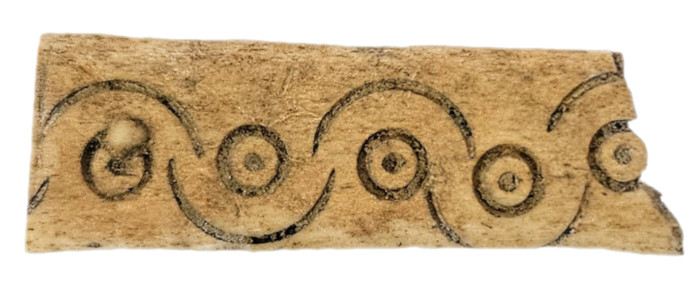
Fragment of an antler box decorated with ring-and-dot marks, from around the year 1000 AD. (© State Office for Heritage Management and Archaeology Saxony-Anhalt/Johannes Groß)
Two Worlds Divided by a Wall
Life in the south-eastern outer yard looked very different. There, excavators again exposed numbers of rectangular pit houses, three to five meters on a side, with walls of woven branches and clay, roofs of timber or reed, and stone-lined hearths. These were the homes and workshops of the ordinary people who kept the palace supplied. Clay loom weights, casting crucibles and a lime kiln show textile work, the production of lime for plaster and mortar, and the working of copper alloys. Walls and ditches separated the two worlds, and the finds suggest that living standards did too. Pottery bearing the typical Slavic wave decoration found across the hill fits the wider picture of Slavic settlement in the region.
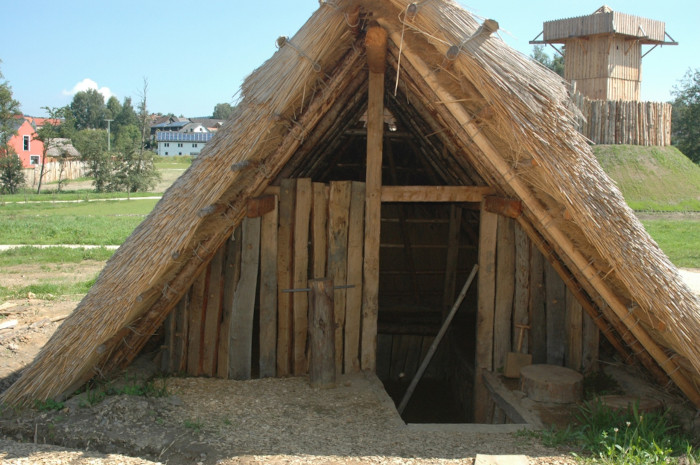
A reconstruction of an early medieval sunken-floored pit house, the kind of dwelling used by the ordinary people who lived and worked in Helfta's outer yard. (Babru/CC BY-SA 3.0)
Coins, Jewelry and a Playable Flute
A later castle rose on the same hill in the 12th century, long after the settlement had lost its weight. Built by the Hackeborn family, its oval main castle measured roughly 50 metres across and was ringed by a ditch; this season's work around its keep has exposed the foundations of the defensive wall, cellars, timber-frame thresholds and a larger hall-like building. The family may have been the household in which Gertrud and Mechthild of Hackeborn, later celebrated nuns of the Cistercian monastery in the valley below, were born.
The small finds are just as evocative: silver coins spanning the 10th to 15th centuries, Ottonian earrings and enameled cloak clasps including a rare crescent-shaped brooch, iron arrowheads, a nearly playable bone flute, and a fragment of an antler box decorated with ring-and-dot motifs from around the year 1000. Graves from the church cemetery and a second late medieval Erdstall tunnel complete the picture. Post holes from a palisade even reach back to the pre-Roman Iron Age, proof that this modest hill has drawn people for well over two thousand years.
Top image: 10th-century stone building in the center of the Helfta palatinate. Right; Fragment of an antler box decorated with ring-and-dot marks, from around the year 1000 AD. Source: Johannes Groß/State Office for Heritage Management and Archaeology Saxony-Anhalt
By Gary Manners
References
Ancient Origins. 2025. DNA Revels How the Slavic Migration Reshaped Central and Eastern Europe. Available at: /news-history-archaeology-evolution-human-origins-human-origins-science/dna-revels-how-slavic
Landesamt für Denkmalpflege und Archäologie Sachsen-Anhalt. 2026. Neue archäologische Untersuchungen auf der ottonischen Königspfalz von Helfta. Available at: https://www.lda-lsa.de/en/presse-und-oeffentlichkeitsarbeit/presseinformationen/121026-helfta
Radley, D. 2026. Second Stone Building at Royal Palace in Helfta. Archaeology Magazine. Available at: https://archaeologymag.com/2026/10/second-stone-building-at-royal-palace-in-helfta/
Vučković, A. 2025. Otto the Great, the Powerful Holy Roman Emperor. Available at: /news-history-archaeology-history-famous-people/otto-great-0021792