The restoration of Emperor Otto the Great's tomb in Magdeburg Cathedral has yielded remarkable discoveries, confirming the identity of the remains and uncovering new details about the medieval ruler's life and burial. The ongoing conservation project, prompted by structural deterioration, has provided researchers with a unique opportunity to examine the contents of one of Germany's most significant royal monuments. The findings shed light on the physical characteristics and health of the man who laid the foundations for the Holy Roman Empire.
Otto I, known as Otto the Great, played a pivotal role in European history by reviving the imperial title in Western and Central Europe. His reign transformed the political landscape, and his decision to elevate Magdeburg to an archbishopric in 968 cemented its status as a major religious center. However, the condition of his tomb, located in the cathedral's High Choir, had become a cause for concern. Routine inspections in 2024 revealed significant damage to the limestone sarcophagus and its marble cover, caused by corroding 19th-century iron reinforcements and moisture infiltration.
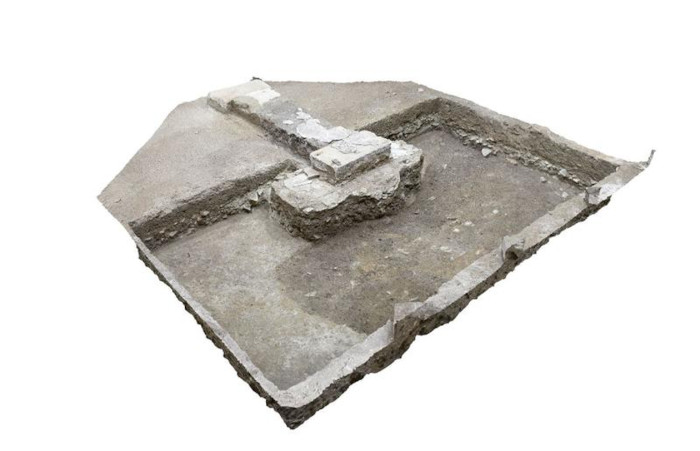
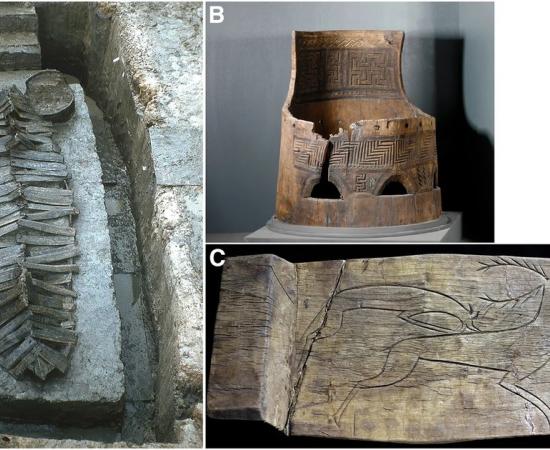
The excavation at the site of Otto I’s tomb in the High Choir of Magdeburg Cathedral, showing the sandstone substructure on which the sarcophagus was placed. (Claudio Dähnel/Denis Dittrich/ Landesamt für Denkmalpflege und Archäologie Sachsen-Anhalt)
A Monument in Peril and the Path to Preservation
To protect the endangered monument, specialists initiated a large-scale conservation effort in early 2025. The tomb was enclosed in a protective structure, and the 300-kilogram marble lid—traced back to ancient Proconnesos in modern-day Turkey—was carefully lifted. Beneath it, researchers found a fragile wooden coffin constructed from pine felled in the winter of 1208. This dating suggests the coffin was made shortly after the cathedral fire of 1207, likely for the reburial of Otto's remains during the building's reconstruction.
Inside the coffin, researchers discovered a fascinating array of artifacts alongside the human remains. Among the items were fragments of a red silk cloth, possibly of Byzantine or Spanish origin, and a blue blanket woven with silver threads. The presence of eggshells, fruit pits, a 13th-century coin, and window glass fragments indicated that the tomb had been disturbed and altered multiple times over the centuries. These findings highlight the complex history of the burial site and the reverence with which it was treated.
- Otto the Great's Tribute to His Late English Queen Finally Makes Sense
- The Mighty Magyars, a Medieval Menace to the Holy Roman Empire
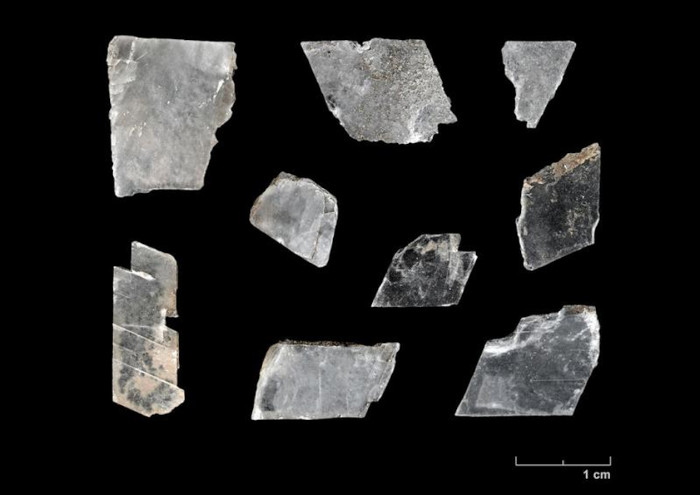
Among the rare finds are fragments of transparent crystalline gypsum, which were used, for example, as window glazing. (Claudio Dähnel/Denis Dittrich/ Landesamt für Denkmalpflege und Archäologie Sachsen-Anhalt)
Confirming the Emperor's Identity
The most anticipated aspect of the investigation was the analysis of the skeletal remains. Anthropological and scientific examinations revealed a nearly complete male skeleton, standing at approximately 180 centimeters (5 feet 11 inches) tall - significantly above the average height for the 10th century. The estimated age at death, between 55 and 65 years, aligns perfectly with historical records stating Otto died at around 60.
Physical evidence painted a vivid picture of a life marked by activity and conflict. Strong muscle attachments on the thigh and pelvic bones suggested extensive horseback riding, consistent with his role as a military leader. The skeleton also bore signs of wear and trauma, including arthritic changes, a healed forearm fracture, and healed injuries on the skull. The loss of three upper front teeth during his lifetime further hinted at the physical toll of his medieval reign.
Crucially, archaeogenetic testing provided the definitive proof of identity. Researchers compared DNA from the Magdeburg remains with those of Emperor Henry II, a known relative buried in Bamberg Cathedral. The results confirmed a third-degree biological relationship along the male line, precisely matching the historical lineage that identifies Henry II as Otto's grand-nephew.
- Charlemagne: One of the Most Important Figures of Early Medieval Europe
- 1000-Year-Old Sarcophagus Discovered Beneath One of Germany's Oldest Churches
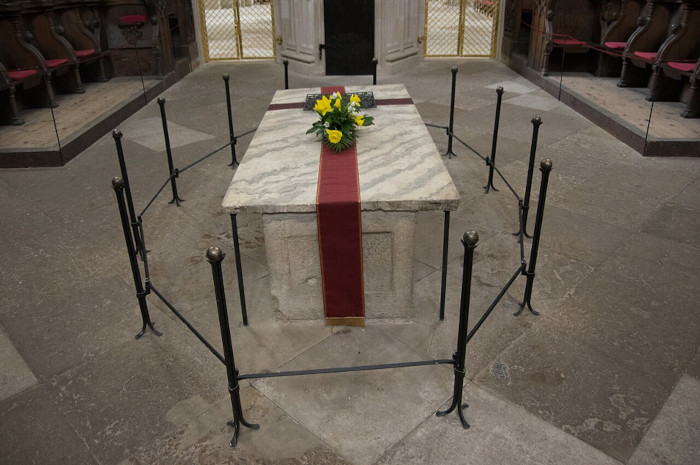
Magdeburg Cathedral interior, showing the location of Otto’s sarcophagus in the High Choir, 2018. (Clemensfranz / CC BY-SA 4.0)
Uncovering the Cathedral's Hidden History
While the analysis of Otto's remains provided compelling insights, excavations beneath the tomb site offered their own revelations. Archaeologists discovered that the sarcophagus rested on large sandstone blocks bearing late medieval stonemasons' marks, indicating the structure had been repositioned. Beneath the foundations, layers of rubble and construction fill pointed to multiple building phases in the cathedral's High Choir.
Despite these extensive investigations, no evidence was found to suggest that Otto's tomb occupied the same location in the earlier predecessor building, leaving the exact site of his original burial a mystery. However, the excavations did yield various artifacts, including coins, glass beads, ceramics, and even a lead bullet, reflecting Magdeburg's turbulent history.
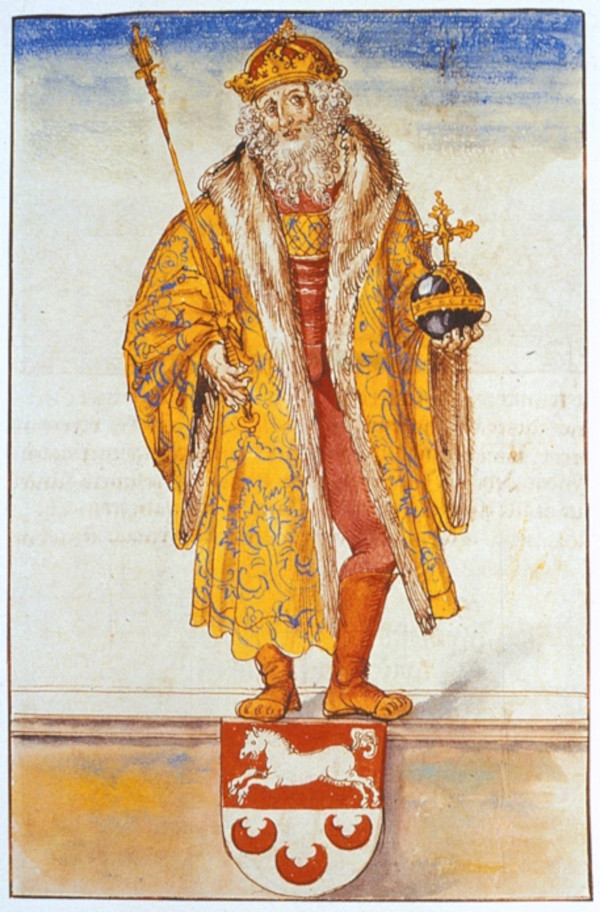
Portrait of Otto I, Holy Roman Emperor, by Lucas Cranach the Elder. (Public Domain)
As conservation work continues, the remains of Otto the Great are scheduled for reinterment on September 1, 2026, in a newly designed coffin. The ongoing research promises to uncover even more details about the life and times of this influential ruler, ensuring that his legacy endures not just in history books, but in the tangible evidence of his existence.
Top image: Otto I, Holy Roman Emperor mosaic, 1903, Berlin. Source: Axel Mauruszat/Public domain
By Gary Manners
References
Heritage Daily. 2026. New discoveries during restoration of Otto the Great’s tomb. Available at: https://www.heritagedaily.com/2026/06/new-discoveries-during-restoration-of-otto-the-greats-tomb/158338
IDW. 2026. The emperor's body. Identity of the mortal remains found in the sarcophagus of Otto the Great confirmed. Available at: https://nachrichten.idw-online.de/2026/03/20/the-emperor-s-body-identity-of-the-mortal-remains-found-in-the-sarcophagus-of-otto-the-great-confirmed
Medievalists.net. 2026. Scientists Confirm Remains of Medieval Emperor Otto the Great. Available at: https://www.medievalists.net/2026/03/scientists-confirm-remains-of-medieval-emperor-otto-the-great/
Sinico, S. 2026. Skeleton in Magdeburg Cathedral is almost certainly Otto I. DW. Available at: https://www.dw.com/en/skeleton-in-magdeburg-cathedral-is-almost-certainly-otto-i/a-76417501