
On that cold, quiet morning of May 29, 1453, the jewel of the Eastern Roman Empire, girded by titanic Theodosian walls and the Bosphorus Strait, a bastion of Christianity in the East for more than a thousand years, changed forever. On that morning, the Ottoman flag would fly over its towers. The world had altered, forever.
Sultan Mehmed II was merely 21 when he started besieging Constantinople in April 1453. But he was no upstart. He had fantasized about taking the city since childhood, swayed by prophecy, ambition, and strategy, to conquer the symbol of that city and claim his divine inheritance.
His army was enormous, with estimates of between 80,000 and 100,000 troops, including crack Janissaries, Anatolian horsemen, engineers, and mercenaries. The Byzantines, led by Emperor Constantine XI Palaiologos, had fewer than 10,000 defenders, including Genoese allies under the unyielding Giovanni Giustiniani, writes Nicolo Barboro in the seminal ’The Seige of Constantinope, 1453’.
The city, drained by centuries of internal conflict, retained the mighty Theodosian walls: three-layered fortifications that had fended off Arab caliphates, Bulgarian tsars, and Latin crusaders. But Mehmed introduced a game-changer—a monstrous bombard called the Basilica, which Hungarian engineer Orban had cast. It launched stone projectiles weighing more than 1,000 pounds, and its roar became the ominous heartbeat of the siege.
- Did Constantinople Fall Because Someone Forgot to Lock the Gate?
- Orban: The Man Whose Cannon Brought Down the Walls of Constantinople – Part I
The Night of Destiny and the Breaking of an Empire
The final attack was launched in the pre-dawn hours of May 29, following weeks of attrition and bombardment. Successive waves of irregulars, then Anatolian troops, and eventually the Janissaries charged the breaches. At the walls close to the Gate of St. Romanus, Giustiniani was killed—a disaster for morale.
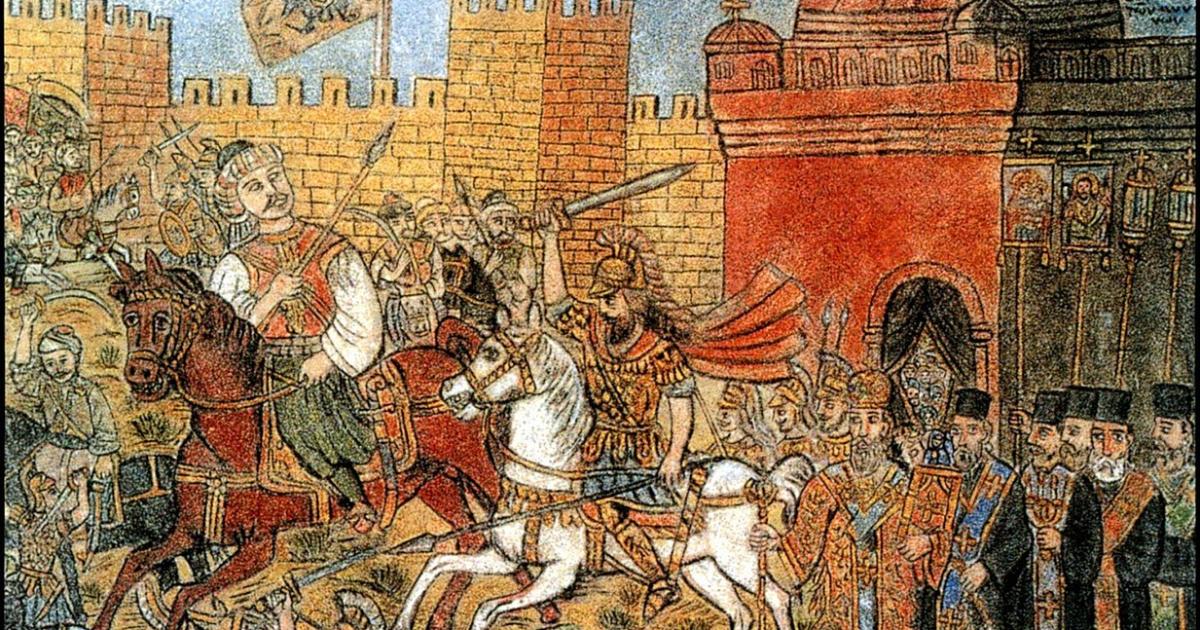
Emperor Constantine reputedly shed his imperial trappings and waded into the thick of battle, disappearing into legend. Some claim his corpse was never discovered. Others mutter that he turned to marble and lies beneath the city, waiting for a Christian reconquest. But the grim reality was stark: before dawn, the Ottoman banner fluttered over the broken ramparts, and Mehmed rode through the city's broken gates.
The city was pillaged, according to the conventions of siege warfare, though Mehmed intervened early according to reports in order to save it from complete destruction. The Hagia Sophia, the greatest church in Christendom, was turned into a mosque that very day. Survivors were left subject to the mercy—or lack thereof—of the Sultan. Many were enslaved, yet others were let go and permitted to return when order was re-established.

Entry of Mehmed II into Constantinople. (Internet Archive Book Images)
Echoes Through Time: A City Transfigured, A World Transformed
The conquest of Constantinople caused shockwaves throughout Europe. While the Byzantine Empire had been a shadow of its former self for centuries, the loss represented a final end to the Roman presence in the East. Papal courts and monarchs throughout Christendom were horrified, mourning the loss of a bulwark against Islam.
But as Europe wept, the Ottomans founded their new capital, Istanbul, over the ruins of the city. Mehmed, not a destroyer at all, rapidly set to rebuilding the city as the center of an empire that would endure into the 20th century. He resettled it with populations from throughout his dominions, restored infrastructure, and established it as a hub of trade and culture, writes Steven Runciman in The Fall of Constantinople.
Ironically, the loss of Constantinople served to galvanize the European Renaissance. Greek intellectuals, who left the city with ancient texts, migrated westward with classical learning. The Age of Exploration was soon to start, partly due to the Ottoman stranglehold on eastern trade routes—inspiring Europe to turn west to the Atlantic, to Africa, and eventually to the Americas.
For the Orthodox world, the fall is an open wound. It is commemorated in modern Greece and among Eastern Christians with solemnity, if not with mourning. Emperor Constantine XI is remembered as a martyr-king, the "Marble Emperor" who would one day rise again.
- Was the First Islamic Siege of Constantinople (674 – 678 AD) a Historical Misnomer?
- A Millennium of Glory: The Rise and Fall of the Byzantine Empire

The Fall of Constantinople. (Matthäus Merian/Public domain)
May 29 is a national victory in Turkey. Mehmed the Conqueror is remembered in schools, and the conquest is dramatized in parades and plays. The city he conquered, now Istanbul, is not only a capital of an empire but the living connection between Asia and Europe, Islam and Christianity, antiquity and modern times. Ultimately, the capture of Constantinople represented a tectonic plate movement in world history. It ended the Middle Ages and began a new chapter, one penned in gunpowder, silk, and blood.
Top image: Constantine the Emperor of the Greco-Romans exits fearless into the battle on 1453 May 29. Source: Theophilos Hatzimihail/Public domain
References
Peter, D.R.M. 2016. The Siege of Constantinople in 1453, according to Nicolo Barbaro. Available at: https://deremilitari.org/2016/08/the-siege-of-constantinople-in-1453-according-to-nicolo-barbaro/.
Runciman, S. 1965. The fall of Constantinople, 1453. Available at: https://archive.org/details/fallofconstantin0000unse/page/n7/mode/2up.
Eparch, T., Pertusi, A. 1976. Account of the Taking of Constantinople. Available at: https://carleton-wp-production.s3.amazonaws.com/uploads/sites/83/2019/06/Thomas_the_Eparch_and_Joshua_Diplovatatzes_for_MARS_website.pdf.