The discovery was made by a research team led by Professor Congcang Zhao from Northwest University in Xi’an, China. By utilizing advanced non-destructive imaging, the scientists managed to identify the microscopic chemical signature of Chinese wolfsbane (Aconitum) splashed across the functional areas of the iron tools. This chemical fingerprint confirms that medieval Chinese surgeons actively managed pain during invasive medical procedures rather than relying on physical restraint. The full study has recently been published in Antiquity journal.
- The Numbing Truth: A History Of Anesthesia
- The Ben Cao Gang Mu – The Bible of Traditional Chinese Medicine
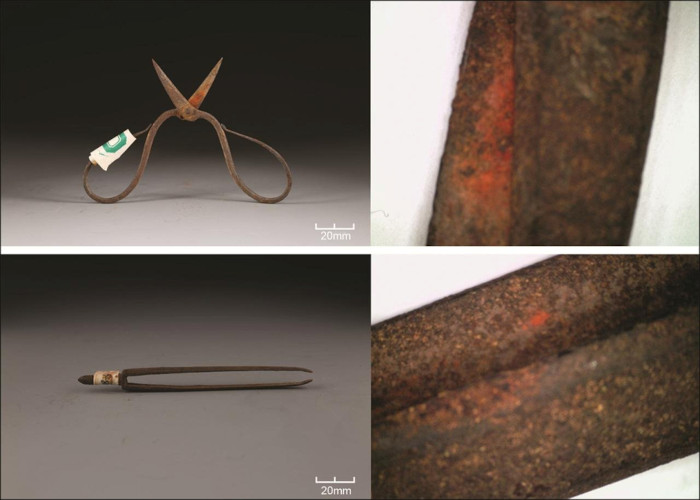
A pair of 600-year-old iron surgical tools (scissors and tweezers) from the tomb of Ming Dynasty physician Xia Quan, showing the locations of the aconitine residue. (Xue Ling et al. /Antiquity Publications Ltd)
The Chemistry of Wolfsbane: Balancing Healing and Lethality
The plant genus Aconitum, commonly known as wolfsbane or monkshood, produces aconitine, one of the most formidable natural neurotoxins known to science. While aconitine acts as an incredibly effective local numbing agent when applied topically, even a minuscule dosage entering the bloodstream can cause fatal cardiac arrhythmia, requiring ancient practitioners to develop rigorous detoxification protocols, explains the study.
To mitigate this danger, Ming Dynasty physicians developed elaborate pharmaceutical recipes to process the raw tuberous roots. Historical texts indicate that these toxic plants were boiled in vinegar, soaked in black soybean decoctions, or treated with the acidic urine of young boys to break down the lethal alkaloids into safer compounds explain the researchers. The resulting liquid or paste, known as Caowu San, was then safely applied to a patient's skin to desensitize the area before a surgeon made incisions.
- Evidence Emerges of Cranial Surgery in China Dating Back More Than 3,500 Years
- Ancient Medicine: How Did Ancient Civilizations Heal Themselves?
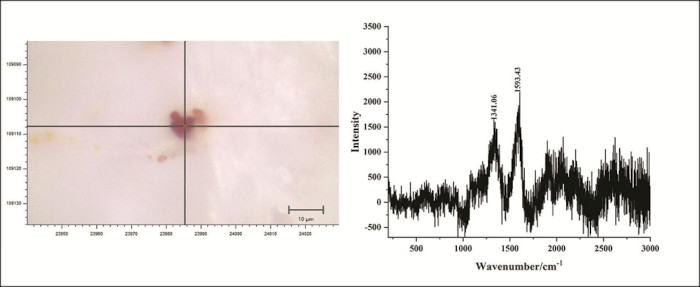
Micro-Raman spectroscopy results showing the structural fingerprint of the red residue found on the surgical tweezers. (Xue Ling et al. /Antiquity Publications Ltd)
Reconstructing Ming Dynasty Surgical Procedures
The specific distribution of the aconitine residue on the tools offers a vivid window into how Xia Quan performed his operations. The red, rust-like residue was highly concentrated on the cutting blades of the scissors and near the gripping tips of the tweezers. This pattern suggests that the liquid anesthetic splashed onto the iron instruments during surgical application rather than being a result of later environmental contamination.
During a typical procedure, the surgeon would first paint the processed Aconitum mixture directly onto the diseased skin or wound to induce numbness. Once anesthetized, the physician used the tweezers to grip and lift the compromised tissue, while using the scissors to precisely trim away dead or infected layers. This conservative, localized approach to surgery represents a distinct medical philosophy compared to the contemporary European focus on systemic sedation and invasive amputations.
Advanced Smelting and the Legacy of Chinese Pharmacology
Beyond chemical residues, the physical composition of these Ming surgical tools highlights the advanced state of Ming Dynasty metallurgy. Elemental testing using X-ray fluorescence revealed that both the scissors and tweezers were forged from high-purity iron alloys averaging 97.1 percent iron content. This exceptional purity provided the tools with the strength and sharp edges required for delicate surgical work, reflecting a highly developed craft specialized for medical needs.
The identification of aconitine on these instruments provides the first physical, chemical proof of surgical anesthesia in ancient China, validating centuries of written records. While legendary texts have celebrated early pioneers like Hua Tuo (the 2nd-century physician who allegedly invented the general anesthetic Mafeisan) physical evidence of such practices had remained entirely elusive until now. This residue analysis study demonstrates that modern science can recover lost medical practices, proving that ancient Chinese surgeons successfully balanced poison and cure to relieve suffering.
Top image: A pair of rusty Ming Dynasty iron surgical scissors and tweezers showing functional areas where anesthetic residue was found. Source: Xue Ling / Antiquity Journal
By Gary Manners
References
Killgrove, K. 2026. Toxic plant on Ming dynasty-era surgical tools may be world’s oldest chemical evidence of topical anesthetic. Live Science. Available at: https://www.livescience.com/archaeology/ancient-china/toxic-plant-on-ming-dynasty-era-surgical-tools-may-be-worlds-oldest-chemical-evidence-of-topical-anesthetic
Ling, X., Li, J., Zhao, G., Cao, X., Weng, X., Zhang, H., Li, Z. and Zhao, C. 2026. Surgical anaesthesia in Ming China: scientific analysis of aconitine residues on medical instruments. Antiquity. Available at: https://www.cambridge.org/core/journals/antiquity/article/surgical-anaesthesia-in-ming-china-scientific-analysis-of-aconitine-residues-on-medical-instruments/7037E2829972C3DC0206A68A916C344B
Moeed, A. 2026. China’s Oldest Known Anesthetic Evidence Found on Ming Dynasty Surgical Tools. Greek Reporter. Available at: https://greekreporter.com/2026/05/27/china-oldest-anesthetic-ming-surgical-tools/
Radley, D. 2026. Ming Dynasty surgical tools reveal traces of toxic herbal anesthetic used 600 years ago. Archaeology News Online Magazine. Available at: https://archaeologymag.com/2026/05/ming-surgical-tools-traces-of-herbal-anesthetic/
Whelan, E. 2021. The Numbing Truth: A History Of Anesthesia. Ancient Origins. Available at: /history-important-events/anesthesia-0015881