
In a discovery that will literally necessitate the rewriting of history, archaeologists digging at the Archaeological Park of Ostia Antica near Rome. Italy have unearthed the remains of the oldest Jewish ritual bath, or mikveh, ever found outside the lands of Israel. This bath dates back to somewhere near the end of the third century, or maybe a bit later, showing that it was constructed during the days of the Roman Empire.
This remarkable find at an ancient coastal city in Italy, across the Mediterranean from the Levant, suggests that Ostia may have functioned as an important center of Jewish settlement and religious practice as much 1,700 years ago. Ostia made sense as a destination for those who had left Israel during the Diaspora, as it was a busy port city located just 15 miles (25 kilometers) southwest of Rome in ancient times (making it the closest harbor to the Empire’s capital).
If indeed the dating of this mikveh is confirmed, it would represent clear evidence that there was an early Jewish community in a heavily trafficked part of the Roman Empire a couple of centuries after the destruction of the Second Temple in Jerusalem and the suppression of subsequent revolts.
Ostia, The Roman Empire’s Melting Pot City
Historical records and archaeological discoveries indicate that Ostia was a melting pot of various cultures and religions for hundreds of years. Recent research has confirmed the existence of a thriving Jewish population in the city in a somewhat later era, indicated by the remains of an ancient synagogue near the city’s coastline. However, the identification of a mikveh at another site was totally unexpected, and especially one that seems to date back to such an early time.
- Ancient ritual bath found beneath a home in Jerusalem
- Why the Romans were not quite as clean as you might have thought
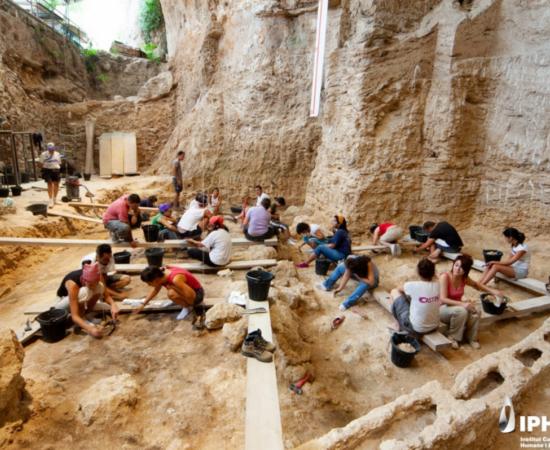
“In 2022, we started excavating an area adjacent to the headquarters of the trading corporations and four pagan temples,” explained Dr. Alessandro D’Alessio, director of the Archaeological Park of Ostia Antica, in an interview with The Times of Israel. “Despite its central location, this section had never been explored before.”
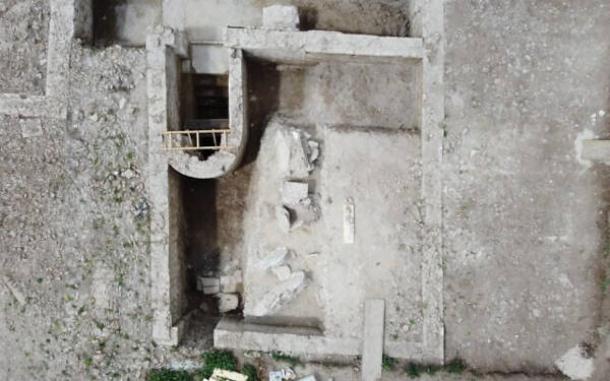
Overhead view of the site of the newly unearthed mikveh in Ostia, near Rome. (Archaeological Park of Ostia Antica).
The excavation was carried out by a team from the Archaeological Park, in collaboration with the Università degli Studi di Catania and Politecnico di Bari, and with the support of the Museums Directorate of the Italian Culture Ministry.
“Last summer, we uncovered a small chamber within the building we were investigating,” D’Alessio noted. “The structure resembled a well, topped with a semiapse, and could be accessed by stairs.”
Initially, researchers were uncertain about its purpose.
“We considered the possibility of a mikveh, so we invited the Chief Rabbi of Rome, Riccardo Di Segni, to examine the site,” D’Alessio said. “While he found the structure intriguing, he could not definitively confirm its function as a ritual bath.”
Further excavation revealed a hole, possibly for a pipe that funneled water into the chamber, allowing it to mix with aquifer water. Researchers believe the pipe may have transported hot water, which of course would be required if this was indeed a ritual bath.
- What in the Roman Republic is this Giant Pool Found Outside Rome?
- Ancient Purification Rituals: Exploring Cleansing and Spiritual Renewal
“As we continued our work, we had two major breakthroughs,” D’Alessio shared. “First, we discovered an element of the structure that would have allowed gradual entry into the water. Second, at the base of the chamber, we found an intact oil lamp featuring Jewish symbols—a menorah and a lulav.”
For D’Alessio and his team, the lamp provided strong evidence supporting the interpretation of the structure as a mikveh.
A Site of Cultural Tolerance in the Roman World?
The discovery was formally presented at a press conference attended by Italian Culture Minister Alessandro Giuli.
“The finding of a Jewish ritual bath at the archaeological park of Ostia Antica further highlights this site as a place of cultural exchange and peaceful coexistence, where diverse peoples found unity under Roman civilization,” Giuli stated.
The oil lamp has provided valuable clues for dating the site. D’Alessio noted that this type of lamp was common between the late fourth and fifth centuries.
“Our research suggests that the building itself dates back to the early third century, based on mosaic patterns we uncovered,” he said. “The mikveh appears to have been added later, possibly as early as the late third century.”
If the dating is confirmed and the structure is indeed a mikveh, it would be the oldest such bath discovered outside Israel, predating other European mikvehs by centuries.
“The earliest Jewish ritual baths previously identified in Europe, including one in Syracuse, Sicily, date to the Early Middle Ages, not the Roman period,” D’Alessio remarked.
Further findings from the site include two additional oil lamps—one nearly identical to the lamp found at the bottom of the mikveh, and another engraved with a Christogram, a symbol associated with early Christianity. D’Alessio pointed out that during this period, Jewish and Christian communities in Rome maintained close connections, making the presence of both symbols within the same structure unsurprising.
Unlocking Ancient Secrets at a Sacred Site
The purpose of the building housing the mikveh remains unclear.
“Our initial hypothesis is that it was a lavish private residence, but it could also have been a public structure,” D’Alessio speculated. “We have identified at least six rooms, including two with ovens for cooking, a latrine, and a probable kitchen. These spaces were arranged around a courtyard facing south. A staircase suggests there was at least one additional floor.”
Asked whether the building could have been a synagogue, D’Alessio dismissed the idea, citing architectural differences.
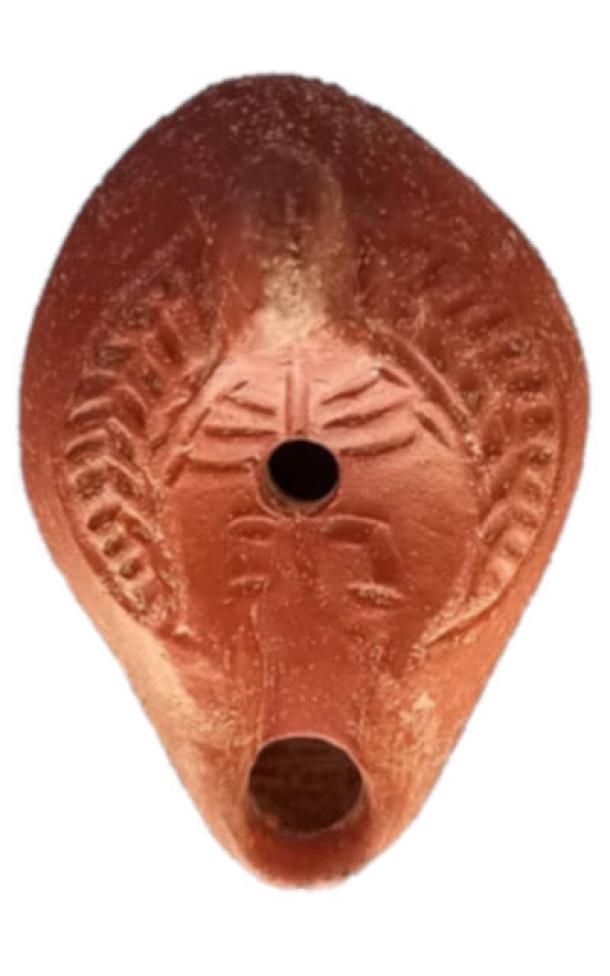
Oil lamp found during excavations around the site of the ancient Jewish ritual bath. (Archaeological Park of Ostia Antica).
The identity of the building’s owner is unknown, as is whether it remained within the same family for generations or was later acquired by a Jewish household that chose to install a mikveh.
“We can only hypothesize at this stage,” said D’Alessio.
Interestingly, the building sits in a more central location than Ostia’s known synagogue, which was positioned near the seashore. The synagogue, oriented toward Jerusalem, was decorated with Jewish symbols, including a menorah, palm trees, a shofar, and an etrog.
Up to now, no mikveh has ever been found near the synagogue, which has been considered surprising.
“It’s unclear whether this is due to excavation limitations, destruction over time, or simply because the community used the ocean for ritual purification,” D’Alessio explained. Jewish law permits immersion in natural bodies of water for purification purposes.
The first definitive archaeological evidence of a Jewish presence in Ostia dates to the first century, when an inscription mentioning iudaei (Jews) was found at the Pianabella Necropolis, the city’s cemetery.
However, historical accounts hint that members of Ostia’s elite may have been Jewish or of Jewish descent as early as the first century BC. The presence of figures such as Publio Lucilio Gamala, a local official whose surname is linked to the Jewish name Gamla, and the Fabii Agrippini family, the suspected patrons of the synagogue, offer evidence in support of this possibility.
D’Alessio and his team hope future excavations will provide more insight into Ostia’s ancient Jewish community, starting with further exploration of the building housing the mikveh.
“In our upcoming excavation season this summer, we will focus on the courtyard,” he said. “We also aim to preserve the site for future public access.”
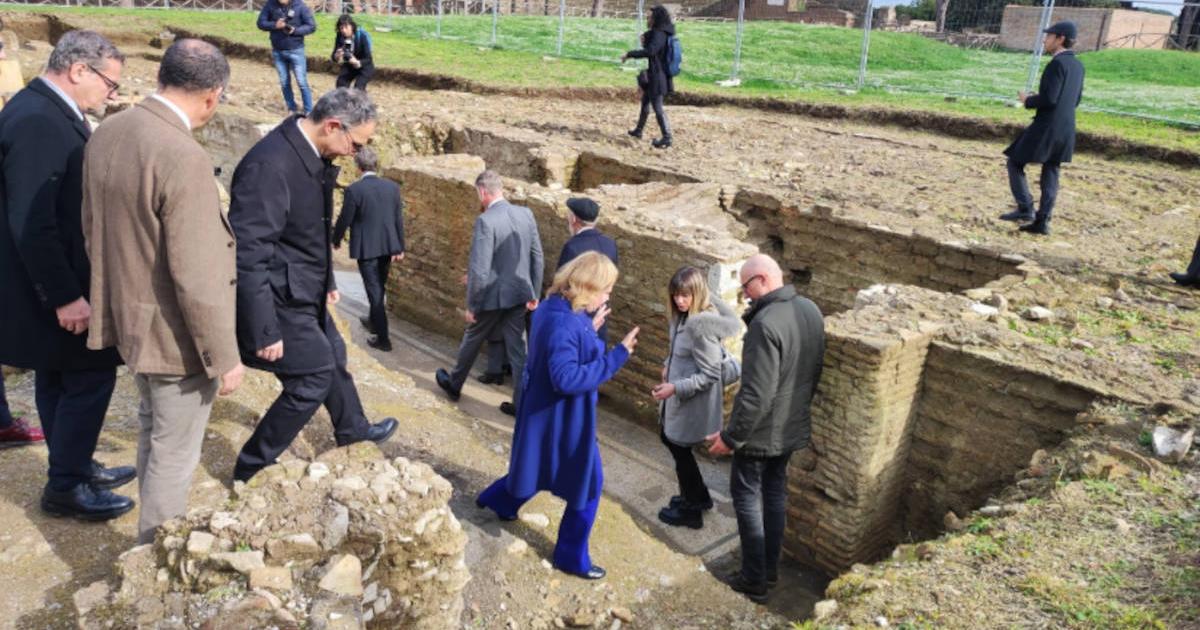
Top image: People visiting the site of the newly unearthed Jewish ritual bath in Ostia, the oldest of its kind found in Europe.
Source: Archaeological Park of Ostia Antica.
By Nathan Falde