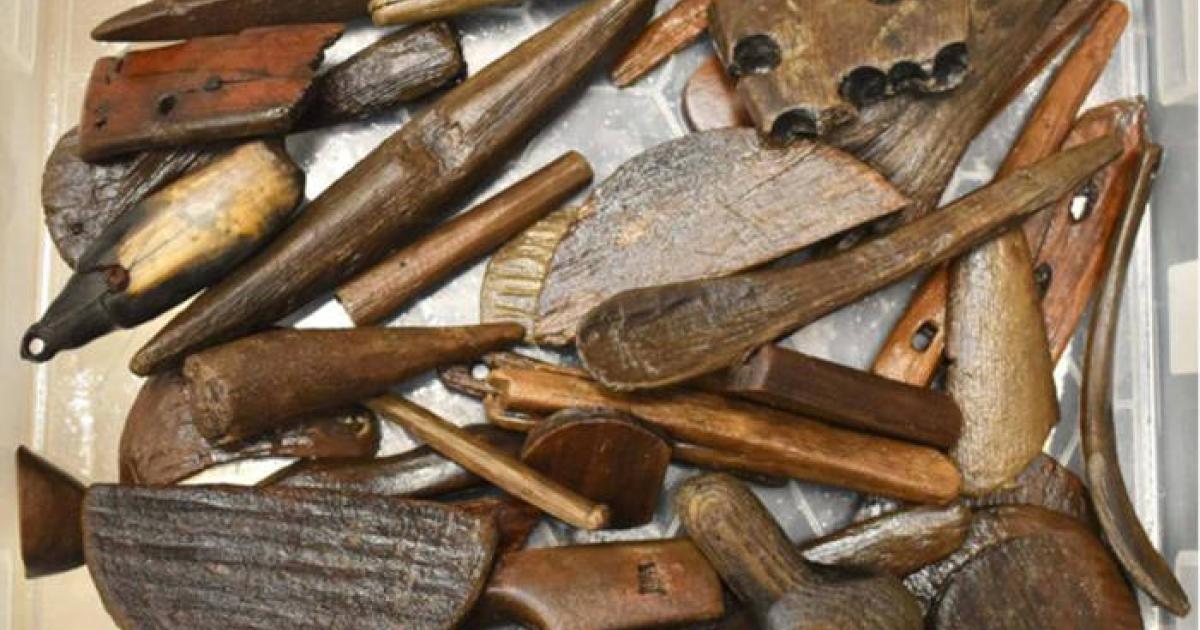

When the remnants of ex-Typhoon Halong battered Alaska's southwestern coastline in mid-October 2025, the small community of Quinhagak escaped the widespread devastation suffered by its western neighbors. However, the fierce winds and surging waters delivered a catastrophic blow to something far more ancient – devastating centuries of carefully preserved Indigenous history in a matter of hours. The storm consumed over 60 feet of shoreline at the Nunalleq archaeological site, scattering possibly 100,000 irreplaceable Yup'ik artifacts across miles of beach and into the frigid Bering Sea. This represents one of the most significant losses to Arctic archaeology in recent memory, threatening our understanding of pre-contact Indigenous life in Alaska.
- Arctic Circle Anomalies: Archaeological Insight Under the Permafrost
- Race Against Time as Climate Change Devours Archaeological Sites

Nunalleq archaeological site before (top) and after (bottom) the ex-Typhoon Halong struck the coastal areas of Quinhagak. (Gabby Salgado/KYUK/Bryan Jones Jr. on behalf of Qanirtuuq Incorporated and Nalaquq, LLC)
World's Largest Collection of Pre-Contact Artifacts Under Threat
The Nunalleq site, whose name means "old village" in the Yup'ik language, houses what archaeologists consider the world's most extensive collection of pre-contact Yup'ik artifacts. Dr. Rick Knecht, an emeritus senior lecturer in archaeology at the University of Aberdeen in Scotland, has devoted 17 years to excavating this remarkable location. According to Knecht's assessment. roughly 100,000 artifacts had been carefully recovered from the site before the storm - a figure that may equal the number of pieces now scattered along the coastline, reports AP News,
"When there are holes or disturbances in the site, it's like trying to read a book with holes in the pages," Knecht explained. "You're going to miss a few things. And the bigger those holes are, the weaker the story gets. There are a few holes in the book right now."
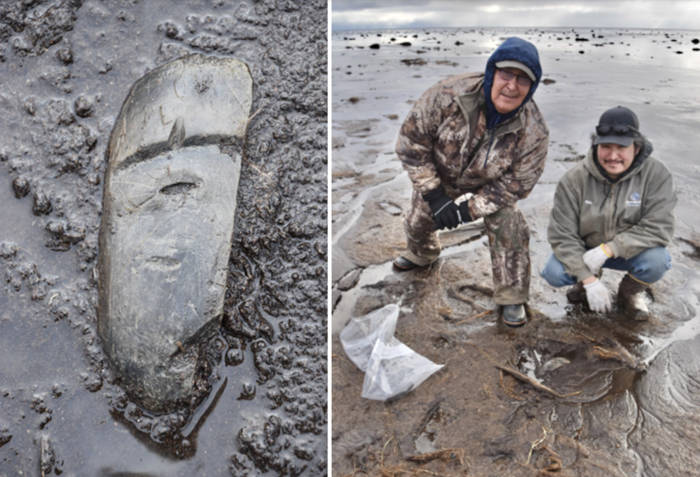
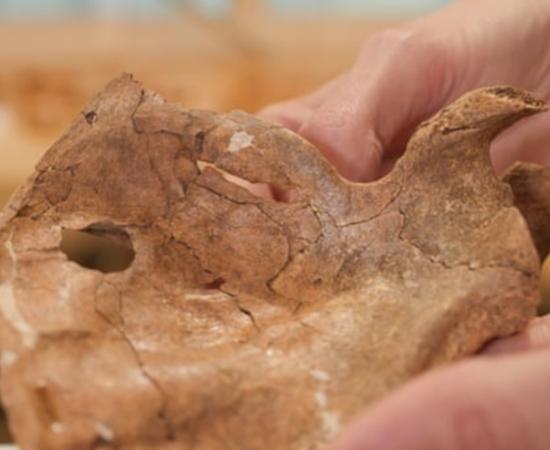
Left; ancient mask recovered from the beach, Right; Rick Knecht and associate searching for the dispersed artifacts. (KYUK)
The village that once stood at Nunalleq flourished between the 14th and 18th centuries before meeting a violent end around 1650. Archaeological evidence reveals the settlement was attacked by a rival village and burned, an event frozen in time by Alaska's unforgiving permafrost. The preserved artifacts - including intricate wooden masks, tools, toys, fishing lures, and everyday utensils - offer an unprecedented window into Yup'ik life before European contact. Much of what modern scholars understand about Indigenous Alaskan culture from this period stems directly from the Nunalleq excavations, making the storm's destruction particularly devastating to anthropologists and the Yup'ik community alike.
- Ancient Bronze Artifacts in Alaska Reveals Trade with Asia Before Columbus
- The Supernatural Traditions of the Alaskan Shaman
Race Against Ice and Time to Recover Lost Treasures
In the immediate aftermath of Typhoon Halong's assault on October 11-12, 2025, community members and researchers mobilized a desperate recovery effort. Teams combing the beaches on foot and by four-wheeler managed to rescue approximately 1,000 artifacts, including precious wooden masks and tools that had been scattered across the tidal flats. According to Art News, these recovered pieces now face their own race against time. The wooden artifacts, saturated with seawater after centuries protected in frozen ground, require immediate specialized treatment to prevent them from cracking to pieces as they dry.
At the Nunalleq Museum's laboratory in Quinhagak, conservators work methodically to soak marine salts from the recovered wood before placing the pieces in special chemicals designed to help them maintain structural integrity during the drying process. "If one were to just take one of the wooden artifacts off the beach and let them dry, they'd crack to pieces, sometimes in a matter of hours," Knecht warned. However, as freezing temperatures and ice settled over the region, further recovery efforts have stalled. The artifacts that remain scattered - potentially numbering in the tens of thousands - now face the harsh Alaskan winter, their fates uncertain until spring arrives and excavation teams can mount what Knecht calls a "rescue excavation."
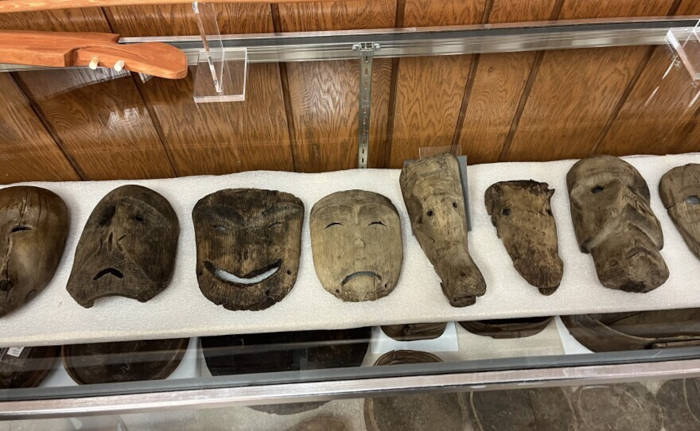
A collection of prehistoric masks from the Nunalleq center. (Gabby Salgado/KYUK/Alaska Public Media)
The Long-Feared Threat Becomes Reality
The devastation wrought by Typhoon Halong represents the materialization of archaeologists' longstanding nightmare. For years, researchers working at Nunalleq have voiced concerns about climate change's threat to the site through melting permafrost, accelerated coastal erosion, and increasingly frequent severe weather events. When Knecht departed Alaska in July 2025, approximately 30 feet of buffer zone separated the excavation from the sea. The October storm obliterated not only that buffer but consumed an additional 30 feet of the archaeological site, depositing piano-sized chunks of tundra across the tidal flats. The transformed landscape proved so unfamiliar that Knecht initially drove past the site without recognizing it. "All the landmarks I'm used to on the beach and at the site were gone or changed," he recounted.
The Nunalleq excavation began in 2007 after artifacts started appearing on Quinhagak's beaches - a harbinger of the erosion threatening to swallow the entire site. The project represented a unique collaboration between international archaeological teams and the Yup'ik community, combining cutting-edge scientific techniques with traditional Indigenous knowledge. Quinhagak's approximately 800 residents depend heavily on subsistence food gathering, making their connection to the land and its history deeply personal. The climate crisis doesn't merely threaten ancient history; it endangers the community's present and future. A 2024 Alaska Native Tribal Health Consortium report warns that thawing permafrost undermines buildings throughout Quinhagak, while erosion threatens critical infrastructure including sewage systems, homes, and fishing camps.
Starting From Scratch: Hope Amid Devastation
Despite the profound loss, archaeologists maintain cautious optimism about salvaging knowledge from the disaster. The storm's destructive force exposed new layers of the site that had been earmarked for future excavation but deprioritized in favor of areas facing more immediate erosion threats. "There was a big chunk where we'd only gone about halfway down and left it for later," Knecht explained, noting that the excavation team had strategically focused on the most vulnerable sections first. In a bittersweet twist, the catastrophe has created conditions reminiscent of the project's early days.
"In some ways, it feels like when teams saw the site in 2009," Knecht reflected. "We've got this raw site with artifacts popping off in every way. So we're starting from scratch again."
The Nunalleq Museum, which opened in 2018 as a community-operated facility, continues to house the world's largest collection of Yup'ik artifacts. Knecht and his colleagues have emphasized the importance of "decolonizing" archaeology by ensuring Indigenous communities maintain control over their cultural heritage and can engage with their history daily.
As teams prepare for the spring 2026 season, they face both tremendous challenges and opportunities. The exposed archaeological layers may yield new insights, but thousands of scattered artifacts remain vulnerable to further degradation. The race to document and preserve Yup'ik history continues, now under the shadow of an irreversible loss and the certain knowledge that climate change will continue threatening humanity's fragile links to the ancient past.
Top image: Various tools, utensils and other artifacts that were recovered after the Typhoon Halong scattered them from a significant Yup'ik archaeological site, known as the Nunalleq site, in Quinhagak, Alaska, Oct. 2025. Source: Richard Arden Knecht/AP
By Gary Manners
References
Associated Press. 2025. Archaeological site in Alaska that casts light on early Yup'ik life ravaged by ex-Typhoon Halong. Available at: https://apnews.com/article/artifacts-typhoon-halong-yupik-alaska-10c481ec12352dbc2771a40b8f7a53cf
Miller, Leigh Anne, 2025. Typhoon Halong Scattered Huge Trove of Yup'ik Artifacts Along Southwestern Alaskan Coast. Art News. Available at: https://www.artnews.com/art-news/news/typhoon-halong-scattered-huge-trove-yupik-artifacts-along-southwestern-alaskan-coast-1234759492/
Bean, S., 2023. Quinhagak's museum has the world's largest collection of Yup'ik artifacts. Alaska Public Media. Available at: https://alaskapublic.org/news/2023-09-05/quinhagaks-museum-has-the-worlds-largest-collection-of-yupik-artifacts-and-archeologists-keep-finding-more
Erickson, E. It looks like a bomb hit.' Ex-typhoon Halong peels back as much as 60 feet from Quinhagak’s shoreline. KYUK. Available at: https://www.kyuk.org/public-safety/2025-10-18/it-looks-like-a-bomb-hit-ex-typhoon-halong-peels-back-nearly-60-feet-from-quinhagaks-shoreline
University of Aberdeen. 2025. Nunalleq: Archaeological Excavation and Conservation Lab. Available at: https://www.abdn.ac.uk/geosciences/departments/archaeology/research/research-projects/nunalleq-archaeological-excavation-and-conservation-lab/