
Archaeologists digging inside the Roman legionary fortress of Novae, on the Danube in northern Bulgaria, have peeled back more than 3,000 square meters of a single monumental building. It held a large bathhouse, painted plaster and a floor of colored bricks. Its excavator thinks it may be the praetorium, the house of the legate who commanded the legion, though he stresses that this still has to be confirmed.
According to Science in Poland, the news service of the Polish Press Agency, the building originally covered about 4,500 square meters, though Archaeology magazine gives the figure as more than 4,500 square feet. On the agency's figure, it was the third largest structure in the camp after the commandant's office and the hospital. The team also recovered fragments of bronze furniture, figurines, precious ceramics, two inscribed altars and a set of sculptures that includes a head of the god Mithras.
Why a Bathhouse Points to the Commander
The case for a commander's house rests mostly on the baths. Professor Piotr Dyczek, director of the University of Warsaw's Antiquity of Southeastern Europe Research Centre, explained to Science in Poland why a private bathhouse stands out inside a military base:
"Few people had private baths in Roman fortresses. There were communal baths for the entire legion. In principle, only the legate could have his own large bathhouse. Although this will have to be confirmed, everything points to a residence, especially since the furnishings were luxurious. We found fragments of bronze furniture, various figurines and precious ceramics."
The University of Warsaw's own announcement, published in Polish, makes the same point in more cautious terms. It says everything indicates that the building was a rich residence, and that this season revealed further pools belonging to the bath complex along with painted plaster and a floor of multicolored bricks. That is promising, but a bath suite and fine furniture are indicative rather than conclusive. No report so far cites an inscription naming a legate in the building itself.
Dyczek also explained what is at stake if he is right. "We have precious few huge residences that could be attributed to legates," he said, adding that such houses "are always reconstructed from fragments." "If our assumptions are confirmed, we will have the first fully discovered structure of this type," he told Science in Poland. Modern cities sit over large parts of many Roman legionary camps, the agency notes, which makes complete excavations impossible.
What Was Novae?
Novae lies near the modern town of Svishtov. The University of Warsaw's Faculty of Archaeology describes it as a legionary camp that was probably founded around the middle of the first century AD. The First Italian Legion, legio I Italica, was based there for most of its existence, and its presence is confirmed until the 430s AD. The camp covers 17.99 hectares, and its best known buildings are the headquarters, the military hospital and the legionary baths.
In late antiquity the defenses were strengthened and an annex of almost 9 hectares was added on the east side. Soldiers and civilians then lived inside the walls together, and the latest traces of Roman activity date to the end of the sixth century, the faculty says. A joint Polish and Bulgarian team has dug at Novae since 1960. Earlier finds from the site include a ceramic box described as a Roman refrigerator and a reused tombstone of a centurion of legio I Italica.
Two Teams, One Question
The hunt for the commander's house at Novae is not new, and Dyczek's team is not the only one on it. According to Science in Poland, three Polish expeditions now work at the site. A separate project led by Agnieszka Tomas of the University of Warsaw's Faculty of Archaeology is also aimed at locating the praetorium, in the part of the fortress behind the legion commandant's office, known as the retentura.
That project's page says a massive building with a regular layout was documented there in 2005, together with the reused base of a statue of the commander of the First Italian Legion under the emperor Gordian III. In a 2025 report in the journal Novensia, Tomas and Emil Jęczmienowski describe trial trenches dug in that area between 2021 and 2024. They found multiphase remains and concluded that "Continued exploration of the northernmost section of the via decumana is essential to reach more definitive conclusions."
The news reports on Dyczek's building do not say which sector of the fortress it lies in, so it is not yet clear whether the two teams are looking at the same structure. That is a question for the excavators to answer.
A Mithras Head and a Rare Priapus
The smaller finds from this season drew as much attention as the building itself. The University of Warsaw lists a head of the god Mithras, a fragment of a marble head from an official imperial portrait and a building finial shaped like a pine cone, which it calls rare on the Lower Danube. It also reports part of a gold ring setting and two inscribed altars, one almost intact with its full inscription.
The rarest piece, the university says, is a small bronze figurine of the god Priapus, and only five similar objects were previously known from the Lower Danube. Reports describe the god differently. Science in Poland and Archaeology magazine call him the "Egyptian god Priapus," but Britannica describes Priapus as a god of fertility in Greek religion whose cult centered especially on Lampsacus, near the Hellespont, and spread throughout the ancient world in Hellenistic times.
Dyczek linked the find to contacts far beyond the Danube frontier. "In Novae we have the remains of Egyptian cults, which may indicate that at that time the legion included people who had contact with the Middle East," he told Science in Poland. The Mithras head calls for caution too. One carved head proves that someone at Novae had an image of Mithras but says very little about where or how he was worshipped there.
Avars and a Missing Port
The season also reached a far later chapter. For the first time, the team uncovered late antique buildings linked to the Avars, nomads who appeared in Europe in the mid sixth century. Dyczek described sunken houses with stoves, including one very large house that was "most likely the leader's house," and "a very rare Avar earring," which he called the first such find in northern Bulgaria.
Low water in the Danube, meanwhile, let the archaeologists document architectural pieces, pottery fragments and roof tiles that normally lie under the river. Science in Poland says the survey could help settle where the ancient port of Novae lay.
Until the inscriptions are read and the building's plan is published, the legate's house at Novae remains less a confirmed address than a strong working hypothesis.
How we label claims
Established: the large building of more than 3,000 square meters with baths, painted plaster and a colored brick floor, and the finds of the Mithras head, the Priapus figurine, the imperial portrait fragment, the pine cone finial and two inscribed altars, all as reported by the University of Warsaw. Unverified: the identification of the building as the praetorium, its original size of about 4,500 square meters, and any link between these finds and the Middle East.
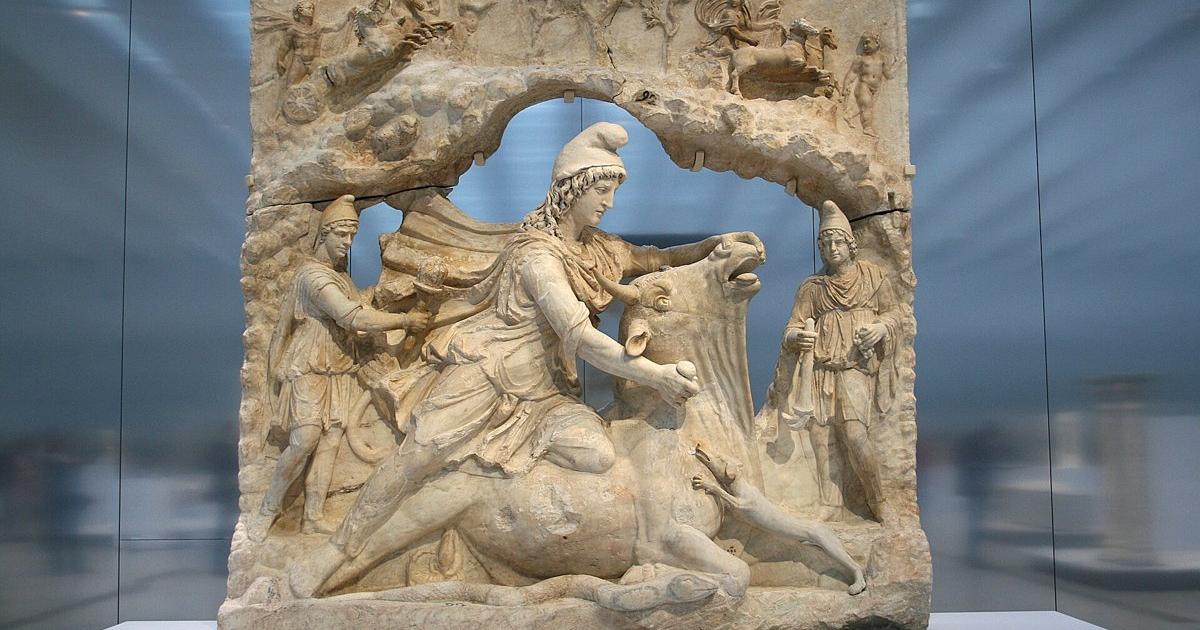
A marble relief of Mithras slaying the bull, dated on its museum file record to 100 to 200 AD and found in Rome, now at the Louvre-Lens. It is shown as an illustration only. It is not from Novae and it is not the Mithras head found there. Photo by Jean-Pol Grandmont, via Wikimedia Commons, CC BY 3.0.
By Aris Manus
Sources
- Ewelina Krajczyńska-Wujec, Polish archaeologists uncover lavish home of Roman legion commander, Science in Poland (PAP), October 22, 2026
- Rezydencja i kolejne zabytki w Novae, University of Warsaw (in Polish)
- Possible Praetorium Found at Roman Fortress in Bulgaria, Archaeology magazine, October 26, 2026
- Priapus, Encyclopaedia Britannica, updated October 7, 2026
- Novae, legionary fortress and late Roman town, Faculty of Archaeology, University of Warsaw
- Agnieszka Tomas and Emil Jęczmienowski, Novae, Sector XIII (retentura), 2021 to 2024. A possible location of the praetorium and the via decumana, Novensia 36, 2025