Peng Zhou/The Conversation
China’s final dynasty experienced severe difficulties based on its internal contradictions, and was unable to absorb the introduction of important new technologies without disruption. The historical experiences of Britain and the United States also have lessons to teach us about the impact of significant new technologies, and about how those impacts can be managed—or mismanaged—to promote the greater good, or to harm it.
The Last Dynasty
China’s final imperial dynasty, the Qing, collapsed under the weight of multiple uprisings both from within and without. Despite achieving impressive economic growth during the 18th century – fuelled by agricultural innovation, a population boom, and the roaring global trade in tea and porcelain – levels of inequality exploded, in part due to widespread corruption.
The infamous government official Heshen, widely regarded as the most corrupt figure in the Qing dynasty, amassed a personal fortune reckoned to exceed the empire’s entire annual revenue (one estimate suggests he amassed 1.1 billion taels of silver, equivalent to around US$270 billion (£200bn), during his lucrative career).
Imperial institutions failed to restrain the inequality and moral decay that the Qing’s growth had initially masked. The mechanisms that once spurred prosperity – technological advances, centralised bureaucracy and Confucian moral authority – eventually ossified, serving entrenched power rather than adaptive reform.
When shocks like natural disasters and foreign invasions struck, the system could no longer respond. The collapse of the empire became inevitable – and this time there was no groundbreaking technology to enable a new dynasty to take the Qing’s place. Nor were there fresh social ideals or revitalised institutions capable of rebooting the imperial model. As foreign powers surged ahead with their own technological breakthroughs, China’s imperial system collapsed under its own weight. The age of emperors was over.
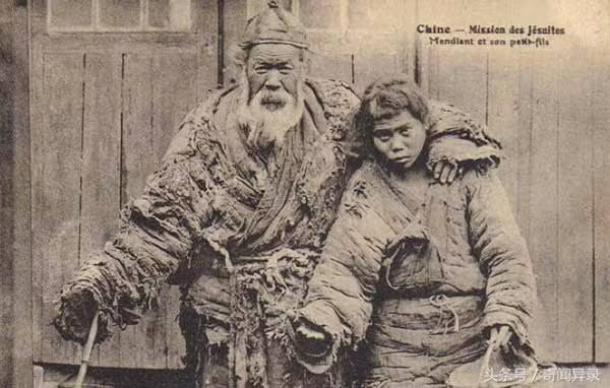
A grandfather and grandson beg for food amid the collapse of China’s Qing dynasty in the late 19th century. (UtCon Collection/Alamy Stock Photo).
The world had turned. As China embarked on two centuries of technological and economic stagnation – and political humiliation at the hands of Great Britain and Japan – other nations, led first by Britain and then the US, would step up to build global empires on the back of new technological leaps.
In these modern empires, we see the same four key influences on their cycles of growth and inequality – technology, institutions, politics and social norms – but playing out at an ever-faster rate. As the saying goes: history does not repeat itself, but it often rhymes.
Rule Britannia
If imperial China’s inequality saga was written in rice and rebellions, Britain’s industrial revolution featured steam and strikes. In Lancashire’s “satanic mills”, steam engines and mechanised looms created industrialists so rich that their fortunes dwarfed small nations.
In 1835, social observer Andrew Ure enthused: “Machinery is the grand agent of civilisation.” Yet for many decades, the steam engines, spinning jennies and railways disproportionately enriched the new industrial class, just as in the Han dynasty of China 2,000 years earlier. The workers? They inhaled soot, lived in slums – and staged Europe’s first symbolic protest when the Luddites began smashing their looms in 1811.
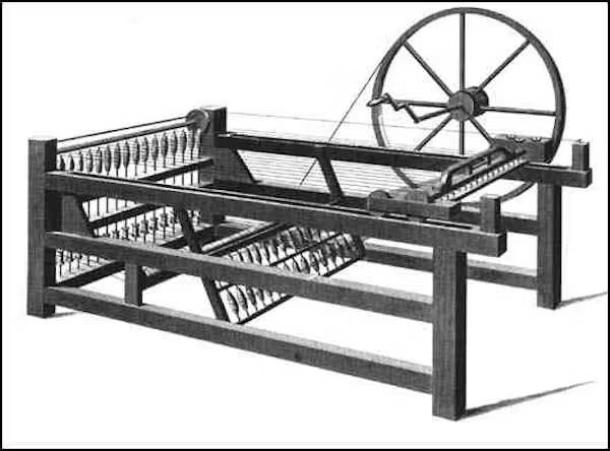
A spinning jenny. (Elcapito22/CC BY-SA 3.0).
During the 19th century, Britain’s richest 1% hoarded as much as 70% of the nation’s wealth, while labourers toiled 16-hour days in mills. In cities like Manchester, child workers earned pennies while industrialists built palaces.
But as inequality peaked in Britain, the backlash brewed. Trade unions formed (and became legal in 1824) to demand fair wages. Reforms such as the Factory Acts (1833–1878) banned child labour and capped working hours.
Although government forces intervened to suppress the uprisings, unrest such as the 1830 Swing Riots and 1842 General Strike exposed deep social and economic inequalities. By 1900, child labour was banned and pensions had been introduced. The 1900 Labour Representation Committee (later the Labour Party) vowed to “promote legislation in the direct interests of labour” – a striking echo of how China’s imperial exams had attempted to open paths to power.
Slowly, the working class saw some improvement: real wages for Britain’s poorest workers gradually increased over the latter half of the 19th century, as mass production lowered the cost of goods and expanding factory employment provided a more stable livelihood than subsistence farming.
And then, two world wars flattened Britain’s elite – the Blitz didn’t discriminate between rich and poor neighbourhoods. When peace finally returned, the Beveridge Report gave rise to the welfare state: the NHS, social housing, and pensions.
Income inequality plummeted as a result. The top 1%’s share fell from 70% to 15% by 1979. While China’s inequality fell via dynastic collapse, Britain’s decline resulted from war-driven destruction, progressive taxation, and expansive social reforms.
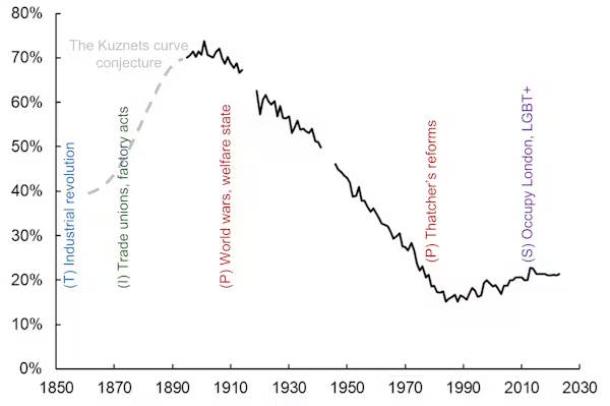
Wealth share of top 1% in the UK, inequality before 1895 is not well documented; dotted curve is conjectured based on Kuznets curve. Sources: Alvaredo et al (2018), World Inequality Database. (Peng Zhou/CC BY-SA).
However, from the 1980s onwards, inequality in Britain has begun to rise again. This new cycle of inequality has coincided with another technological revolution: the emergence of personal computers and information technology — innovations that fundamentally transformed how wealth was created and distributed.
The era was accelerated by deregulation, deindustrialisation and privatisation — policies associated with former prime minister Margaret Thatcher, that favoured capital over labour. Trade unions were weakened, income taxes on the highest earners were slashed, and financial markets were unleashed. Today, the richest 1% of UK adults own more 20% of the country’s total wealth.
The UK now appears to be in the worst of both worlds – wrestling with low growth and rising inequality. Yet renewal is still within reach. The current UK government’s pledge to streamline regulation and harness AI could spark fresh growth – provided it is coupled with serious investment in skills, modern infrastructure, and inclusive institutions geared to benefit all workers.
At the same time, history reminds us that technology is a lever, not a panacea. Sustained prosperity comes only when institutional reform and social attitudes evolve in step with innovation.
The American Century
While China’s growth-and-inequality cycles unfolded over millennia and Britain’s over centuries, America’s story is a fast-forward drama of cycles lasting mere decades. In the early 20th century, several waves of new technology widened the gap between rich and poor dramatically.
By 1929, as the world teetered on the edge of the Great Depression, John D. Rockefeller had amassed such a vast fortune – valued at roughly 1.5% of America’s entire GDP – that newspapers hailed him the world’s first billionaire. His wealth stemmed largely from pioneering petroleum and petrochemical ventures including Standard Oil, which dominated oil refining in an age when cars and mechanised transport were exploding in popularity.
- American People Suffering Historical Amnesia With Many Citizens Knowing “Virtually Nothing” About Their History
- America: A Nation Defined by its Mythology (Part 1)
Yet this period of unprecedented riches for a handful of magnates coincided with severe imbalances in the broader US economy. The “roaring Twenties” had boosted consumerism and stock speculation, but wage growth for many workers lagged behind skyrocketing corporate profits. By 1929, the top 1% of Americans owned more than a third of the nation’s income, creating a precariously narrow base of prosperity.
When the US stock market crashed in October 1929, it laid bare how vulnerable the system was to the fortunes of a tiny elite. Millions of everyday Americans – living without adequate savings or safeguards – faced immediate hardship, ushering in the Great Depression. Breadlines snaked through city streets, and banks collapsed under waves of withdrawals they could not meet.
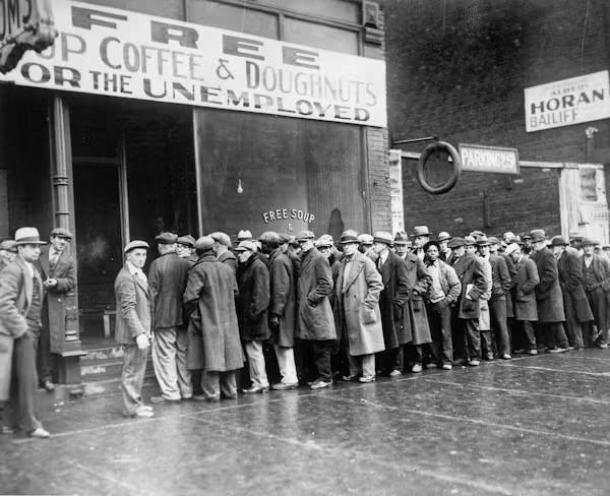
Unemployed men queued outside a Great Depression soup kitchen in Chicago, 1931. (National Archives at College Park/Public Domain).
In response, President Franklin D. Roosevelt’s New Deal reshaped American institutions. It introduced unemployment insurance, minimum wages, and public works programmes to support struggling workers, while progressive taxation – with top rates exceeding 90% during the second world war. Roosevelt declared: “The test of our progress is not whether we add more to the abundance of those who have much – it is whether we provide enough for those who have too little.”
In a different way to the UK, the second world war proved a great leveller for the US – generating millions of jobs and drawing women and minorities into industries they’d long been excluded from. After 1945, the GI Bill expanded education and home ownership for veterans, helping to build a robust middle class. Although access remained unequal, especially along racial lines, the era marked a shift toward the norm that prosperity should be shared.
Meanwhile, grassroots movements led by figures like Martin Luther King Jr. reshaped social norms about justice. In his lesser-quoted speeches, King warned that “a dream deferred is a dream denied” and launched the Poor People’s Campaign, which demanded jobs, healthcare and housing for all Americans. This narrowing of income distribution during the post-war era was dubbed the “Great Compression” – but it did not last.
As oil crises of the 1970s marked the end of the preceding cycle of inequality, another cycle began with the full-scale emergence of the third industrial revolution, powered by computers, digital networks and information technology.
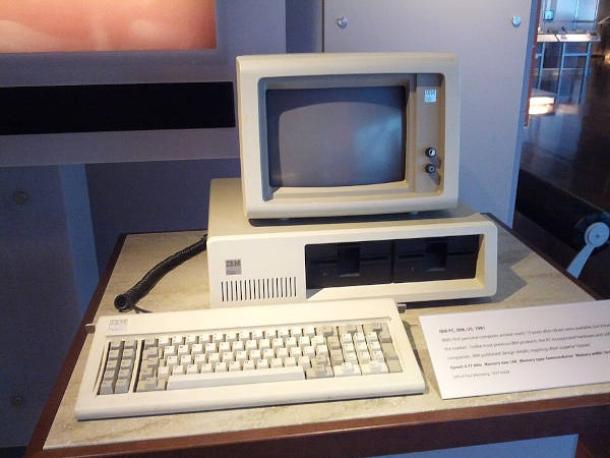
The first personal computer, made by IBM. (Photographing Travis/CC BY-SA 2.0).
As digitalisation transformed business models and labour markets, wealth flowed to those who owned the algorithms, patents and platforms – not those operating the machines. Hi-tech entrepreneurs and Wall Street financiers became the new oligarchs. Stock options replaced salaries as the true measure of success, and companies increasingly rewarded capital over labour.
By the 2000s, the wealth share of the richest 1% climbed to 30% in the US. The gap between the elite minority and working majority widened with every company stock market launch, hedge fund bonus and quarterly report tailored to shareholder returns.
But this wasn’t just a market phenomenon – it was institutionally engineered. The 1980s ushered in the age of (Ronald) Reaganomics, driven by the conviction that “government is not the solution to our problem; government is the problem”. Following this neoliberalist philosophy, taxes on high incomes were slashed, capital gains were shielded, and labour unions were weakened.
Deregulation gave Wall Street free rein to innovate and speculate, while public investment in housing, healthcare and education was curtailed. The consequences came to a head in 2008 when the US housing market collapsed and the financial system imploded.
The Global Financial Crisis that followed exposed the fragility of a deregulated economy built on credit bubbles and concentrated risk. Millions of people lost their homes and jobs, while banks were rescued with public money. It marked an economic rupture and a moral reckoning – proof that decades of pro-market policies had produced a system that privatised gain and socialised loss.
Inequality, long growing in the background, now became a glaring, undeniable fault line in American life – and it has remained that way ever since.
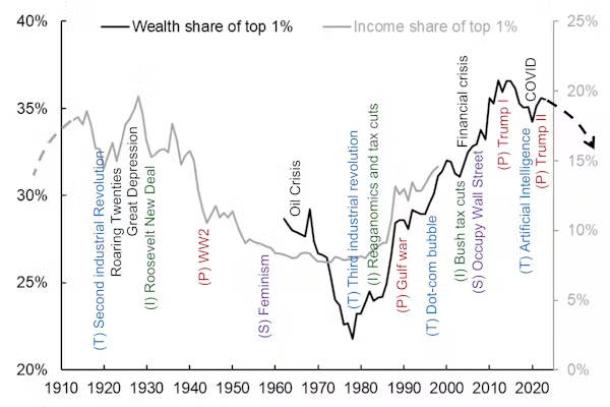
Wealth share and income share of top 1% in the US: World Inequality Database; income share: Picketty & Saez (2003). Dotted curves are conjectured based on Kuznets curve. (Peng Zhou/CC BY-SA).
So is the US proof that the Kuznets model of inequality is indeed wrong? While the chart above shows inequality has flattened in the US since the 2008 financial crisis, there is little evidence of it actually declining. And in the short term, while Donald Trump’s tariffs are unlikely to do much for growth in the US, his low-tax policies won’t do anything to raise working-class incomes either.
The story of “the American century” is a dizzying sequence of technological revolutions – from transport and manufacturing to the internet and now AI – crashing one atop the other before institutions, politics or social norms could catch up. In my view, the result is not a broken cycle but an interrupted one. Like a wheel that never completes its turn, inequality rises, reform stutters – and a new wave of disruption begins.
Our Unequal AI Future?
Like any technological explosion, AI’s potential is dual-edged. Like the Tang dynasty’s bureaucrats hoarding grain, today’s tech giants monopolise data, algorithms and computing power. Management consultant firm McKinsey has predicted that algorithms could automate 30% of jobs by 2030, from lorry drivers to radiologists.
Yet AI also democratises: ChatGPT tutors students in Africa while open-source models such as DeepSeek empower worldwide startups to challenge Silicon Valley’s oligarchy.
The rise of AI isn’t just a technological revolution – it’s a political battleground. History’s empires collapsed when elites hoarded power; today’s fight over AI mirrors the same stakes. Will it become a tool for collective uplift like Britain’s post-war welfare state? Or a weapon of control akin to Han China’s grain-hoarding bureaucrats?
The answer hinges on who wins these political battles. In 19th-century Britain, factory owners bribed MPs to block child labour laws. Today, Big Tech spends billions lobbying to neuter AI regulation.
Meanwhile, grassroots movements like the Algorithmic Justice League demand bans on facial recognition in policing, echoing the Luddites who smashed looms not out of technophobia but to protest exploitation. The question is not if AI will be regulated but who will write the rules: corporate lobbyists or citizen coalitions.
The real threat has never been the technology itself, but the concentration of its spoils. When elites hoard tech-driven wealth, social fault-lines crack wide open – as happened more than 2,000 years ago when the Red Eyebrows marched against Han China’s agricultural monopolies.
To be human is to grow – and to innovate. Technological progress raises inequality faster than incomes, but the response depends on how people band together. Initiatives like “Responsible AI” and “Data for All” reframe digital ethics as a civil right, much like Occupy Wall Street exposed wealth gaps. Even memes – like TikTok skits mocking ChatGPT’s biases – shape public sentiment.
There is no simple path between growth and inequality. But history shows our AI future isn’t preordained in code: it’s written, as always, by us.
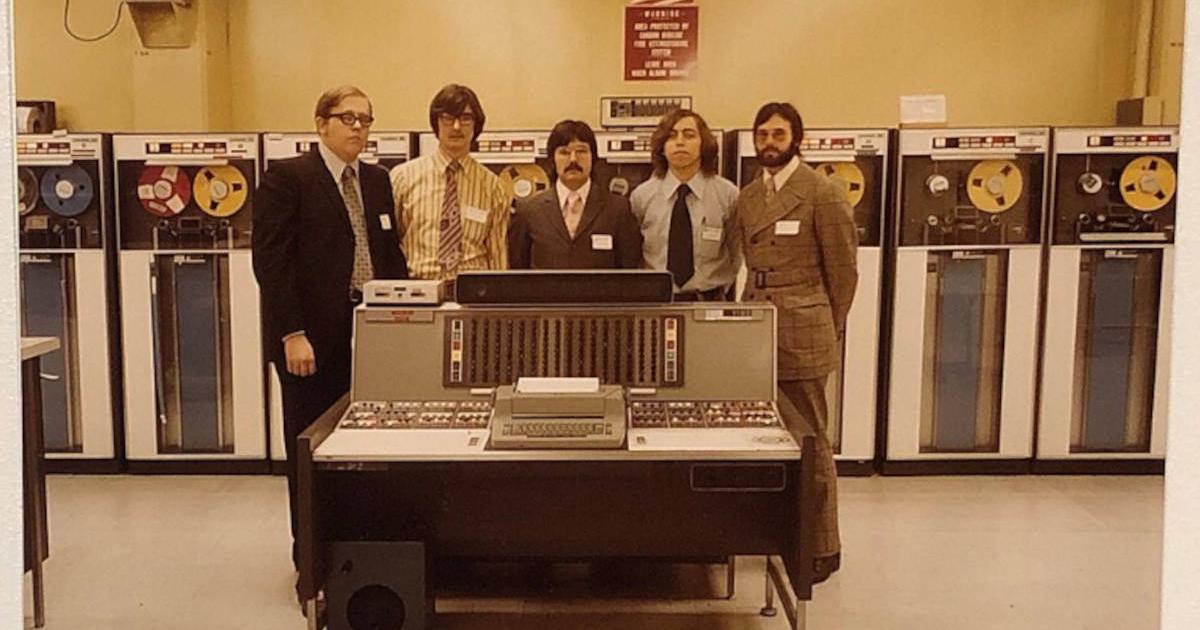
Top image: Photo of an early IBM 7030 computer, in the 1960s, on display at National Cryptologic Museum.
Source: ArnoldReinhold/Public Domain.
This article was originally published under the title ‘What 2,000 years of Chinese history reveals about today’s AI-driven technology panic – and the future of inequality’ by Peng Zhou on The Conversation, and has been republished under a Creative Commons License.