



A vast Neolithic sanctuary near Chleby was built around 6,500 years ago, more than a millennium before Stonehenge. Archaeologists say its twelve entrances were arranged to frame important positions of the Sun and Moon, suggesting that the enclosure was both a ritual center and a carefully planned place for observing the sky. The discovery offers a glimpse of how Europe’s first farming communities connected landscape, ceremony and time.

Archaeologists and visitors beside an excavation trench at the Chleby sanctuary. (University of West Bohemia)
A Monumental Enclosure in Bohemia
The site lies near Chleby, east of Prague. According to the University of West Bohemia’s excavation report, the almost circular enclosure measures about 230 meters across and was cut into the ground by a ditch more than 2.5 meters deep. Twelve entrances break the circuit, although they are irregularly spaced.
That pattern became significant when archaeologists plotted the geometry of the openings. “Their geometry creates a system that made it possible to observe the most significant moments of the solar and lunar cycles,” said Petr Krištuf of the University of West Bohemia, who leads the research. Circular enclosures from this period are not otherwise known in the region, making the Chleby Neolithic sanctuary exceptional even before its possible celestial function is considered.
- 7000-Year-Old Ritual Site Unearthed in Poland
- Mysterious Roundel Older than Stonehenge and the Egyptian Pyramids
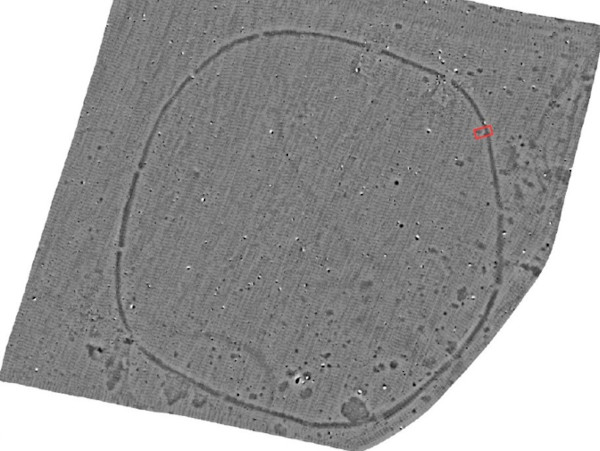
Survey image showing the circular enclosure identified at Chleby. (University of West Bohemia)
A Calendar Written into the Entrances
The research team has identified two principal observation relationships. One appears to correspond with the Moon’s extreme positions on the horizon during its roughly 18-year cycle, while another links sunrise at the summer solstice with sunset at the winter solstice. Krištuf told the university that the arrangement resembles Stonehenge’s main axis, but organic material dates the Czech site more than 1,000 years earlier.
The comparison is striking, but it does not mean the two monuments had identical purposes. As the record of Goseck Circle shows, an alignment can support seasonal observation without reducing a site to a simple “calendar.” A similar caution surrounds Stonehenge’s solstice axis, where natural landforms and human design may have worked together.
For early farmers, the seasonal cycle was not abstract. The summer-solstice sunrise could mark a beginning, while the winter-solstice sunset suggested an ending, a rhythm that may have helped communities organise work and gatherings. Comparable ideas appear in discussions of winter-solstice monuments and the proposed solar and lunar alignments of Ales Stenar, although each monument must be interpreted in its own setting.
Bull horns, Burials and a Changing Sacred Place
Evidence supporting ritualistic practices at the site has been uncovered from the ditch. Bull skulls and horns were found near the entrance, and archaeologist Jan Turek of Charles University believes these artifacts were used to decorate large doorways. He associated the bull with symbolic meaning in early farming societies in Europe.
The discovery of human remains provides a different aspect of the site's past. Previous research has documented a Bronze Age burial site related to the Únětice Culture, which contained approximately eighteen individuals and appeared to have been placed within the grave over an extended period of time. While there is no definitive proof that the purpose of the original Neolithic sanctuary remained unchanged, the fact that this burial site has continued to exist within the same general area as where it was originally constructed provides evidence for the long-term significance of this structure.
- Goseck Circle: The Oldest Known Solar Observatory
- The Winter Solstice at Seven Amazing Megalithic Sites
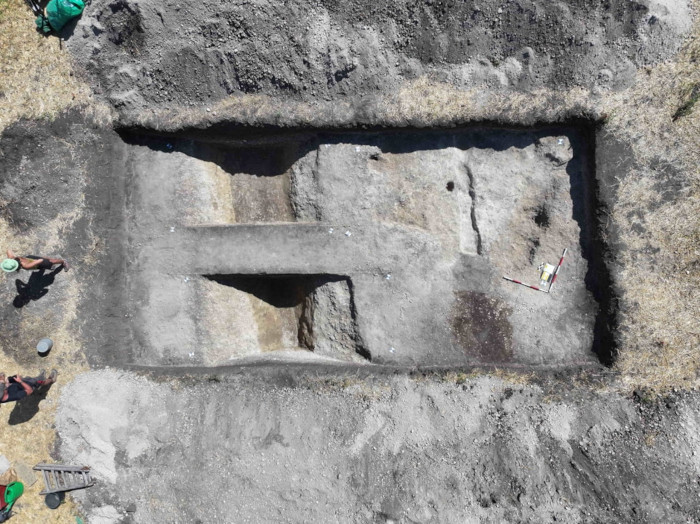
An excavation trench investigated by the archaeological team at Chleby. (University of West Bohemia)
Researchers state that by the Iron Age (beginning about 800 BC), the sanctuary started to lose its original purpose due to being used as a dike [a type of water control structure]. As the dike filled in over time, houses were built and an ordinary town developed in areas where historically, there were houses of worship (as opposed to something like Stonehenge where the ceremonial site remained for continued periodic use).
Analysis of the soil at Chleby is being conducted by Dr Jan Fišer from the University of Hradec Králové on behalf of the international research project known as Long-Term Land Use Dynamics in Prehistoric Ritual Areas. This hopes to provide evidence to increase the knowledge of the different activities the area was used for, such as celebrations and crafting as opposed to the visible remnants found at many ceremonial monuments
The Long-Term Land Use Dynamics Project includes teams from the University of West Bohemia (UWB), Charles University (CU) and the University of Hradec Králové (UHK) who are all engaged in understanding how ritual landscapes evolved over time throughout prehistory.
At Chleby, the Sun and Moon may have shaped the first design, but the soil could tell how people used the place.
Top image: Interpretive visualization of a possible ritual scene; the University of West Bohemia labels this image “Visualisation made by ChatGPT,” not an archaeological photograph. Source: University of West Bohemia.
By Gary Manners
References
Čandová, A. 18 August 2026. A thousand years older than Stonehenge: Archaeologists explore a Czech sanctuary near Chleby. Available at: https://info.zcu.cz/A-thousand-years-older-than-Stonehenge--Archaeologists-explore-a-Czech-sanctuary-near-Chleby/clanek.jsp?id=9882
Expats.cz. 19 August 2026. 6,500-year-old sanctuary older than Stonehenge uncovered in Central Bohemia. Available at: https://www.expats.cz/czech-news/article/6-500-year-old-sanctuary-older-than-stonehenge-uncovered-in-central-bohemia
Radio Prague International. 17 August 2026. Archaeologists uncover 6,500-year-old ritual site in central Bohemia. Available at: https://english.radio.cz/archaeologists-uncover-6500-year-old-ritual-site-central-bohemia-8894992






















