
Neanderthals were renowned for strong, muscular bodies. Their robust physique has generally provided greater upper-body strength than that of most modern humans, according to an international study led by researchers from the Max Planck Institute for Evolutionary Anthropology and Karolinska Institutet. Their denser skeletal framework showed evidence of more extensive muscle attachment sites and about double the upper-body power potential. Elite modern athletes could outperform them in some respects, but the typical Neanderthal outmatched modern humans in physical force. They also differed in characteristic features, including prominent brow ridges and relatively short tooth roots. Growth hormones likely contributed to some aspects of skeletal and muscular development, although Neanderthal anatomy resulted from many genetic and developmental factors. Specific growth hormones help shape the body by regulating the growth of both muscle and bone. After the hormone is released by the pituitary gland at the base of the brain, it travels through the bloodstream to its target cells. To act on a cell, a hormone must bind to a receptor on its surface, which then transmits the signal into the cell.
- The Origin of ‘Us’: What We Know So Far About Where We Humans Come From
- Scientists Create Fully Functioning Neanderthal Mini Brain
A Stronger Response to Growth Hormone
Hugo Zeberg and Phillip Kanis's team discovered that the Neanderthal version of this receptor has two key changes absent in modern humans, leading to a stronger response to growth hormone in lab-grown cells, which grew about forty percent more than cells with the modern receptor.
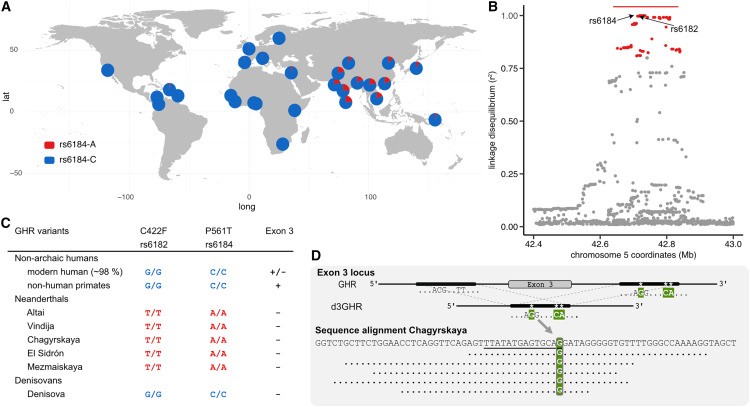
The figure traces the Neanderthal-derived growth hormone receptor through modern populations. It includes a global allele-frequency map, linkage disequilibrium analysis, comparisons between Neanderthal, Denisovan, and modern human genomes, and genomic diagrams showing the inherited Neanderthal haplotype on chromosome 5. "Increased Signaling of the Neanderthal Growth Hormone Receptor."(Kanis, Philipp, Hugo Zeberg, Miriam Berreiter/Current Biology)
The Legacy of Neanderthal Inbreeding
Modern humans inherited this Neanderthal-derived variant of the receptor through interbreeding with Neanderthals around 47,000 years ago. Today, it’s quite common throughout South and East Asia. Up to 24 percent of people in some South Asian populations carry it, compared with only around 0.5 percent of Europeans. According to Phillip Kanis, first author of the study and a researcher at the Max Planck Institute for Evolutionary Anthropology, “Cells grown in the laboratory responded more strongly, while data from over a million people showed signs of the same effect in the body. It is rare to see laboratory and population evidence fit together so clearly.”
- How Ancient Hominid Interbreeding has Shaped Humans Today
- Neanderthal DNA Recovered from Cave Dirt Using Breakthrough Technology
Neanderthal Effect Emerges in Adulthood
The difference appears to emerge after childhood. The researchers were also able to examine certain body measurements from more than 6,000 children, but did not find a direct link between the Neanderthal version and body growth up to age 11. This data suggests that the effect becomes noticeable later in life, around the age at which puberty becomes more pronounced throughout the body, and growth hormone levels increase substantially. A survey of the many adults who carry the Neanderthal version showed that, on average, they had 270 grams more muscle mass.
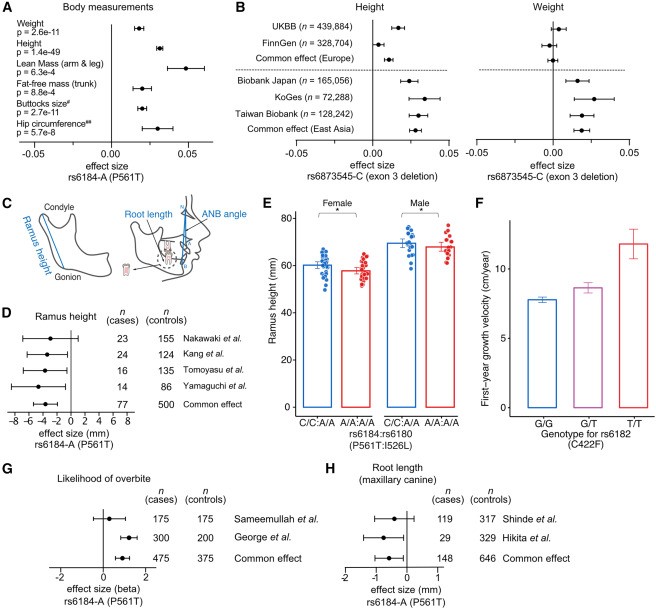
This multi-panel figure summarizes the measurable effects of carrying the Neanderthal-derived GHR variant. It presents statistical analyses of body weight, lean muscle mass, height, hip circumference, jaw morphology, tooth-root length, and childhood growth. The study found modest but statistically significant increases in muscle mass and several subtle craniofacial traits among adult carriers. "Increased Signaling of the Neanderthal Growth Hormone Receptor." (Kanis, Philipp, Hugo Zeberg, Miriam Berreiter/Current Biology)
The Neanderthal Blueprint Lives On
According to study co-author Miriam Berreiter, “As someone who does CrossFit, I was delighted to find Neanderthal genetics and muscle mass coming together in the same study.” However, she points out that genetics is not the complete answer: “Even a Neanderthal growth hormone receptor is no substitute for training.” The Neanderthal receptor variant was also associated with subtle differences in the skull and teeth. Carriers tend to have a slightly shorter rear section of the lower jaw combined with shorter tooth roots.
- Cultural and technological boom 50,000 years ago linked with less testosterone.
- Toolmaking Teachers? Surprising Skills Shared Between Neanderthals and Modern Humans
According to Hugo Zeberg, senior author of the study, “It is fascinating that one genetic change inherited from the Neanderthals can still have an effect on the human body today. But this is only one of many genetic influences on growth and body shape. It cannot explain the Neanderthal body type on its own, and it certainly does not determine a person’s overall appearance.”
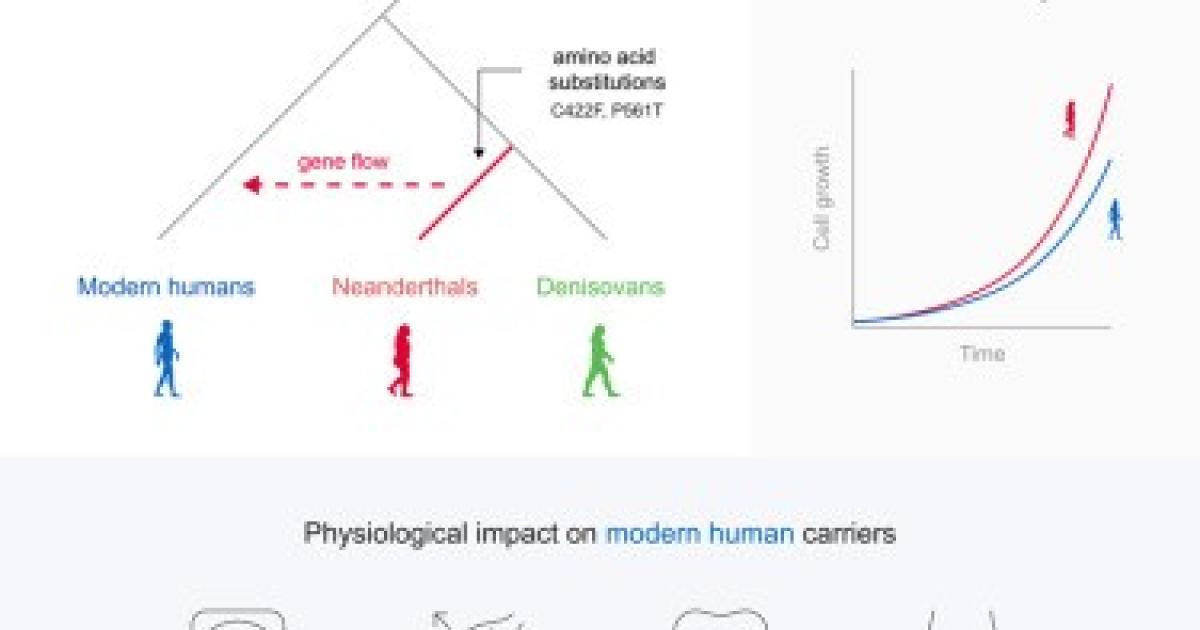
Top Image: This graphical abstract summarizes the study's central findings. It illustrates how the Neanderthal-derived growth hormone receptor (GHR) differs from the modern human receptor, resulting in stronger cellular responses to growth hormone. The illustration also highlights several subtle physical characteristics associated with carriers, including increased body weight, greater muscle mass, shorter tooth roots, and wider hips."Increased Signaling of the Neanderthal Growth Hormone Receptor. Source:(Kanis, Philipp, Hugo Zeberg, Miriam Berreiter/Current Biology)
By Ramsey Hardin
References
Currie, J. August 5, 2026. People With This Neanderthal Hormone Receptor Have More Muscle Mass. Nautilus. Available at:https://nautil.us/people-with-this-neanderthal-hormone-receptor-have-more-muscle-mass-1283409
Hawks, J. Auguts 5, 2026. How Neanderthal Ancestry Affects Growth and Muscle. John Hawks. Available at:https://www.johnhawks.net/p/how-neanderthal-ancestry-affects
Kanis, P., et al. August 3, 2026. Neandertal Growth Hormone Receptor Increases Muscle Mass in People Today. Current Biology. Cell Press. Available at:https://www.cell.com/current-biology/
Lehmann, J. August 5, 2026. Some People Carry a Neanderthal Growth Hormone Receptor That Is Linked to Greater Muscle Mass. Discover Magazine. Available at:https://www.discovermagazine.com/some-people-carry-a-neanderthal-growth-hormone-receptor-that-is-linked-to-greater-muscle-mass-49498
Max Planck Society and Harley, S, August 5, 2026. Neanderthal Growth Hormone Receptor Increases Muscle Mass in People Today.Phys.Org. Available at:https://phys.org/news/2026-08-neanderthal-growth-hormone-receptor-muscle.html