

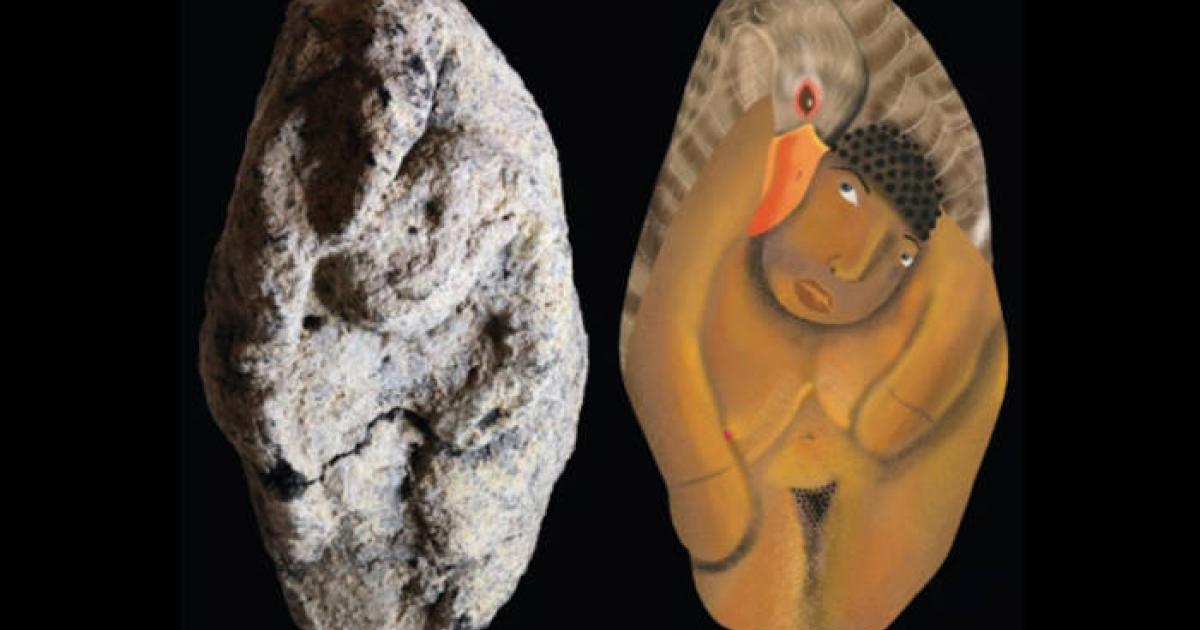

In a remarkable discovery that bridges the ancient and modern understanding of human imagination, archaeologists have unearthed a 12,000-year-old clay figurine from northern Israel that represents the earliest known depiction of human-animal interaction. The tiny sculpture, measuring just 3.7 centimeters tall, portrays a woman crouched forward with a goose perched upon her back, offering an unprecedented window into the spiritual and symbolic world of Late Natufian peoples who lived along the shores of the Sea of Galilee at the end of the Paleolithic era.
The figurine was discovered at Nahal Ein Gev II, a prehistoric village excavated by Dr. Laurent Davin and Professor Leore Grosman of the Hebrew University of Jerusalem's Institute of Archaeology. Published in the Proceedings of the National Academy of Sciences (PNAS), the study reveals that this delicate artwork predates the Neolithic period and marks a turning point in artistic expression, combining naturalistic detail with mythological imagination in ways that would not fully emerge until thousands of years later.
- Discoveries Show that Galilee and Jerusalem are Far Older Than Once Believed
- Ice Age Galileans Thrived During Global Ice Melts

The Nahal Ein Gev excavation site overlooking the Sea of Galilee. (Hebrew University of Jerusalem)
A Masterpiece of Early Pyrotechnology
The creation of this figurine demonstrates sophisticated technical knowledge that challenges previous assumptions about prehistoric capabilities. Crafted from local clay and deliberately heated to approximately 400°C, the artifact represents one of the earliest examples of controlled pyrotechnology used for artistic purposes, as reported by Phys.org. Microscopic and chemical analyses conducted by the research team revealed fascinating details about both the object's composition and its maker.
Red pigment residues, identified as ochre, were found on both the woman and the goose, suggesting the entire figurine was once painted in vibrant crimson hues. Perhaps most intriguingly, a preserved fingerprint left in the wet clay indicates the artisan was likely a young adult or adult female. The sculptor employed sophisticated techniques to create depth and perspective through the manipulation of light and shadow, foreshadowing artistic innovations that would not become widespread until the subsequent Neolithic period thousands of years later.
The level of detail is extraordinary for such an ancient work. The goose's beak, wings, and posture are rendered with careful attention to anatomical accuracy, while the female figure displays clearly defined breasts and pubic area. "The sculptor used light and shadow to create depth and perspective," Dr. Davin explained to the Times of Israel, highlighting technical sophistication that would take millennia to fully develop in ancient art traditions.
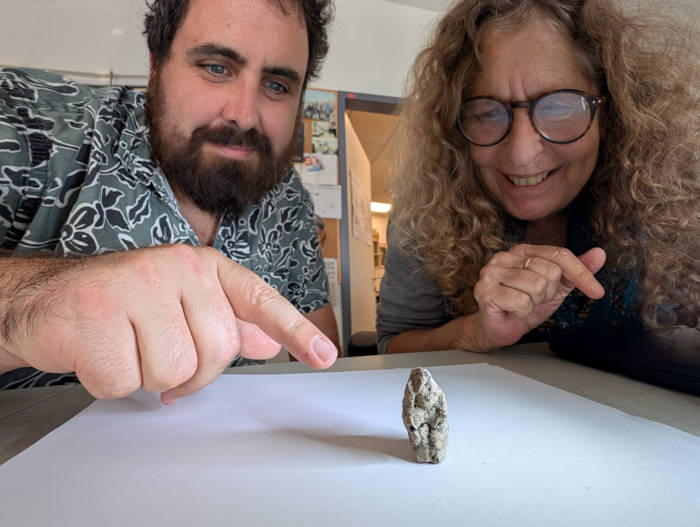
Prof. Leore Grosman and Dr. Laurent Davin with the figurine. (Hadas Goldgeier/Hebrew University)
Mythological Imagination in Clay
What makes this figurine truly revolutionary is not only its age or craftsmanship, but what it represents. The positioning of the figures suggests something far beyond a simple hunting scene or naturalistic observation. The goose, with its neck extended and wings enveloping the woman in an embrace-like gesture, appears alive and engaged in an imagined interaction.
"A real goose would not adopt this kind of position on a woman, and therefore we understand that this is an imaginary scene, rather than a real one," Dr. Davin noted in the study.
The researchers interpret this composition as depicting a mythological or ritual encounter consistent with animistic beliefs, a worldview that perceives humans and animals as spiritually interconnected beings capable of transformation and interaction beyond the physical realm. Such beliefs have persisted in human cultures worldwide for millennia, manifesting in shamanic visions, erotic dreams, and storytelling traditions. The Greek myth of Zeus transforming into a swan to seduce Leda represents a later iteration of similar themes that may have ancient roots in beliefs like those held by the Natufian peoples.
The scene captured in clay reveals an early human community grappling with questions of identity, connection with nature, and the boundaries between human and animal worlds.
"It bridges the world of mobile hunter gatherers and that of the first settled communities, showing how imagination and symbolic thinking began to shape human culture," Professor Grosman emphasized in the published study.
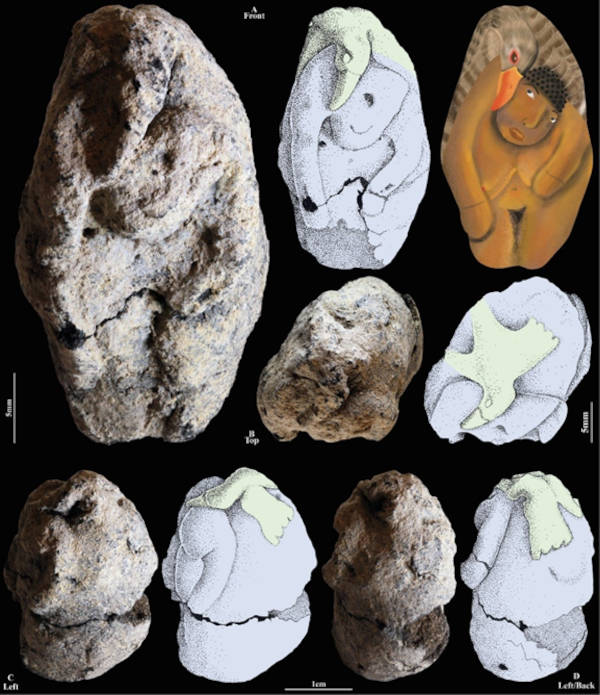
Different views of the 12,000-year-old figurine with artistic reconstructions. (Laurent Davin/Hebrew University)
Life at the Dawn of Sedentary Culture
The figurine emerged from a semicircular stone structure containing burials and ceremonial deposits at Nahal Ein Gev II, a settlement that extends across at least 1,000 square meters near Kibbutz Ein Gev. Dating to approximately 12,000 years ago, the site represents a pivotal moment in human history when hunter-gatherer communities began establishing permanent villages. The Natufian culture, spanning roughly 15,000 to 11,500 years ago, marks humanity's transition from fully nomadic lifestyles to settled communities with complex social structures and symbolic practices.
The building where the figurine was discovered served initially as a burial chamber, with archaeologists uncovering remains of at least 20 individuals beneath layers of lime plaster. After abandonment, the structure became a site for ritual deposits, suggesting the community maintained cultural memory of its sacred significance. Radiocarbon dating of charcoal from the burials places the interments between 12,630 and 12,041 years ago, with the figurines deposited at least several decades later, approximately 90 centimeters above the plaster layer.
Faunal remains throughout the site reinforce the special relationship between the Natufian inhabitants and geese. Unlike other contemporary settlements where geese represented just one food source among many, at Nahal Ein Gev these waterfowl dominated the archaeological record. Evidence shows the villagers not only hunted geese for meat but also plucked their feathers for decoration and fashioned certain bones into ornaments, demonstrating a multifaceted symbolic connection that extended beyond mere sustenance.
The site has yielded numerous groundbreaking discoveries beyond this figurine, including the earliest evidence of wheel technology and advanced plaster production techniques. "The Natufians built the first villages of humanity," Dr. Davin explained. "They were still hunter-gatherers, they were not producing their food, but they created circular or semi-circular stone structures where they lived."
Seeds of Myth and Meaning
Beyond its technical achievements, this small sculpture embodies humanity's earliest articulated attempts at mythmaking and narrative expression through three-dimensional art. While earlier cave paintings depicting human-animal interactions exist, including a 51,000-year-old scene of communal pig hunting in Sulawesi, Indonesia, and an 18,000-year-old bird-headed figure with a speared bison in France's Lascaux Cave, the Nahal Ein Gev figurine represents the first portable sculpture showing such interaction.
"This discovery is extraordinary on multiple levels," Dr. Davin stated in the published study.
"Not only is this the world's earliest figurine depicting human-animal interaction, but it's also the earliest naturalistic representation of a woman found in Southwest Asia."
The artifact demonstrates that long before the development of agriculture and animal domestication, early sedentary communities were already constructing complex symbolic vocabularies through art, exploring relationships between humanity and nature through imaginative rather than purely representational lenses.
The Natufian people left behind abundant evidence of symbolic behavior unprecedented in earlier periods. They created elaborate ornaments, beads, and jewelry; developed new funerary practices including burial beneath house floors; and collected human skulls from graves for unknown ritual purposes. This figurine fits within that broader cultural revolution, representing an explosion of artistic and spiritual expression that laid foundations for the mythological traditions, religious practices, and artistic conventions that would flourish in subsequent civilizations across Southwest Asia and beyond.
The tiny woman and goose, frozen in their enigmatic embrace for twelve millennia, speak to fundamental human needs to understand our place in the natural world, to imagine connections that transcend physical boundaries, and to express those visions in lasting form. They remind us that the seeds of civilization, mythology, and spiritual life were planted not by farmers in the Neolithic, but by hunter-gatherers at places like Nahal Ein Gev, where creativity and symbolic thinking began reshaping human culture in profound and enduring ways.
Top image: A 12,000-year-old clay figurine from Nahal Ein Gev II depicting a woman and goose in a mythological scene, representing the earliest known sculpture of human-animal interaction. Source: Laurent Davin/Hebrew University
By Gary Manners
References
Davin, L. 2025. A 12,000-year-old clay figurine of a woman and a goose marks symbolic innovations in Southwest Asia. Available at: https://pnas.org/doi/10.1073/pnas.2517509122
Phys.org. 2025. The woman and the goose: A 12,000-year-old glimpse into prehistoric belief. Available at: https://phys.org/news/2025-11-woman-goose-year-glimpse-prehistoric.html






















