
A 700-year-old burial of a woman discovered in China could be the first to offer archaeological proof of nasal amputation performed as punishment in the region. A new study focuses on the remains of the woman, whose nose was partially amputated and who was laid face down in a cemetery in Henan. The study classifies nasal amputation as an act of punishment as highly possible, but it does not confirm with certainty whether such an amputation was performed in the case of this individual. That distinction matters, because the skeleton reveals a violent procedure without naming the woman, identifying her alleged crime, or showing who ordered it.

The skull showing evidence of the nasal punishment technique. Cranium of M318. (Zhou et al./Journal of Archaeological Science)
A face-down burial raises questions
The remains, known as M318, originate from the first phase of the Sanzhiyuan Cemetery in Sanmenxia City. This site was surveyed in 2018, due to the construction of a new college campus nearby, and the remains were excavated in 2019. Radiocarbon dating of the right leg bone indicates that the woman lived between 1298 and 1404, a timeframe crossing from the late Yuan and into the early Ming dynasties.
M318 was an adult female who died around the age of 40 to 45. Out of 213 burials from this cemetery, it was noted that she was the only individual found in a face-down position and with a midfacial disfigurement. The authors indicate that prone burial may be due to several different reasons such as a local custom, humility, punishment, unnatural death, or taking penance, so that burial position provides a context, rather than proof in itself.
- Amputation Found to be Elite Punishment in 550 BC
- Ancient Ink: How Tattoos Can Reveal Hidden Stories of Past Cultures
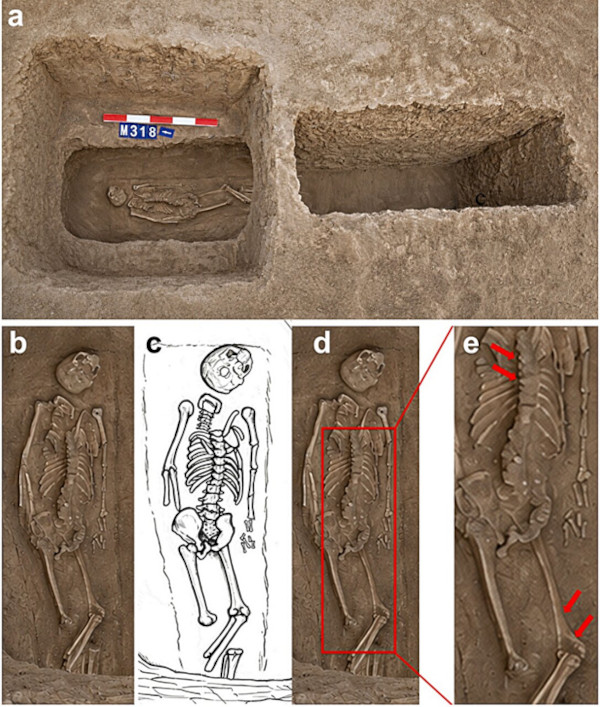
The tomb (a) and skeleton of M318 (b,c,d) of the Sanzhiyuan site. The in situ spinal column and pelvis were preserved in a prone orientation (b, c), indicating that the body of M318 was buried in a face down or prone position. (Zhou et al./Journal of Archaeological Science)
CT reveals healed nasal damage
CT imaging revealed that certain elements of the nasal bones and some delicate structures of the nasal cavity of M318 had been removed. The surrounding facial bones did not show the wider fracture pattern expected from a serious fall, and the front teeth were unharmed. New bone growth around the nasal opening demonstrates that the injury healed, meaning the woman survived the procedure and may have lived for years afterward, although the study was not able to reveal just how long.
According to the authors of the study, the injury “could be the first archaeological case of punitive nasal amputation” in China “if confirmed.” Their wording indicates the central problem: there are indications of intentional mutilation, but it is not possible to understand the motive for that just by examining the bones. Interpersonal violence, other forms of intended injury, and medical treatment should be included in the more general interpretation of what happened, although punishment seems to be the most appropriate explanation when the injury is combined with the unusual burial position.
- Cluster of Yuan Dynasty Tombs with Stunning Brick Murals Found in China
- DNA Data Reveals Face of a Chinese Emperor after 1,500 Years
A punishment tradition, but not a conviction
Nasal amputation, also called yi, has a very long history among Chinese punishments involving deliberate mutilation. The legal historian Norman P. Ho includes yi in the same category as facial tattooing, foot amputation, and castration and explains that while these punishments were abolished at the times of Emperor Wen of Han in 167 BC, there was much debate about their possible reinstatement later on. The archaeological study goes on to say that towards the end of the Yuan dynasty, nasal amputation was mostly associated with livestock theft, but the remains found in grave M318 do not indicate that this individual had committed that or any other crime.
Thus, this case connects historical data and material evidence without merging them into one another. While historians know that the Chinese legal system described cutting the nose, the evidence doesn’t tell them if M318 was sentenced in the court of Yuan or Ming court, whether she was punished by an official, and whether this prone burial had a special meaning in terms of humiliation. The report in Ancient Origins titled Punishment: 3000 year old Chinese Foot Amputation May Be Oldest in History shows why such interpretations are compelling, while also underscoring the need to distinguish skeletal evidence from the story reconstructed around it.
The study’s significance lies in that careful balance. If further evidence confirms the interpretation, M318 would provide a rare archaeological counterpart to historical descriptions of nasal amputation in China. For now, the healed wound and unusual burial make a brutal punishment plausible, not certain.
Top image: Historical illustration of a Chinese prisoner wearing a cangue, a public punishment device. Source: William Alexander/ Public domain
By Gary Manners
References
Arnold, P. 2026. Medieval Chinese skeleton may reveal first evidence of a brutal punishment. Available at: https://phys.org/news/2026-09-medieval-chinese-skeleton-reveal-evidence.html
Ho, N. P. 2018. Debates on Mutilating Corporal Punishments and Theories of Punishment in Traditional Chinese Legal Thought. Available at: https://www.tsinghuachinalawreview.law.tsinghua.edu.cn/issues/info/10222?page=18&key=
Wang, A. D. I. H. 2021. A Brief History Of Punishment In Ancient China. Available at: https://www.youtube.com/watch?v=wIDNsBK4Cj8
Zhou, Y., Zhang, C., Yan, F. and Wang, Q. 2026. First skeletal evidence of facial mutilation as a form of punishment from ancient China (1298–1404 CE ): A unique archaeological case of nasal amputation in Yuan-Ming Dynasties. Available at: https://doi.org/10.1016/j.jasrep.2026.106031