

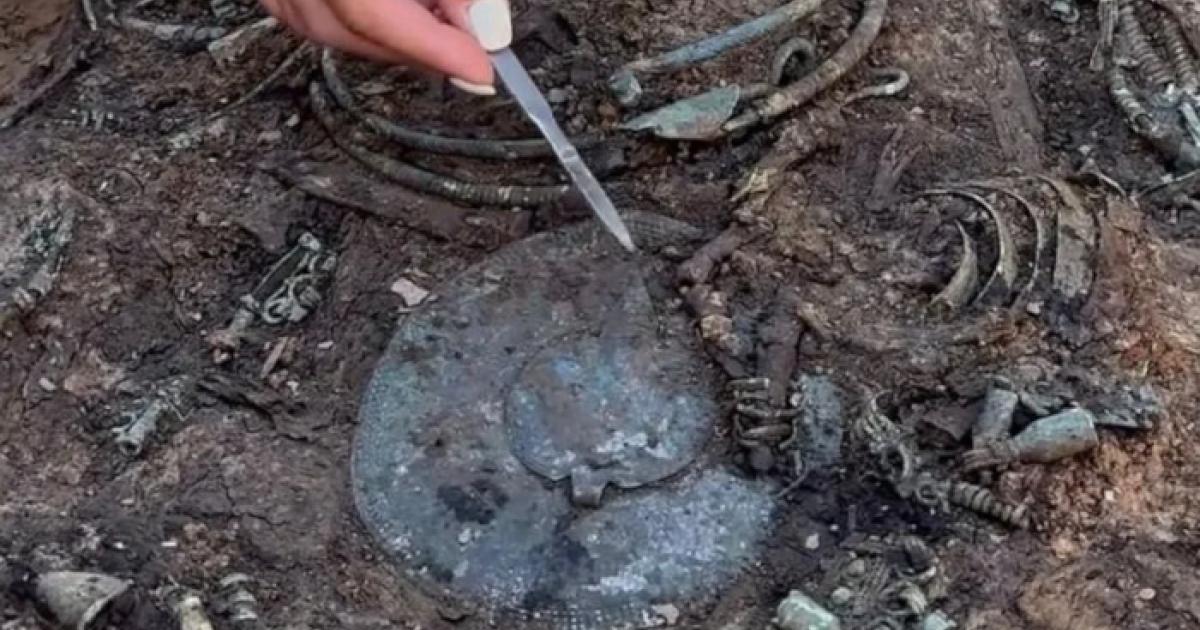

An early medieval Muroma burial ground in western Russia has yielded the discovery of an exquisitely outfitted grave of a young female, which includes an exceptionally stunning silver decoration that was presumably meant to symbolize her transition through the gate for her soul as a part of her burial.
The unique artifact, discovered at the Zvyagino burial site located in the Vachsky District in the Nizhny Novgorod region of Russia, is a sizable disc-shaped silver plate consisting of a smaller circular lid affixed centrally to its body. It is speculated that the lid may have been opened to a certain extent during the burial rites, thus serving to convert the decoration into a door through which departed souls pass.
The burial can be tentatively dated to the late seventh or early eighth century, which makes it one of the earliest graves currently studied at the cemetery. It seems the deceased was a young female who was buried with an ornate ceremonial dress that featured many decorations.
A Young Woman Buried in Ceremonial Dress
Archaeologists recovered elements of a complex headdress, temple rings, a forehead band, leather strips decorated with metal fittings, and two rigid neck rings. Greenish traces of oxidized metal preserved in the soil also revealed the outline of a garment once covered with tiny beads.
According to Anastasia Shvetsova, head of the archaeology sector at the Nizhny Novgorod Museum-Reserve, the headdress may have included decorated cords that crossed above the head. These could have supported a tall textile covering or formed part of an elaborate hairstyle in which strands of hair were wrapped in leather and bronze spirals. When worn, the ornaments may have created a halo-like frame around the woman’s head.
- Rare Artifacts and Full Horse Skin Found in Medieval Siberian Burial
- Medieval Rus Warrior Burials Discovered in Russia
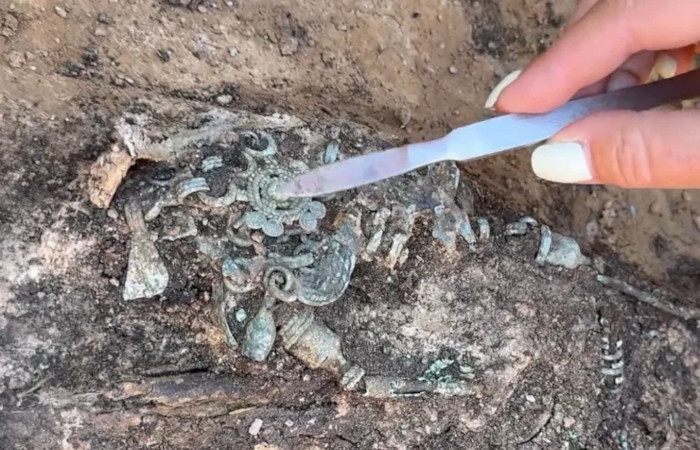
Parts of a complex headdress, temple rings, a forehead band, leather strips decorated with metal fittings and two rigid neck rings. (Nizhny Novgorod Museum-Reserve via VK)
Her shoulder accessories were just as elaborate. Leather straps held clusters of metal ornaments that jingled as she moved. "Rattling" jewelry typifies some Ural-speaking groups in medieval times in the Volga area, but it also could have served visual and spiritual functions.
One of the accessories was a small animal figure of a horse. The exact interpretation is unclear, however, there is no doubt that in Murom tradition, horses were essential elements in burial practices.
Was the Silver Lid Designed for the Escape of the Soul?
The silver lid found near her chest area looks like a brooch but it has an opening in the middle that functions like a door. Shvetsova said archaeologists are considering the object as part of a ritual costume. One interpretation is that the lid represented an opening through which the soul could leave the body and begin its journey into another world.
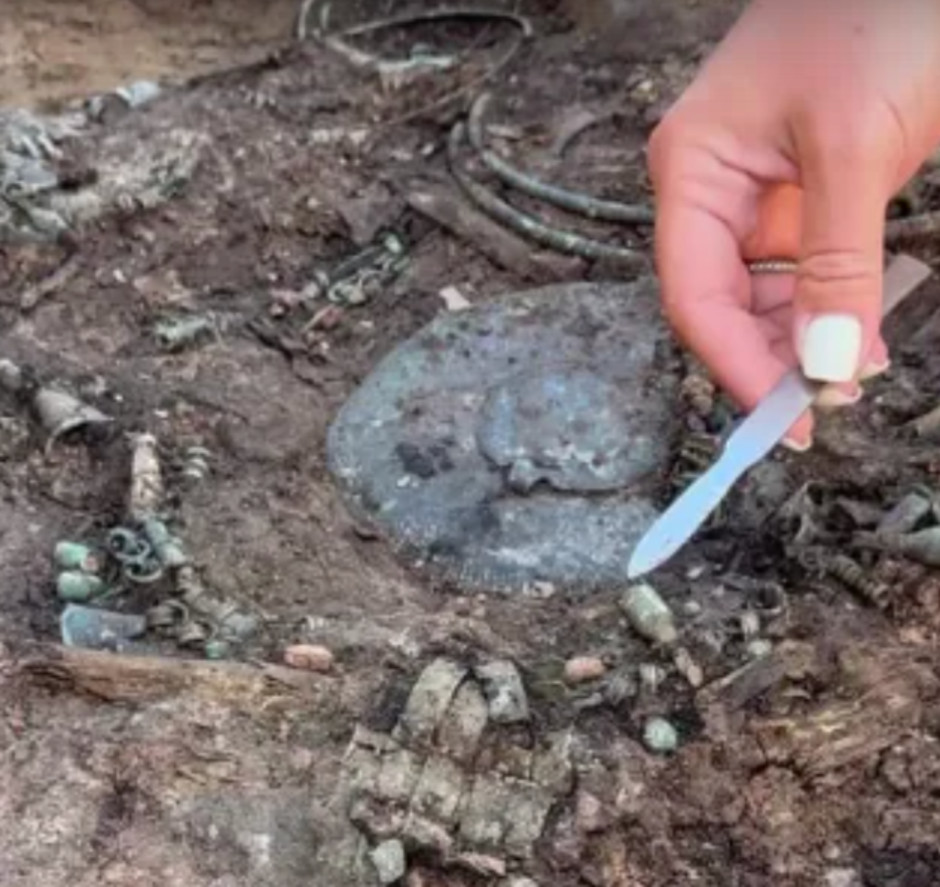
The silver lid’s position, construction, and association with an elaborate ceremonial costume suggest that it was more than a decorative piece. (Nizhny Novgorod Museum-Reserve via VK)
Recent accounts of the excavation suggest that the small cover may have been left slightly open during the funeral ceremony. This reconstruction is plausible, but researchers have not yet presented direct evidence proving exactly how the object was manipulated during the funeral. The “door to the afterlife” should therefore be understood as a working interpretation based on the object’s form and funerary context, not as a fully established fact.
Even so, the plaque provides a rare glimpse into a belief system that survives almost entirely through archaeology. The Muroma left no known written accounts explaining their rituals. Objects placed on the body, the positioning of the dead and the structure of the graves are therefore essential for reconstructing how they understood death.
- Volga Finns Jewelry Hoard Sheds Light On Russia's Prehistory
- Giant 13th-Century Warrior's Saber Unearthed at 'Eagle's Nest' in Russia
An Organized Cemetery with Human and Horse Burials
The Zvyagino cemetery was identified in 2022 after local residents reported illegal digging at the site. Systematic excavations began the following year and are being conducted jointly by the Nizhny Novgorod Museum-Reserve and the Volga Expedition of the Institute of Archaeology of the Russian Academy of Sciences.
The 2026 campaign is concentrating on the northern section of the cemetery, where researchers believe the earliest graves are located. The excavation area contains 42 burials selected for investigation. By mid-July, at least 15 had been examined, while another 11 were being excavated.
The graves were arranged in orderly rows without later burials cutting through earlier ones. Most of the deceased were placed with their heads facing north or northwest, suggesting that the cemetery followed a carefully maintained spatial plan rather than developing randomly. Four of the graves under investigation contained horses. The animals were smaller than most modern horses and appear to have held considerable ritual importance. Horse burials became less common after the tenth and eleventh centuries, making them an important chronological indicator for the cemetery’s earlier phases.
Who Were the Muroma?
The Muroma were a medieval Volga-Finnic people belonging to the wider Uralic-speaking cultural world. They lived mainly around the lower reaches of the Oka River, east of present-day Moscow. They appear briefly in the Primary Chronicle, which lists them among the peoples living along the Oka and notes that they possessed their own language. The modern Russian city of Murom still preserves their name.
Archaeological evidence suggests that Muroma culture flourished between approximately the eighth and tenth centuries, although the latest discoveries at Zvyagino may push the cemetery’s origins back into the seventh century, or potentially even earlier. A type of dress fastener found during the current excavations has parallels dating to the sixth century, but archaeologists caution that such objects could have been inherited before being placed in a later grave.
The Muroma were not an isolated forest community. Finds from their cemeteries include Baltic amber, cowrie shells originating near the Indian Ocean, beads linked to Central Asia and Byzantium, Arab silver dirhams and Western European coins. These objects reveal participation in far-reaching trade networks connecting the Oka River with northern Europe, the Islamic world and routes extending deep into Asia.
By the eleventh century, the material culture of the cemetery began to change. Traditional Muroma ornaments appeared alongside objects associated with the expanding Rus’ world. Researchers interpret this as evidence of prolonged contact and gradual cultural integration rather than sudden conquest or disappearance. By the twelfth century, the Muroma were no longer recorded as a separate people. They were gradually absorbed into the East Slavic population, although elements of their culture may have survived among communities of the Oka region.
The Zvyagino cemetery preserves that transformation across several centuries. Earlier graves contain distinctive Muroma costumes, weapons, horse burials and ritual objects. Later burials display an increasingly mixed cultural identity, making the site one of the most important archaeological records of interaction between medieval Uralic-speaking communities and the emerging Rus’ state.
Top image: Archaeologists recovered elements of a complex headdress, temple rings, a forehead band, leather strips decorated with metal fittings and two rigid neck rings. Source: Nizhny Novgorod Museum-Reserve via VK
By Gary Manners
References
Altuntaş, L. 2026. A Tiny Silver Door to the Afterlife? Richly Furnished Grave of a Teenage Girl Discovered at 1,300-Year-Old Muroma Cemetery. Arkeonews. Available at: https://arkeonews.net/a-tiny-silver-door-to-the-afterlife-richly-furnished-grave-of-a-teenage-girl-discovered-at-1300-year-old-muroma-cemetery/
Ivanova, Y. 2026. Тайны племени мурома продолжает раскрывать Звягинский могильник. Vremyan.ru. Available at: https://www.vremyan.ru/news/607107
Koshechkina, V. 2026. Могильник с десятками захоронений обнаружили в российском регионе. Lenta.ru. Available at: https://lenta.ru/news/2026/07/20/mogilnik-s-desyatkami-zahoroneniy-obnaruzhili-v-rossiyskom-regione/






















