
A chemical study of 91 ancient iron objects suggests that meteorite iron was not merely a rare curiosity in Bronze Age Greece. At least ten rings were probably made with metal that fell from the sky, and their burial contexts indicate that this unusual material may have functioned as a conspicuous badge of power among Minoan and Mycenaean elites. The discovery shows trade, technology, and display meeting in a single object.
Nickel points to a celestial source
The finding comes from Iron in Greece in the second millennium B.C.E., a study by astrophysicist and chemist Matthieu Gounelle and archaeologist Eleni Mantzourani in the Journal of Archaeological Science. Published in August 2026, the research examines a time when iron was still exceptional in the Aegean. The researchers used non-destructive X-ray fluorescence to examine objects from 33 archaeological sites and 15 museums, dating broadly from 3,000 to 4,000 years ago.
Most of the objects were made from smelted terrestrial iron. Thirteen, however, were rings or fragments of rings containing significant nickel, a chemical clue that the metal may have come from meteorites. In the paper’s abstract, nine are described as very likely and one as quite likely to have a meteoritic origin, while three remain less certain; Science News summarizes those ten as probably meteoritic. That distinction matters because meteorite iron naturally contains nickel, unlike most smelted Bronze Age iron.
The result places the Aegean evidence within a much wider history of “heavenly metal.” An ancient Egyptian dagger linked to King Tutankhamun is already known to have been fashioned from meteoritic iron, while meteorite swords and an iron arrowhead from Bronze Age Switzerland show that the material circulated across several ancient societies. Its unusual origin amplified cultural value more than practical utility.

Cut and etched Toluca iron meteorite, an illustrative example of an iron-nickel meteorite (CC BY-SA 3.0)
Rings of status in the Aegean
The archaeological settings strengthen the case that the rings were more than experiments in early metalworking. With one exception—the specimen from the Anemospilia temple on Crete—the nickel-bearing rings came from tholos and chamber tombs, where they lay alongside gold vessels, amber jewelry, and seals carved from stone. Several were signet rings, with broad engraved faces that could have marked identity, authority, or access to a particular social network. Their placement among valuables supports, though does not prove, deliberate elite display.
Science News quoted Mantzourani describing the result as evidence that “meteoritic iron was considered a very precious metal used for producing objects of special value and for a high-status group of people,” probably Minoan and Mycenaean elites. That interpretation fits other evidence of Aegean prestige culture, including the four gold rings from the Tomb of the Griffin Warrior and a Minoan gemstone associated with a powerful Bronze Age warrior. That may explain why this rare material appeared in rings rather than ordinary tools.
- Meteorite Swords Forged from the Fire of the Heavens
- Swiss Scientists Identify Bronze Age Iron Arrowhead Made from Meteorite

The Minoan “Ring of Minos” from Knossos, dated to 1450–1400 BC. (Public Domain)
A fashion that vanished
The study also raises a question about supply. Meteorites are comparatively scarce in Greece and Crete, where many would have fallen into the sea, so Gounelle and Mantzourani propose that the raw material may have arrived through established Bronze Age trade routes from Egypt, whose deserts preserve abundant meteorites. If correct, the rings were not just objects made from a remarkable substance; they were also evidence of long-distance exchange and elite control over rare goods. The Egyptian connection remains a proposal, not a proven source for every ring.
The fashion appears to have ended around the 12th century BC, close to the upheavals that brought down the Mycenaean palace system. As another Ancient Origins report on Arctic meteorite iron shows, knowledge of working metal from space did not disappear everywhere. In the Aegean, however, the rings’ disappearance may reflect the collapse of palatial networks, the loss of Egyptian connections, changing tastes—or simply the difficulty of obtaining a scarce and prestigious material. The evidence suggests a short-lived fashion in which symbolism mattered as much as metal.
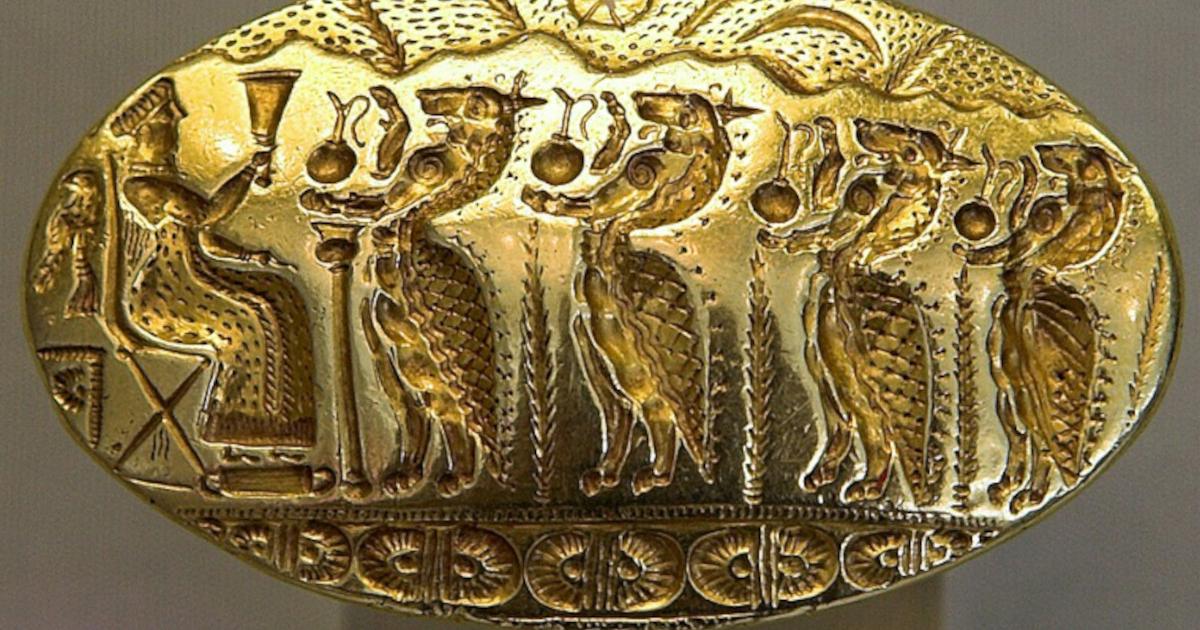
Top image: Mycenaean gold signet ring with a seated goddess and procession of Minoan genii, from Tiryns, Greece, held by the National Archaeological Museum of Athens. This is an illustrative comparison, not one of the nickel-bearing iron rings analyzed in the new study. Source: Zde/ CC BY-SA 3.0
References
Farkas, I. 2026. Metal From Beyond Our World Found in Rings Worn by Ancient Mediterranean Elites. Available at: https://www.sciencealert.com/metal-from-beyond-our-world-found-in-rings-worn-by-ancient-mediterranean-elites
Gounelle, M. and Mantzourani, E. 2026. Iron in Greece in the second millennium B.C.E. Available at: https://www.sciencedirect.com/science/article/abs/pii/S0305440326001524
Metcalfe, T. 2026. Ancient Greek rings may have been forged with iron from meteorites. Available at: https://www.sciencenews.org/article/bronze-age-greek-rings-iron-meteorites