

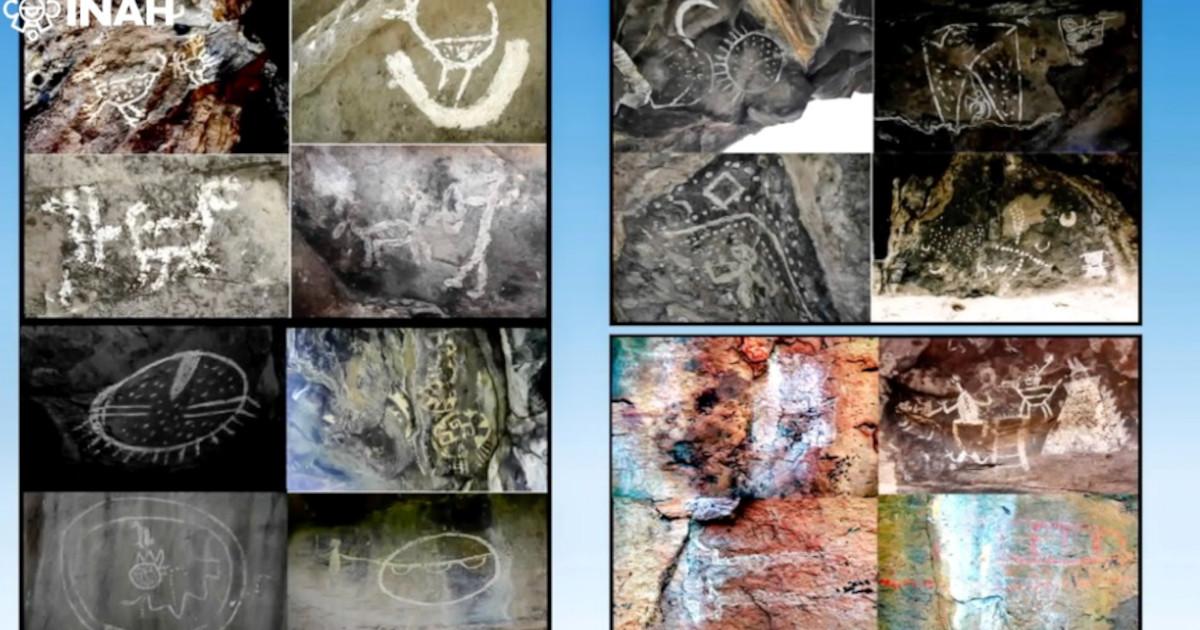

Archaeologist Alfonso Torres Rodríguez has revealed a recurring encounter with the lord of the underworld appearing at least 55 times in Hidalgo rock art in the region north of Mexico City. Spread across 25 sites and mostly dated between 350–750 AD, the scenes demonstrate how ancient communities imagined death as a meeting between people, ancestors, and supernatural powers. The same story might still find resonance during healing rituals around the present-day Otomi shamans.
A Journey Guided by a Canid
In an official release from Mexico’s Ministry of Culture and the National Institute of Anthropology and History (INAH), Torres Rodríguez describes the scenes as a “graphic syntagm.” In simple terms, this means a group of images arranged in a recognizable order, rather than a collection of unrelated marks. One or two warrior-like figures are often led by a canid (dog, wolf, fox etc) toward a being connected with the moon, a funerary bundle, descent, or an ancient subterranean place.
This type of pattern has been observed in Huapalcalco, Xihuingo, Dahñé, San Miguel de las Piedras, and other sites in the state. Torres Rodríguez identified four types of setups: one visitor meeting one being, one visitor meeting two beings, two visitors meeting one being, and two confronting two. According to Ancient Origins’ Xolotl article, the dog and the twin figures hold significant positions in the later Aztec mythology regarding the journey through the underworld, although the images from Hidalgo should not be identified with just one, specific Aztec god.
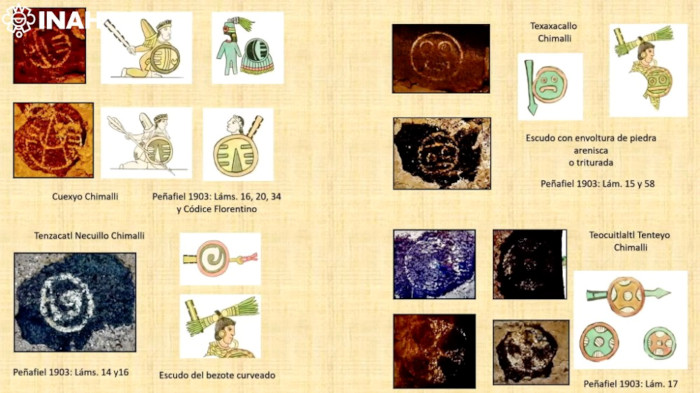
Rock-art motifs from between 350-750 AD associated with the Hidalgo research. (INAH).
Three Faces of the Underworld
According to Torres Rodríguez, the figures identified can be categorized into three principal iconographic groups. The first group, termed the Tezcatlipoca-Huémac-Yaotl, includes characters with warrior qualities, snakeskin, and unusually broad hands. The second group - Otontecuhtli-Tlotli-Mictlantecuhtli - revolves around a seated figure indicating a divine connection to traditions of highland Otomi communities. The final group consists of pairs of ancestors, thereby indicating that the dead had an active role participating in a continuing relationship with the living.
Regional distinctions contribute an additional aspect to the interpretation. Scenes involving two main characters are frequently found in eastern and southern mountain areas. The Mezquital Valley offers more representations of a lone visitor meeting one or two other beings, which is similar to ways scholars now read sequences in Maya art. In this case, the location of the figures and their relationship might imbue them with meanings that surpass the significance of each individual representation.
- Chichen Itza's Shadows: Unexpected Light Shed on Ancient Maya
- Sacrifice and Destruction: The Apocalyptic Aztec Creation Myths
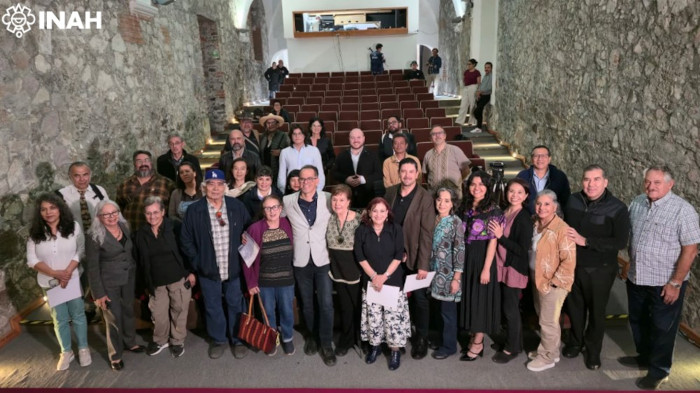
Group of speakers and authorities at the X International Colloquium on History, Architecture, Sculpture, Urbanism, and Funeral Customs. (INAH / Sergio García)
Twins, Transformation and Living Memory
Twinship is central to Torres Rodríguez’s interpretation, but the paired figures are not identical copies. Their differences suggest complementary forces: one brother is masculine, martial, solar, and military, while the other is feminine, sacrificial, lunar, and agricultural. That balance recalls the wider Mesoamerican habit of expressing whole systems through paired opposites, as seen in the Hero Twins’ descent into Xibalba in the Popol Vuh.
The most provocative analogy goes into the present. There is an Otomi bädi, or healer, found in the mountains of Mexico, whose belief is that in order to connect with the supernatural or other world, one must possess duality of the soul or “double heart”. According to Torres Rodríguez: “If it does not have the character of twinship, it cannot come into contact with the force of the underworld,” although he adds that the encounter can recover nzahki, or “great force,” and eventually become an alliance.
The comparison does not prove tradition remained unchanged across 1,500 years, but it does illustrate why rock art is more than isolated symbols: it preserves a visual script for thinking about death, memory, and transformation. As Ancient Origins’ discussion of Chichén Itzá’s underworld gateways notes, caves, cenotes, and ritual spaces could be points of contact between the human world and the realm below.
The INAH colloquium ended on September 11, 2026, with discussion of death, memory, and funerary heritage. The Hidalgo scenes give that discussion a particularly vivid subject: a story carved and painted across a landscape, where a guided traveler approaches the dead and returns carrying the possibility of renewed strength.
Top image: Landscape collage of rock-art panels documented in Hidalgo. Source: INAH
By Gary Manners
References
Bartek, J. 22 September 2026. Meeting The Lord Of The Underworld: A Mesoamerican Myth Depicted In Hidalgo Rock Art. Available at: https://www.ancientpages.com/2026/09/22/meeting-the-lord-of-the-underworld-a-mesoamerican-myth-depicted-in-hidalgo-rock-art/
Fery, G. 21 February 2020. Chichen Itza's Shadows: Unexpected Light Shed on Ancient Maya. Available at: /ancient-places-americas/chichen-itza-shadow-0013319
Milligan, M. 17 September 2026. Ancient rock art in Hidalgo reveals enduring myth of journey to the underworld. Available at: https://www.heritagedaily.com/2026/09/ancient-rock-art-in-hidalgo-reveals-enduring-myth-of-journey-to-the-underworld/159311
Secretaría de Cultura. 14 September 2026. Examinan el mito de la visita al señor del inframundo en la gráfica rupestre de Hidalgo. Available at: https://www.gob.mx/cultura/prensa/examinan-el-mito-de-la-visita-al-senor-del-inframundo-en-la-grafica-rupestre-de-hidalgo?tab=
Wu, M. 29 April 2018. Xolotl – The Underworld Dog God of the Aztecs. Available at: /myths-legends-americas/xolotl-underworld-dog-god-aztecs-009970






















