
Fact Check verdict: Disputed. The Merneptah Stele confirms the Bible.
A post shared widely on X on October 26, 2026 calls the Merneptah Stele "one of the most important confirmations of the Bible ever found." For many readers of scripture the stele matters, and it deserves to. How much of the post does the stone itself support?
According to the scholars consulted, the core of the post is right. The stele names Israel as a people in Canaan around 1208 BCE, the earliest secure mention outside the Bible. Claims about the Exodus, the conquest and the hill country go further than its one line can carry, and scholars disagree over what it means for the Bible.
What the evidence says
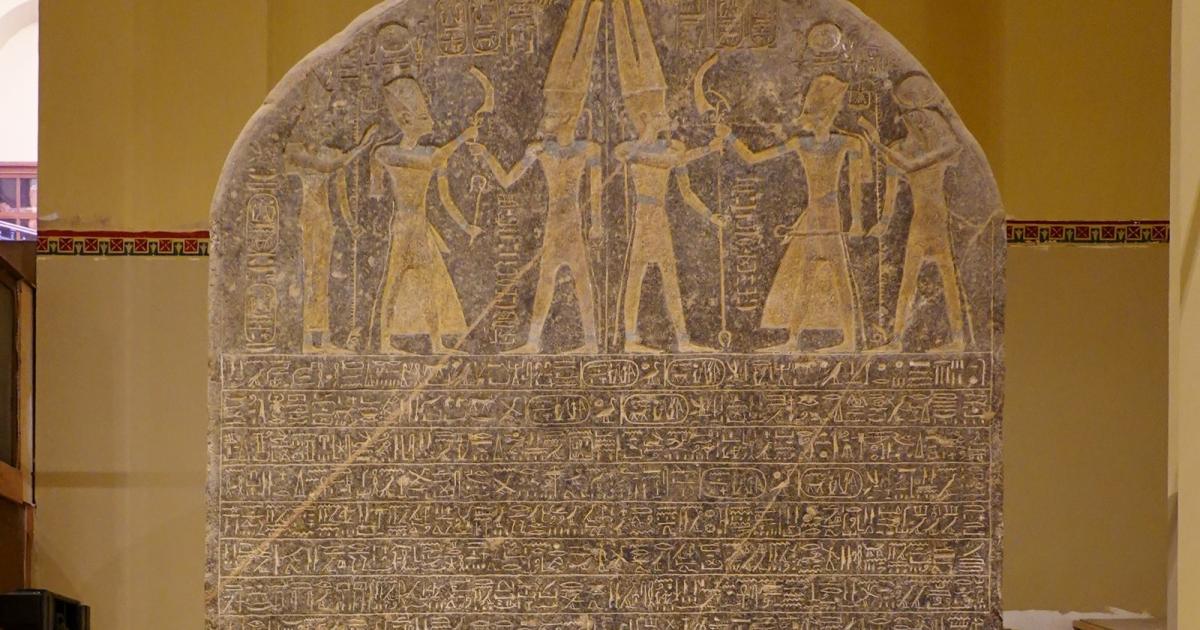
The stele is a granite slab in the Egyptian Museum in Cairo, catalogued as JE 31408. According to the Global Egyptian Museum record, it carries a 28-line hymn celebrating Merneptah's victory over the Libyans in his fifth regnal year, carved on a stele reused from the mortuary temple of Amenhotep III.
James Henry Breasted, writing in 1906, records the text "On a stela discovered by Petrie in the ruins of Merneptah's mortuary temple at Thebes, in 1896". Only the closing lines turn to Canaan. His translation, dated to "Year 5, third month of the third season," names Ashkelon, Gezer and Yenoam, then says Israel "is desolated, his seed is not" in the stele's line 27.
The post's wording, "Israel is laid waste" and "its seed is no more," is close to modern renderings such as Josh Meynell's for Tyndale House. Kenneth Kitchen puts Merneptah's Year 5 at 1209/1208 BCE, Israel Finkelstein and Neil Asher Silberman date the stele to 1207 BCE and Meynell to around 1200 BC, so the post's 1208 BC sits within the range scholars give.
Breasted called it the earliest mention of Israel then known in literature. In 2010 Peter van der Veen, Christoffer Theis and Manfred Görg described it as "the only mention of Israel in any extant Egyptian text" apart from the Berlin name they proposed. Finkelstein and Silberman, who doubt much of the conquest story, accept that a "group known as Israel was already in Canaan by that time."
The post is also right that Israel stands apart from the cities beside it, for the wrong reason. It says the name is "written in masculine form, which in ancient Egyptian grammar means a people." The sources rest the point on the determinative, a sign scribes added after a name to show what kind of thing it was. Meynell explains that the throw stick marks foreigners, and that a seated man and woman and three strokes are "used together to indicate something like" a large group of people.
Ashkelon and the other names carry a different sign, "three hills, which is used to designate a foreign" land, in Meynell's words. The museum record says: "The name refers to the people and not to the state, like other localities mentioned on the stela." No source consulted argues from masculine and feminine endings, so that detail is unverified.
The post also says the stele places Israel in the land "shortly after Joshua's death" and confirms that the conquest had begun, that the tribes lived in the hill country and that "Egypt's chariots could not reach them there". The inscription names no leader, no tribe, no hill country and no chariots. The link to the period of the Judges is a reading the stone allows without stating.
Breasted also urged caution. He wrote that the assertion of victory over Israel "is so brief and bald that little can be drawn from it," and that "his seed is not" was "a conventional phrase applicable to any defeated and plundered people." He still judged that "there can be no doubt that Israel there suffered defeat and pillage at his hands." Finkelstein and Silberman are blunter: "The boast was clearly an empty one".
Some readers name Merneptah as the pharaoh of the Exodus. The museum record answers: "The occurrence of this word indicated to some scholars that this king is the pharaoh of the Exodus but there is no evidence to prove that." Meynell notes that all mainstream views on the date of the Exodus place the Israelites in Canaan by Merneptah's reign, so the stele marks a later point.
The alternative view
The liveliest debate is whether the stele is the first mention. In 2001 Görg proposed that a broken name ring on a granite pedestal relief in Berlin, numbered 21687, could be an early spelling of Israel. The slab, acquired by Ludwig Borchardt in 1913, lists the name beside Ashkelon and Canaan.
Van der Veen, Theis and Görg argue that Israel "remains the most logical candidate" for the broken name, and they tentatively date the relief to the reign of Ramesses II or earlier, possibly copied from an older list.
As van der Veen and his coauthors report, James Hoffmeier rejected the reading and argued that the spelling raises "serious linguistic and orthographic problems that preclude it from being Israel," chiefly because the Berlin name uses a different s sound from the one on Merneptah's stele. The authors reply that the name is attested as a personal name in Bronze Age texts with that sound and that Egyptian spellings of foreign sibilants were not always consistent. They concede that their proposal "will need to be supported by additional archaeological and epigraphic evidence."
Meynell sees the reference as fitting the period of the Judges, when the text presents Israel as a people living in tents. Finkelstein and Silberman argue that the biblical account, the archaeology and the Egyptian records fail to fit a large conquest, since the stele says only that this "obscure people, living in Canaan, had suffered a crushing defeat."
Where this leaves it
According to the sources consulted, the Merneptah Stele is an important witness. It shows that a people called Israel lived in Canaan in Merneptah's fifth year, and that Egypt thought them worth naming beside Ashkelon and Gezer. For readers of Judges that date carries weight, and Meynell sees in it "one more pointer to the trustworthiness of the biblical narrative."
The stele on its own does not confirm the Exodus, the conquest or the whole biblical account, and on those questions scholars still disagree. Its single line on Israel is indicative rather than conclusive. The claims built on grammatical gender, the hill country and chariots remain less secure than the plain fact the stone records: Israel was there.
How we checked this
Read for this check: the Global Egyptian Museum record, Breasted's 1906 translation and commentary, the 2010 article by van der Veen, Theis and Görg, and Meynell's 2024 article. Finkelstein and Silberman's The Bible Unearthed (2001) and Kitchen's page 164 were read in Internet Archive scans. Hoffmeier's objection and Görg's 2001 article are known here only as summarized by van der Veen and his coauthors.
No interviews were conducted, earlier Ancient Origins coverage was not used as a source, and every quote was checked against a saved copy on October 27, 2026.
How we label claims: see How we check evidence.
More in this series: Göbekli Tepe, the Sphinx and Atlantis: what the evidence says.
The upper part of the Merneptah Stele in the Egyptian Museum in Cairo. The name Israel appears in line 27 of the hymn, near the foot of the stone and below the area shown here. Olaf Tausch, via Wikimedia Commons. Licensed under Creative Commons Attribution 3.0 Unported (CC BY 3.0), cropped
By Aris Manus
Claim by claim
- Disputed: The Merneptah Stele confirms the Bible. Reason: it confirms that a people called Israel lived in Canaan by Merneptah's fifth year, and scholars disagree over how far that supports the wider biblical account.
- Established: The stele names Israel, the earliest secure mention outside the Bible. Reason: Breasted and Finkelstein and Silberman call it the earliest mention, and the one earlier name proposed remains disputed.
- Established: Israel is marked as a people, unlike the cities beside it. Reason: the name carries the determinative for a group of people, where Ashkelon, Gezer and Yenoam carry the sign for a foreign land.
- Unverified: The name's masculine grammar shows Israel was a people. Reason: no source consulted argues from grammatical gender, and the sources rely on the determinative.
- Disputed: A Berlin pedestal names Israel even earlier. Reason: Görg, van der Veen and Theis argue for the reading, and Hoffmeier rejects it on linguistic grounds.
- Unverified: It confirms the conquest, the hill country settlement and the chariot detail. Reason: none appears in the inscription.
Sources
- Global Egyptian Museum. Stela of Merenptah (Israel Stela), Egyptian Museum, Cairo, JE 31408. Collection record.
- Breasted, James Henry (1906). Ancient Records of Egypt, Volume III: The Nineteenth Dynasty. Chicago: University of Chicago Press. Sections on the Israel Stela of Merneptah.
- van der Veen, Peter, Christoffer Theis and Manfred Görg (2010). Israel in Canaan (Long) Before Pharaoh Merenptah? A Fresh Look at Berlin Statue Pedestal Relief 21687. Journal of Ancient Egyptian Interconnections 2 (4): 15 to 25.
- Meynell, Josh (2024). Artefact in focus: Merneptah Stele. Tyndale House, June 14, 2024.
- Finkelstein, Israel, and Neil Asher Silberman (2001). The Bible Unearthed: Archaeology's New Vision of Ancient Israel and the Origin of Its Sacred Texts. New York: Free Press. Read in an Internet Archive scan.
- Kitchen, Kenneth A. (2003). On the Reliability of the Old Testament. Grand Rapids: Eerdmans. Page 164, read in an Internet Archive scan.
- Imtiaz Mahmood (@ImtiazMadmood), post on X, October 26, 2026. Used only for the claims tested.