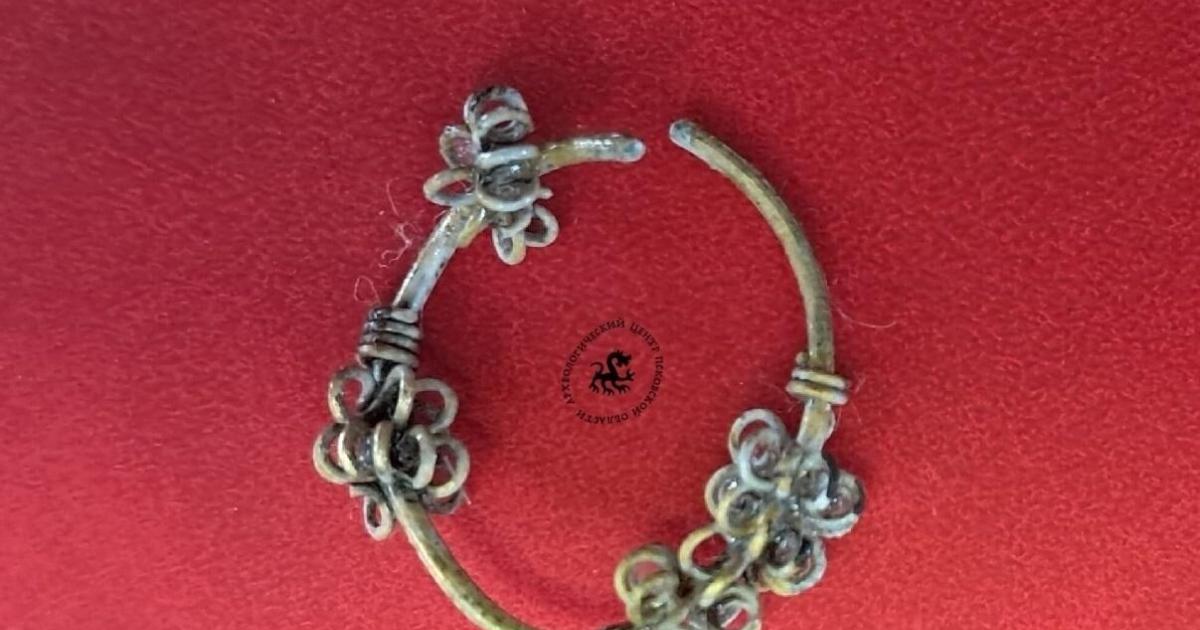

A unique Balkan-style ring was uncovered during the recent field excavation season at the Olginsky-10 archaeological site within the historic district of Zavalyhe, located directly across the Velikaya River from Pskov’s medieval center. After excavation, conservators at the Pskov region Archaeological Center carefully cleaned and restored the object, revealing its original appearance and quite delicate spiral-wire decoration. This archaeological discovery is particularly noteworthy because all three Balkan-style temple rings that have been found in Pskov previously have also come from the same excavation sites dating to from the 11th to 13th centuries. This suggests the ornament, while still extremely uncommon, was still present in the city during its medieval flourishing.
- DNA Reveals How the Slavic Migration Reshaped Central and Eastern Europe
- Between the Hammer and Anvil: The Life of Grand Prince Alexander Nevsky
Purpose of Temple Ring
Where finger rings serve as a testament to one’s personality, status, relationships, and cultural identity, temple rings were actually suspended near sacred temples or even put into braided hair. These rings often served as select markers of cultural identity, regional fashion, and social status, not to mention being quite common among Slavic peoples between the 8th and 12th centuries, although different styles varied widely from region to region. The newly restored ring belongs to a specific Balkan-type denoted by its decorative spiral-twisted wire. This set style is concentrated principally in the Danube Basin and the Balkan Peninsula, making its appearance in northwestern Russia quite unusual.
- How the Rise and Fall of the Roman Empire Shifted Populations
- The Kievan Rus’ – When Vikings and Slavs Cooperated to Shape History
Rare Find in Eastern Europe
Researchers have found that discoveries of similar Balkan-style temple rings outside southeastern Europe are very uncommon, making this Pskov specimen an incredible addition to the archaeological record of medieval Eastern Europe. This restored ornament mostly consists of a metal ring decorated with tightly wound spiral wire, a manufacturing technique most often linked with jewelry traditions of the Balkans. Restoration has also exposed certain details which had been obscured by corrosion, allowing specialists to classify this specific ring within this rare group of jewelry.
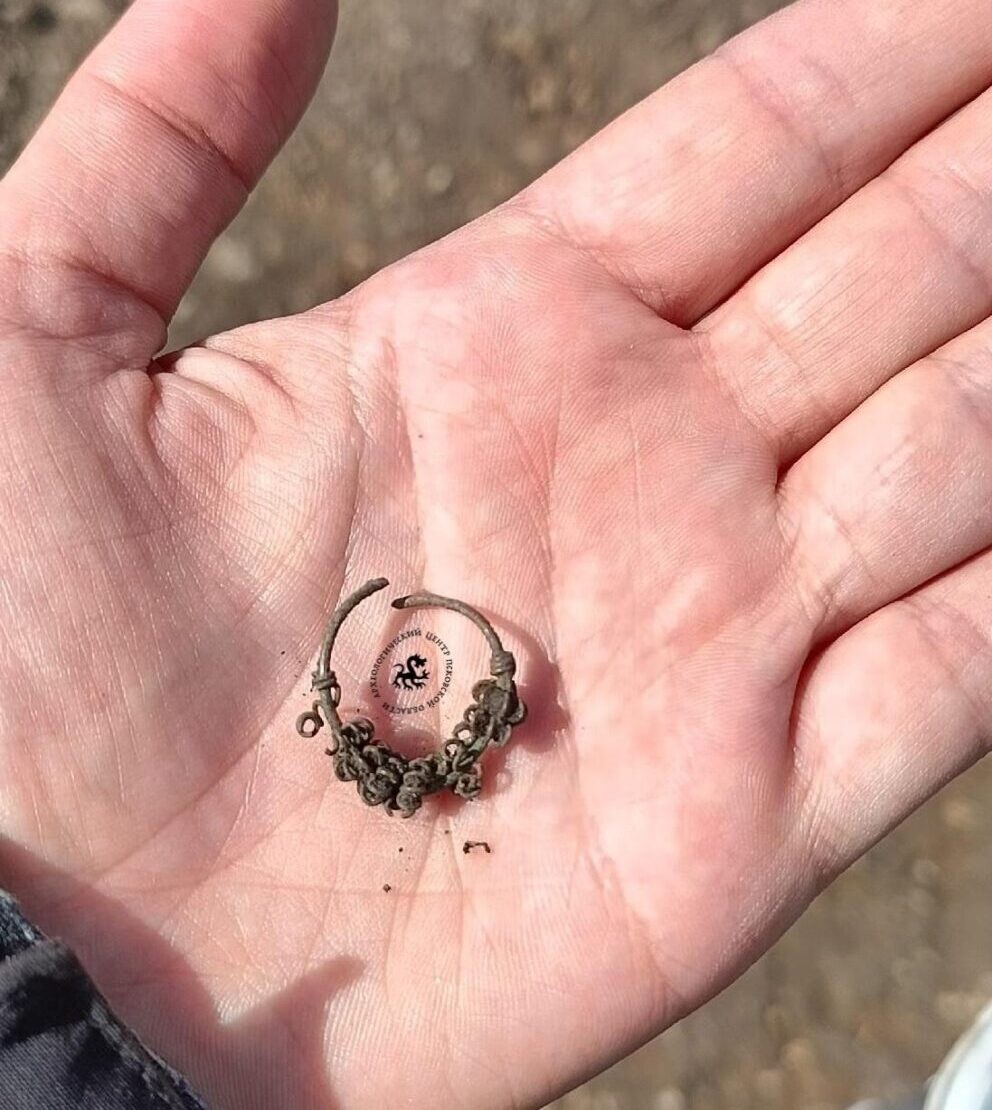
Rare Balkan-style silver temple ring discovered during excavations at the Olginsky-10 archaeological site in the Zavelychye district of Pskov, Russia. The ornament belongs to a rare class of spiral-decorated Slavic temple rings associated with Byzantine and Danube-Balkan jewelry traditions and dates broadly to the 11th–13th centuries. Its discovery provides evidence for long-distance cultural connections between the Balkans and medieval northwestern Rus'. (Pskov Region Archaeological Center)
How Did the Ring Reach Pskov?
Archaeologists believe the ring’s presence in Pskov actually shows long-distance contacts rather than simply relying on local production. Different explanations have been proposed but can mainly be broken down into four separate categories: Commercial exchange throughout various trade routes, migratory patterns of individuals or families from the Balkans, diplomatic or ecclesiastical connections between Rus’ and the Byzantine sphere of influence, and finally personal possessions carried by travelers or merchants alike. Although no single theory can be confirmed, the discovery itself demonstrates that Pskov was able to participate in extensive networks connecting the principalities of the Northern Rus’ with southeastern Europe.
- How Byzantine Art and Architecture Captivated the Known World
- When Vikings Come to Rule: The History of the Rurik Dynasty
Pskov’s Role in Medieval Trade
From the 11th to 13th centuries, the medieval city of Pskov was an integral commercial center at the crossroads between Scandinavia, the Baltic Region, Novgorod, and the Byzantine Empire. Merchants travelling these lucrative routes exchanged not only goods but also breathtaking artistic styles, technologies, and cultural traditions. The Balkan temple ring has been provided evidence that, in fact, luxury ornaments or the people who came to wear them could travel hundreds of miles across medieval Europe, illustrating the interconnected nature of the period.
- Border Change Causes Cultural Destruction of the Seto People
- Cyril and Methodius - Spiritual Fathers of Slavic Civilization
Scholarly Context
This particular discovery also supports earlier research proposed by archaeologist Yulia V. Stepanova, who has also studied the distribution of similar Balkan-type temple rings throughout what once constituted the territory of Medieval Rus’. Her work demonstrated that these ornaments are mainly concentrated in the Balkans and the Danube region, with only certain isolated examples appearing farther north. The Pskov ring can then be seen to represent an exceptional example of cultural transmission across much of Eastern Europe.
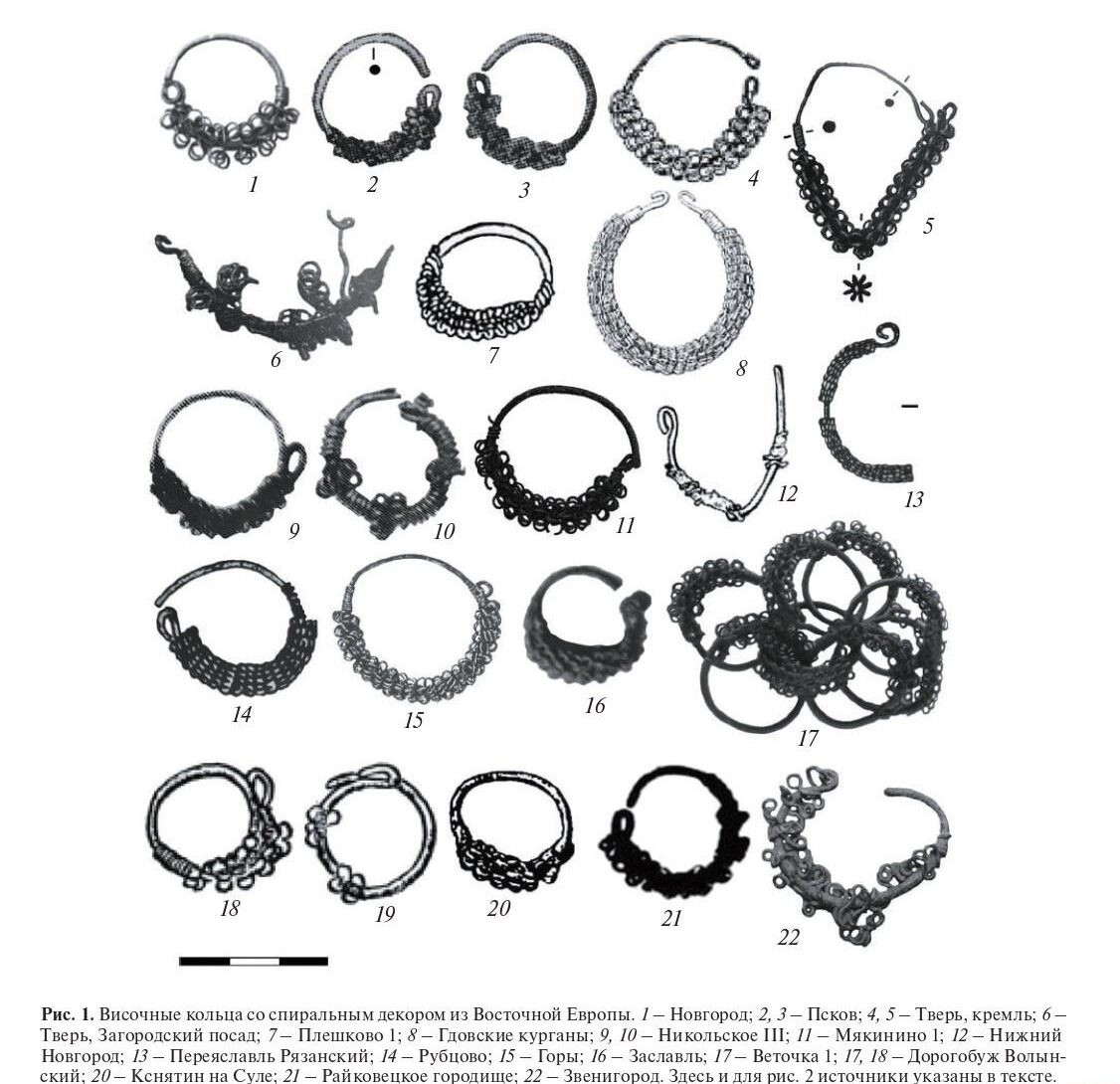
Comparative typology of spiral-decorated medieval Slavic temple rings recovered from archaeological sites across Eastern Europe. The illustration demonstrates the close morphological similarities between finds from Pskov and related examples from Novgorod, Belarus, Ukraine, and the Danube-Balkan region, supporting their interpretation as part of a wider Byzantine-inspired jewelry tradition. (Russian Academy of Sciences/Russian Archaeology)
Rethinking Medieval Pskov’s Forgotten Neighborhood
For a long period of time, the peripheral suburb outside of Pskov’s medieval center, Zavelyche, has been reinterpreted by archaeologists as a truly thriving urban district in its own right. Ongoing excavations held at the Olginsky-10 site have continued to uncover much evidence of medieval occupation - including but not limited to homes, workshops, imported goods, personal ornaments, and traces of everyday commerce. This demonstrates that the neighborhood was closely interlinked with the city’s economic as well as its social life rather than simply existing on the margins.
More than Jewelry: The True Meaning Behind Medieval Temple Rings
These temple rings were a distinct form of personal adornment used by women throughout much of the medieval Slavic world, dating from the 8th to 13th centuries. Rather than being worn on the fingers, these ornaments came to be held from a headdress, attached to ribbons, or woven into braided hair so they hung beside the temples-giving the jewelry its modern archaeological name. Styles varied quite widely region to region, with not only different shapes but also decorative motifs and manufacturing techniques which often served as markers of local identity, cultural affiliation, or social status.
- Revolutionary Discovery Reveals Viking Silver Hoards' Global Links
- The First Crusade: Christian and Muslim Bloodshed as Peasants, Princes, and Turks Clash in the Holy Land
Some women even wore simple bronze or silver wire crafted into loops, while others came to feature elaborate spiral decorations, pendants, or beadwork. Because temple rings were closely linked with certain cultural traditions, archaeologists can use them as markers for both chronological and geographic categories. This aids in tracing patterns of migration, trade, and cultural exchange across much of medieval Eastern Europe. The rare Balkan-style ring excavated in the city of Pskov represents not just a piece of beautiful jewelry but is also evidence that certain personal ornaments could travel vast distances alongside merchants, pilgrims, and migrants.
Top Image: Rare Balkan-style silver temple ring excavated at the Olginsky-10 site in Pskov, Russia. Source: Pskov Region Archaeological Center
By Ramsey Hardin
References
Altuntaş, Leman. “Rare Balkan-Style Temple Ring Found in Pskov, Only the Third from the Medieval City.” Arkeonews, July 31, 2026. Accessed August 3, 2026.https://arkeonews.net/rare-balkan-style-temple-ring-found-in-pskov-only-the-third-from-the-medieval-city/
Stepanova, Iuliia. “Temporal Rings with Spiral Ornamentation: The Spreading Area and Chronology.” Russian Archaeology, no. 4 (2021): 119–131. https://doi.org/10.31857/S086960630010200-9.
“A temple ring with spiral décor was discovered in the excavation by Pskov archaeologists”. InformPskov. Available at: Височное кольцо со спиральным декором обнаружили в раскопе псковские археологи
A unique Balkan-style ring was uncovered during the recent field excavation season at the Olginsky-10 archaeological site within the historic district of Zavalyhe, located directly across the Velikaya River from Pskov’s medieval center. After excavation, conservators at the Pskov region Archaeological Center carefully cleaned and restored the object, revealing its original appearance and quite delicate spiral-wire decoration. This archaeological discovery is particularly noteworthy because all three Balkan-style temple rings that have been found in Pskov previously have also come from the same excavation sites dating to from the 11th to 13th centuries. This suggests the ornament, while still extremely uncommon, was still present in the city during its medieval flourishing.
- DNA Reveals How the Slavic Migration Reshaped Central and Eastern Europe
- Between the Hammer and Anvil: The Life of Grand Prince Alexander Nevsky
Purpose of Temple Ring
Where finger rings serve as a testament to one’s personality, status, relationships, and cultural identity, temple rings were actually suspended near sacred temples or even put into braided hair. These rings often served as select markers of cultural identity, regional fashion, and social status, not to mention being quite common among Slavic peoples between the 8th and 12th centuries, although different styles varied widely from region to region. The newly restored ring belongs to a specific Balkan-type denoted by its decorative spiral-twisted wire. This set style is concentrated principally in the Danube Basin and the Balkan Peninsula, making its appearance in northwestern Russia quite unusual.
- How the Rise and Fall of the Roman Empire Shifted Populations
- The Kievan Rus’ – When Vikings and Slavs Cooperated to Shape History
Rare Find in Eastern Europe
Researchers have found that discoveries of similar Balkan-style temple rings outside southeastern Europe are very uncommon, making this Pskov specimen an incredible addition to the archaeological record of medieval Eastern Europe. This restored ornament mostly consists of a metal ring decorated with tightly wound spiral wire, a manufacturing technique most often linked with jewelry traditions of the Balkans. Restoration has also exposed certain details which had been obscured by corrosion, allowing specialists to classify this specific ring within this rare group of jewelry.
Rare Balkan-style silver temple ring discovered during excavations at the Olginsky-10 archaeological site in the Zavelychye district of Pskov, Russia. The ornament belongs to a rare class of spiral-decorated Slavic temple rings associated with Byzantine and Danube-Balkan jewelry traditions and dates broadly to the 11th–13th centuries. Its discovery provides evidence for long-distance cultural connections between the Balkans and medieval northwestern Rus'. (Pskov Region Archaeological Center)
How Did the Ring Reach Pskov?
Archaeologists believe the ring’s presence in Pskov actually shows long-distance contacts rather than simply relying on local production. Different explanations have been proposed but can mainly be broken down into four separate categories: Commercial exchange throughout various trade routes, migratory patterns of individuals or families from the Balkans, diplomatic or ecclesiastical connections between Rus’ and the Byzantine sphere of influence, and finally personal possessions carried by travelers or merchants alike. Although no single theory can be confirmed, the discovery itself demonstrates that Pskov was able to participate in extensive networks connecting the principalities of the Northern Rus’ with southeastern Europe.
- How Byzantine Art and Architecture Captivated the Known World
- When Vikings Come to Rule: The History of the Rurik Dynasty
Pskov’s Role in Medieval Trade
From the 11th to 13th centuries, the medieval city of Pskov was an integral commercial center at the crossroads between Scandinavia, the Baltic Region, Novgorod, and the Byzantine Empire. Merchants travelling these lucrative routes exchanged not only goods but also breathtaking artistic styles, technologies, and cultural traditions. The Balkan temple ring has been provided evidence that, in fact, luxury ornaments or the people who came to wear them could travel hundreds of miles across medieval Europe, illustrating the interconnected nature of the period.
- Border Change Causes Cultural Destruction of the Seto People
- Cyril and Methodius - Spiritual Fathers of Slavic Civilization
Scholarly Context
This particular discovery also supports earlier research proposed by archaeologist Yulia V. Stepanova, who has also studied the distribution of similar Balkan-type temple rings throughout what once constituted the territory of Medieval Rus’. Her work demonstrated that these ornaments are mainly concentrated in the Balkans and the Danube region, with only certain isolated examples appearing farther north. The Pskov ring can then be seen to represent an exceptional example of cultural transmission across much of Eastern Europe.
Comparative typology of spiral-decorated medieval Slavic temple rings recovered from archaeological sites across Eastern Europe. The illustration demonstrates the close morphological similarities between finds from Pskov and related examples from Novgorod, Belarus, Ukraine, and the Danube-Balkan region, supporting their interpretation as part of a wider Byzantine-inspired jewelry tradition. (Russian Academy of Sciences/Russian Archaeology)
Rethinking Medieval Pskov’s Forgotten Neighborhood
For a long period of time, the peripheral suburb outside of Pskov’s medieval center, Zavelyche, has been reinterpreted by archaeologists as a truly thriving urban district in its own right. Ongoing excavations held at the Olginsky-10 site have continued to uncover much evidence of medieval occupation - including but but not limited to homes, workshops, imported goods, personal ornaments, and traces of everyday commerce. This demonstrates that the neighborhood was closely interlinked with the city’s economic as well as its social life rather than simply existing on the margins.
More than Jewelry: The True Meaning Behind Medieval Temple Rings
These temple rings were a distinct form of personal adornment used by women throughout much of the medieval Slavic world, dating from the 8th to 13th centuries. Rather than being worn on the fingers, these ornaments came to be held from a headdress, attached to ribbons, or woven into braided hair so they hung beside the temples-giving the jewelry its modern archaeological name. Styles varied quite widely region to region, with not only different shapes but also decorative motifs and manufacturing techniques which often served as markers of local identity, cultural affiliation, or social status.
- Revolutionary Discovery Reveals Viking Silver Hoards' Global Links
- The First Crusade: Christian and Muslim Bloodshed as Peasants, Princes, and Turks Clash in the Holy Land
Some women even wore simple bronze or silver wire crafted into loops, while others came to feature elaborate spiral decorations, pendants, or beadwork. Because temple rings were closely linked with certain cultural traditions, archaeologists can use them as markers for both chronological and geographic categories. This aids in tracing patterns of migration, trade, and cultural exchange across much of medieval Eastern Europe. The rare Balkan-style ring excavated in the city of Pskov represents not just a piece of beautiful jewelry but is also evidence that certain personal ornaments could travel vast distances alongside merchants, pilgrims, and migrants.
Top Image: Rare Balkan-style silver temple ring excavated at the Olginsky-10 site in Pskov, Russia. Source: Pskov Region Archaeological Center
By Ramsey Hardin
References
Altuntaş, Leman. “Rare Balkan-Style Temple Ring Found in Pskov, Only the Third from the Medieval City.” Arkeonews, July 31, 2026. Accessed August 3, 2026.https://arkeonews.net/rare-balkan-style-temple-ring-found-in-pskov-only-the-third-from-the-medieval-city/
Stepanova, Iuliia. “Temporal Rings with Spiral Ornamentation: The Spreading Area and Chronology.” Russian Archaeology, no. 4 (2021): 119–131. https://doi.org/10.31857/S086960630010200-9.
“A temple ring with spiral décor was discovered in the excavation by Pskov archaeologists”. InformPskov. Available at: Височное кольцо со спиральным декором обнаружили в раскопе псковские археологи