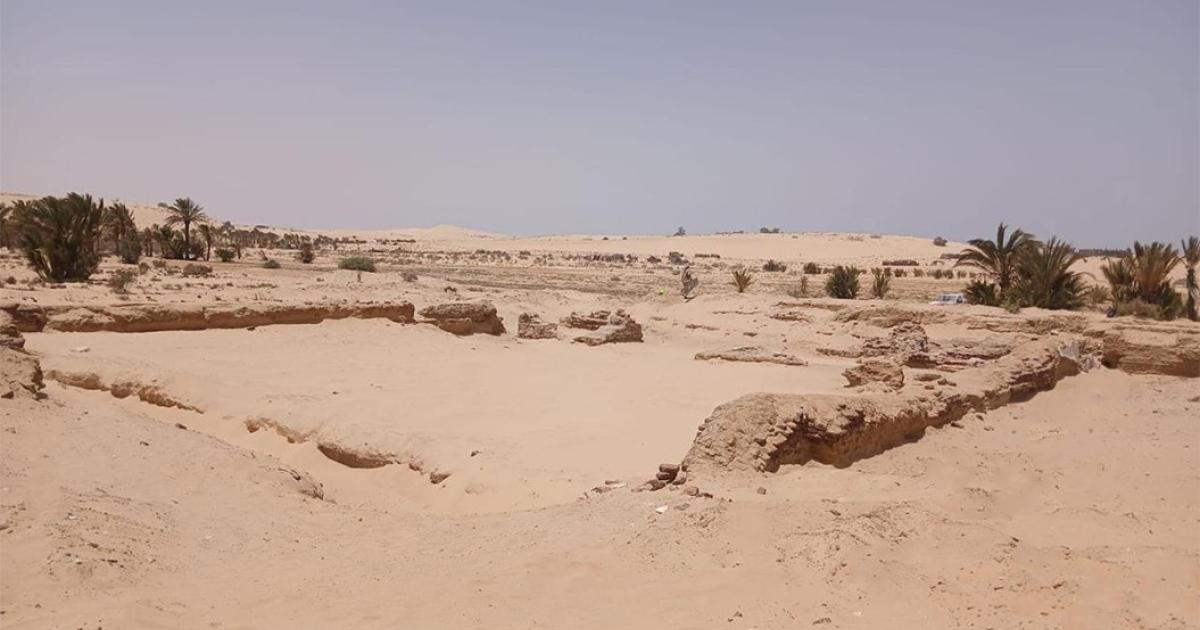

Egypt’s Ministry of Tourism and Antiquities has announced the discovery of the remains of a substantial building in the lost city of Asila in North Sinai, believed to have functioned as a roadside khan or caravanserai serving travelers along one of Egypt’s historic routes.
Ancient Caravanserai Emerges From the Sands of the North Sinai
Excavators from the Supreme Council of Antiquities’ North Sinai Islamic and Coptic Antiquities Department uncovered the foundations of a substantial building believed to have served as a caravanserai, a roadside inn or rest stop for merchants, pilgrims, soldiers, and postal couriers who could shelter, trade, and resupply during their grueling journeys.
- A History of Islam: The Second Largest Religion in Today’s World Began With a Divine Revelation
- Ten Stunning Yet Little Known Ancient Treasures Across Africa

Some of the buildings that are emerging from the sand covering Asila in North Sinai. (Egypt’s Ministry of Tourism & Antiquities)
From Pilgrims to Armies: The Travelers Who Crossed the Sinai
Tourism and Antiquities Minister Sherif Fathy described the find as a useful addition to a growing string of discoveries that have enhanced reconstruction of Sinai’s history and the civilizations that once flourished there. He noted that this site had lain buried beneath layers of sand for several centuries before excavations began last year. The recent work has begun to bring the site’s features to light. According to the minister, the discovery provides additional details about the historic road network that connected Egypt to the Arab East, as well as the vast routes used by pilgrims, traders, armies, and mail that depended on it. He emphasized that the ministry values excavation, documentation, and restoration work across the Sinai Peninsula to preserve its heritage.
- On the Road to Enlightenment: 7 of the World's Most Historic Pilgrimage Routes
- Archaeologists Announce that New Discoveries Solve Mystery of How the Great Pyramid Was Built
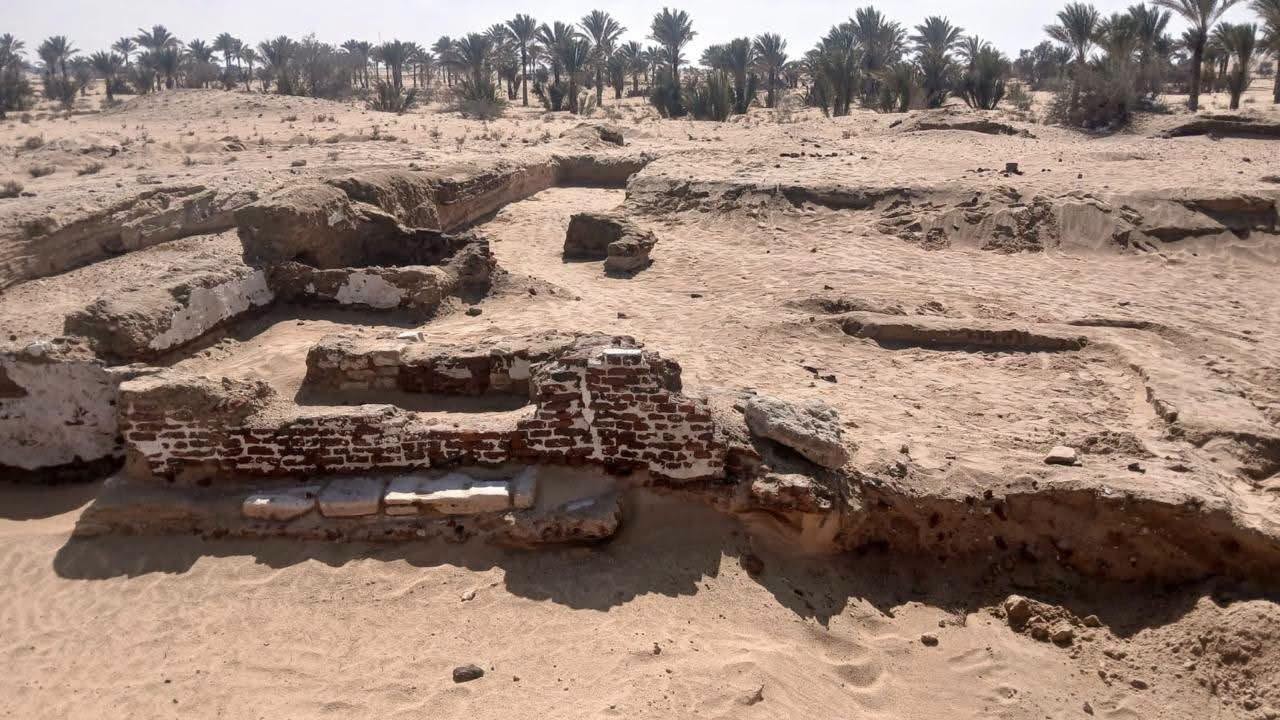
Mud and red brick walls exposed by the recent excavations. (Egypt’s Ministry of Tourism & Antiquities)
Mudbrick Walls Reveal the Caravanserai’s Original Layout
Dr. Hisham El-Leithy, Secretary-General of the Supreme Council of Antiquities, explained that the excavation revealed walls built of mudbrick and red brick, reinforced at their bases with large limestone blocks, a construction technique commonly used for major buildings during the Islamic era in Egypt. The walls extend to the north, east, and south, forming a layout with numerous interior rooms, some of which are thought to have served as shops attached to the inn.
Artifacts Reveal Daily Life at Asila’s Desert Inn
El-Leithy noted that the site layout resembles Khan al-Khuwaynat, another important trading station in North Sinai, though the Asila site is smaller in scale. The size difference supports the theory that the building functioned specifically as a rest stop for pilgrims and merchants traveling the Sultani Road, rather than a larger commercial hub. Dr. Diaa Zahran, head of the Islamic Antiquities sector, reported that the research team recovered artifacts that offer visual insight into daily life at the site. Researchers report finding storage jars once used to retain water and gather provisions, vessels coated in olive-green glaze, pieces painted in red and white, and shell fragments of oil lamps used for lighting. Together these artifacts provide archaeologists with evidence about storage, food and water, provisioning, lighting, and daily activities at the roadside station.
- Survey Finds Two Dozen Shipwrecks Proving Historic Mediterranean Sea Routes
- Why Mount Sinai is in Egypt and Other Exodus Enigmas
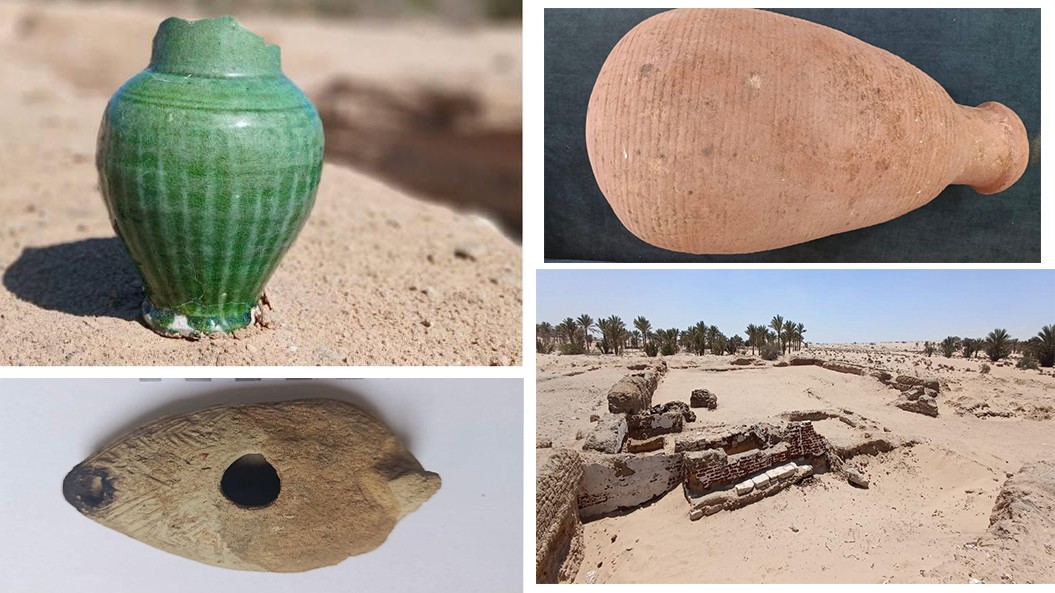
Artifacts such as an olive-green glazed vessel, a large pottery storage container, an oil lamp, and remains of the probable roadside khan suggest the site served pilgrims and caravans along the Darb al-Sultani, likely dating to the Mamluk period. (Egypt’s Ministry of Tourism & Antiquities)
A Network of Waystations Connected Egypt and the Levant
Zahran pointed out that Asila’s proximity to other historic waystations such as Khywaynat, Amoria, and Qatia places it within a broad network of stations that supported traders, pilgrims, and travelers across Sinai, underscoring the peninsula’s crucial role not only as a civilization bridge but also as a commercial link between Egypt and the greater Levant. Mohammed Khalil and Saddam Hussein, co-directors of the excavation mission, said the discovery increases understanding of the infrastructure that connected the principal economic and cultural elements such as trade caravans, pilgrim convoys, and military movements during the Islamic period.
- Oldest Arabic inscription provides missing link between Nabatean and Arabic writing
- Understanding the Crusades from an Islamic Perspective
Pottery Fragments May Carry the Name of a Powerful Sultan
Among the finds are vessels with olive-green glaze characteristic of the era, along with glazed pottery sherds bearing decorative motifs that archaeologists believe may be attributed to the reign of Sultan al-Nasir Muhammad ibn Qalawun during the Bahri Mamluk era. Some of the fragments found at the site show Arabic lettering that could form part of the word “al Nasir,” though further study is needed to confirm the precise dating and the exact function of the site’s buildings.
Trade and Pilgrimage Converged Along the Sultani Road
Excavation work is continuing in an effort to uncover additional architectural elements and determine more precisely how the Asila complex functioned. The discovery also highlights the importance of the historic routes that crossed Sinai, carrying pilgrims, merchants, government messengers, and other travelers between Egypt, the Levant, and the Arabian Peninsula. Political conditions repeatedly altered these routes. During periods of Crusader control and military activity in the 12th century, Egyptian pilgrims increasingly relied on a southern itinerary through Qus and the Red Sea port of Aidhab, from where they sailed to Jeddah. The overland pilgrimage route across Sinai was later revived under the Mamluks, however, and developed into an important network of stations and water points serving travelers bound toward Aqaba and the Hijaz. The probable Mamluk date of the newly discovered Asila khan places it within this later flourishing phase of movement across Sinai.
Top Image: Remains of the probable medieval roadside khan uncovered at the lost city of Asila in North Sinai. The station appears to have served pilgrims, merchants, and other travelers using the historic Darb al-Sultani, also known as the Egyptian Hajj Road. Source: Egyptian Ministry of Tourism and Antiquities/Supreme Council of Antiquities
By Ramsey Hardin
References
Altuntaş, L. 2026. Egypt Uncovers Remains of a Medieval Caravanserai for Pilgrims in the Lost City of Asila, North Sinai. Available at:Arkeonews – original article
Bauden, F. 2025. Bandar al-Ṭūr. A Port on the Red Sea and Its Development in the Ninth/Fifteenth Century. Der Islam 102 (2). De Gruyter Brill. Available at:De Gruyter Brill research article
Saudi Press Agency. 2025. Historic Egyptian Hajj Road: A Legacy of Faith and Passage. Available at:Saudi Press Agency
Tamari, S. 1982. Darb al-Ḥajj in Sinai: An Historical-Archaeological Study. Atti dell'Accademia Nazionale dei Lincei, Memorie della Classe di Scienze Morali, Storiche e Filologiche, Series 8, Vol. 25, Fasc. 4, pp. 431–525. Accademia Nazionale dei Lincei. Available at:Mamluk Bibliography Online – University of Chicago