
Epigraphists have successfully identified a woman who held supreme power in the ancient Maya city of Cobá during the 6th century AD. The ruler, known as Ix Ch'ak Ch'een, emerges from inscriptions carved into a remarkable limestone monument called the "Foundation Rock," discovered near a natural water reservoir in the Nohoch Mul Group of Cobá, located in Mexico's Quintana Roo state. This breakthrough provides unprecedented insight into female political authority in the ancient Maya world and reveals the complex dynastic networks that connected powerful city-states during the Classic Period.
The Foundation Rock represents one of the most extensive hieroglyphic texts ever discovered at Cobá, and conservation efforts have allowed specialists to unlock its secrets more than a year after its initial discovery. Epigraphers David Stuart from the University of Texas at Austin and Octavio Esparza Olguín from Mexico's National Autonomous University (UNAM) have been painstakingly deciphering the weathered inscriptions, which contain dates, events, personal names, and references to protective deities that governed the spiritual and political landscape of this ancient metropolis.
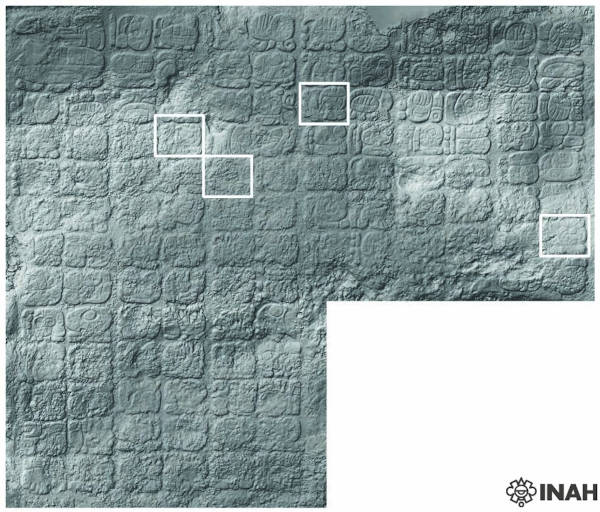
The Foundation Rock inscription discovered at Cobá, Mexico, which revealed the name of ruler Ix Ch'ak Ch'een. The hieroglyphic cartouches it refers to are indicated in the boxes. (INAH)
The Reign of Ix Ch'ak Ch'een
According to the National Institute of Anthropology and History (INAH), the Foundation Rock records a pivotal date: 9.6.15.6.9 in the Maya Long Count calendar, corresponding to May 12, 569 AD. This date marks the establishment of the kaloomte' institution at a location called Kehwitznal, meaning "Place of the Mountain of the Deer," believed to reference the Nohoch Mul area where Cobá's largest pyramids were constructed. Ix Ch'ak Ch'een appears as the central figure associated with this foundational event, establishing her role as a supreme political and military leader.
The ruler's name appears with slight variations across multiple monuments at Cobá, including Panel 7 and Stelae 26 and 30. On Stela 30, she is referred to as Ix Ch'ak Ch'een Yopaat, while the Foundation Rock associates her with the deity K'awiil, a powerful Maya god connected to lightning, serpents, and royal lineage. Despite these variations, the proximity of dates across different monuments confirms they reference the same sovereign. Her documented achievements include overseeing construction of the Group D ballcourt and presiding over the completion of the seventh k'atun cycle on December 8, 573 AD, reports Archaeology Magazine.
- Tulum: Maya City of the Dawning Sun, a Caribbean Paradise
- Unravelling the Mysteries Trapped Within Mayan Hieroglyphs
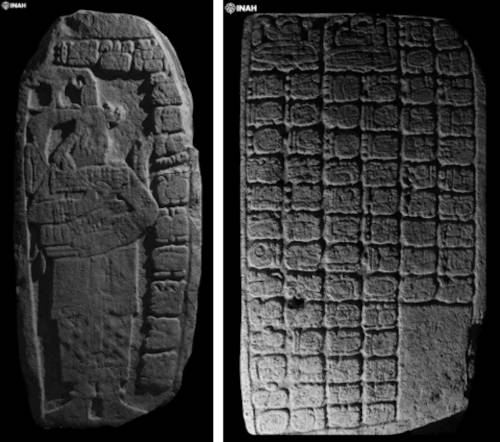
Left, Maya stela 26, Right, Panel 7, both include the female ruler’s name, along with stelae 30. (Octavio Esparza/INAH)
Sacred Landscapes and Divine Connections
The Foundation Rock inscription reveals that Ix Ch'ak Ch'een's authority was intimately connected to Cobá's sacred geography. The monument was carved directly onto a limestone slab at the edge of the aguada (natural water reservoir) in the Nohoch Mul Group, a location of tremendous spiritual significance. The text references her relationship with protective deities, particularly Bolon Tz'akab Ajaw, or "Lord of Innumerab Generations," linking her reign to Cobá's mythological foundation and the city's ruling lineage.
According to Octavio Esparza Olguín, the inscription also discusses the serpent witz', a supernatural entity associated with bodies of water that maintained an intimate relationship with the Nohoch Mul aguada. This connection between political authority, water sources, and cosmological order reflects the Maya worldview in which rulers served as intermediaries between the human and divine realms. The choice to carve such an important text directly onto bedrock beside a sacred water source underscores the monument's role in legitimizing dynastic authority and connecting Maya rulers to the landscape itself.
Mayan Queens interview from the Ancient Origins Store.
Political Networks and Regional Power
Comparative analysis of inscriptions from other Maya sites reveals that Ix Ch'ak Ch'een operated within a complex web of political alliances and diplomatic relationships. References found at Okop (also known as Yo'okop) in José María Morelos municipality suggest connections between the Cobá sovereign and Sky Witness, a powerful ruler of the Kaanul dynasty. The Kaanul polity, also known as the Snake Kingdom, represented one of the most formidable political forces in the Maya world during the Classic Period, controlling vast territories and resources across the Yucatan Peninsula and Guatemala.
While the exact nature of the relationship between Ix Ch'ak Ch'een and the Kaanul dynasty remains unclear due to limited references in Cobá's inscriptions, the mere mention of this connection indicates that female rulers participated fully in the diplomatic and political machinations of their era.
At its height, Cobá covered approximately 80 square kilometers (30 sq miles) and supported a population estimated at 50,000 inhabitants, making it one of the largest Maya cities. The site's extensive network of sacbeob (white roads or causeways) connected various architectural groups and linked Cobá to other regional centers, facilitating trade, communication, and political control.
Ancient Origins Magazine, Maya Edition, available from the AO Store.
Women and Political Authority in Maya Society
The identification of Ix Ch'ak Ch'een adds to the growing body of evidence demonstrating that Maya women could and did wield significant political power. While male rulers dominated Maya political structures, numerous inscriptions and archaeological discoveries have revealed that elite women served as regents, military strategists, diplomatic envoys, and occasionally as supreme rulers in their own right. Women rulers planned military strategies and sometimes led troops as warrior queens, while noble and elite women maintained high status within Maya society through their roles in ritual practices, textile production, and lineage preservation.
Ix Ch'ak Ch'een joins a distinguished roster of known Maya queens including Yohl Ik'nal of Palenque, who ruled in the late 6th century, and Lady K'abel of El Peru-Waka', who held the title of kaloomte' and wielded authority equal to or greater than her royal husband.
The discovery of the Foundation Rock and the identification of Ix Ch'ak Ch'een's name in the inscription provide tangible evidence of female political agency during a period when Maya city-states competed fiercely for resources, trade routes, and regional dominance. Her association with both the establishment of the kaloomte' office and the construction of the ballcourt suggests she commanded both military and ceremonial authority.
Research into the Foundation Rock inscription continues, and epigraphers expect that ongoing conservation work and analysis will yield additional information about Ix Ch'ak Ch'een's reign, her relationship with other Maya dynasties, and the historical events that shaped Cobá during the 6th century AD. Archaeological excavations conducted by the Promeza Cobá project in the Nohoch Mul Group promise to complement epigraphic findings with material evidence that may further illuminate this fascinating period of Maya history.
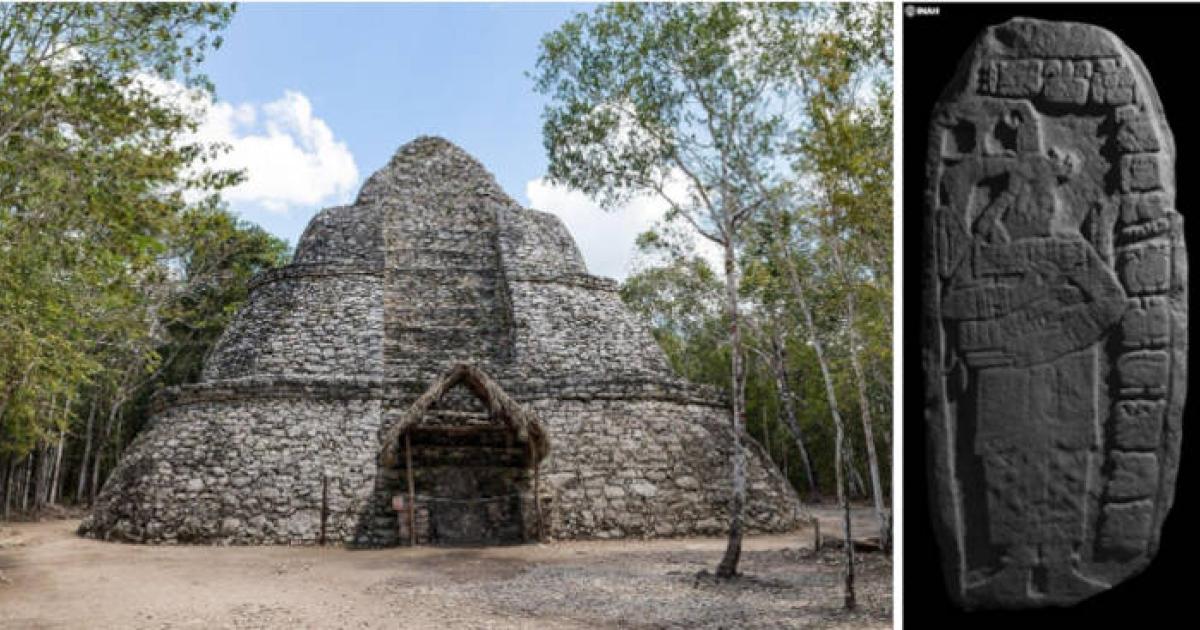
Top image: Right; Ancient Maya city of Cobá showing the extensive site layout. Maya stela 26, with the name of the queen mentioned. Source: Left; dronepicr / CC BY 2.0, Right; Octavio Esparza/INAH
By Gary Manners
References
Esparza Olguín, O. and Stuart, D. 2025. Epigraphic Analysis of the Foundation Rock, Cobá. Available at: https://www.inah.gob.mx/boletines/epigrafistas-identifican-a-ix-chak-cheen-mujer-que-goberno-coba
INAH. 2025. Epigrafistas identifican a Ix Ch'ak Ch'een, mujer que gobernó Cobá. Available at: https://www.inah.gob.mx/boletines/epigrafistas-identifican-a-ix-chak-cheen-mujer-que-goberno-coba
Staff Writer. 2025. Ix Ch'ak Ch'een: Queen Who Ruled the City of Cobá. Archaeology Magazine. Available at: https://archaeologymag.com/2025/10/ix-chak-cheen-queen-who-ruled-the-city-of-coba/