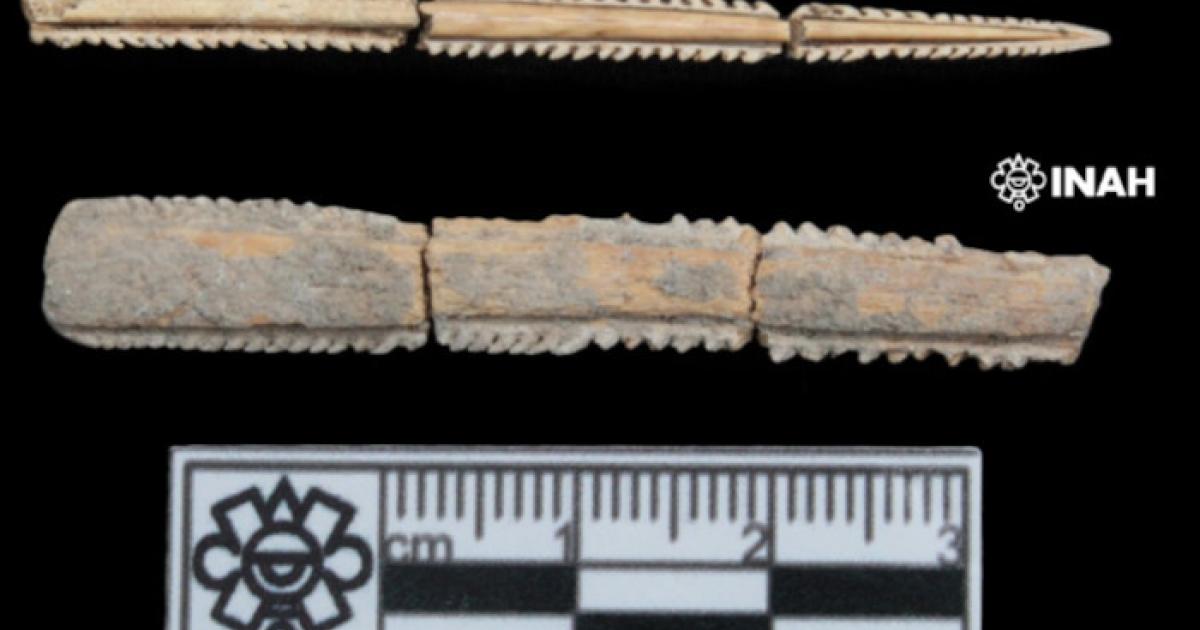

Four fish spines excavated from graves near the Usumacinta River in Mexico might be rare physical evidence of Maya bloodletting. Archaeologists are examining three ray spines and one catfish spine found during the archaeological rescue work at Site 1 of the Maya Train construction. Despite the small size of these artifacts, their burial context and the treated surfaces may provide a unique insight into the rituals of the ancient Maya.
- Sieving For Micro-Insights into the Maya Rituals at Palenque Palace
- Maya Canoe Found in Sinkhole Provides Clues to Belief in Underworld

An INAH researcher analyzes three stingray stingers and a catfish thorn recovered in the archaeological salvage of Section 1 of the Mayan Train. (Aldo Dena/INAH)
Four Spines, One Ritual Question
The artifacts were discovered at an approximately three-hectare site close to Tenosique, Tabasco, during excavations in June 2021. Section 1 runs 226 kilometers (140 miles) from Palenque, Chiapas, to Escárcega, Campeche and the salvage project led to the closer examination of previously ignored materials, similar to the way fine sieving revolutionized the interpretation of ritual deposits in Palenque. Marisol Arce Acosta, head of the project’s Zooarchaeology Laboratory, is directing the new analysis with archaeologist Said Amiel Luna Limón.
Two ray fragments have polished surfaces, likely due to sediment abrasion, while another retains striations (ridges) and heavy sediment. At least two of the pieces were discovered in burial contexts, and the catfish spine was discovered in the grave of the adult male.
The spines are broken into several pieces, which is likely due to sediment pressure.
- Child’s Handprints in Mexican Cave Reveal Ancient Maya Ritual
- Maya Gateway to the World Below: Balankanché Cave, Throne of the Tiger Priest
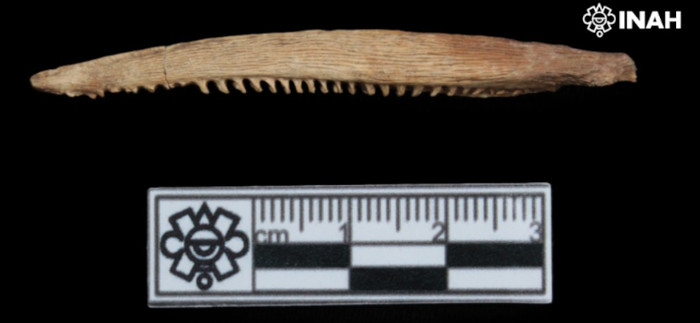
The catfish thorn discovered in Mexico. (Amiel Luna/INAH)
Why Ray Spines Mattered
INAH places the artifacts within a long tradition of self-sacrifice, or the intentional spilling of one’s own blood as a form of offering. This practice occurred in the Maya world from the Late Preclassic to the Postclassic period, or from around 500 BC to 1520 AD, and was particularly linked to members of the elite class, with the intention of sustaining cosmic order. Earlier studies have found possible traces of human blood on Maya arrowheads, although each artifact must be studied in its own context.
According to Luna Limón, tongues, penises, earlobes, and fingertips were areas used for piercing, and the choice carried symbolic meaning. The blood was caught on bark paper which was later burned so that the sacrifice would rise in the form of smoke to the ‘other world’, a concept that also shaped sacrificial performances tied to Maya creation stories. Ray spines seem to have been considered the best tools for piercing in southern lowlands. The INAH report states:
“In the Southern Lowlands, the stingray stinger was the instrument of choice, as has been reflected in lintels and documents describing that blood was collected in containers containing leaves of tree bark, which, once dried, was burned and, in this way, ascended, immaterialized, to the 'other world.’”
The INAH notes it is possible that the first ray spine was put in the grave as a funerary offering rather than an implement actually used in Maya bloodletting.
Saltwater Tools Beside a Great River
The species of fish involved make the deposit more telling. Arce Acosta identified the rays as members of the saltwater Dasyatidae and Myliobatidae families, whereas the catfish belonged to Ictaluridae, a freshwater family. Catfish spines are uncommon in documented self-sacrifice, so researchers do not yet know whether this specimen served the same purpose or simply shared a burial context with the better-known ritual objects.
Its presence nevertheless fits a broader symbolic pattern in which aquatic materials were connected with Xibalba, the Maya underworld. Ancient Origins has previously examined that relationship through Maya Blue and offerings in the Sacred Cenote, a ritual canoe recovered from a sinkhole, and difficult evidence from human remains in a Guatemalan cave. Here, the mixture of marine and river species may show how waterways supplied both food and raw material for sacred objects.
Rescue Archaeology and Necessary Caution
The four spines form only one part of a much larger rescue effort spanning the Maya Train route. An INAH overview published in 2023 described survey, excavation, LiDAR, photogrammetry and laboratory analysis across five Mexican states, while discoveries of hundreds of ceremonial complexes in southern Mexico show the scale of the cultural landscape. Yet scale should not be mistaken for certainty about any single artifact.
As Culture Secretary Claudia Curiel de Icaza observed in the INAH bulletin, “Every find recovered during archaeological salvage opens new questions about our past,” and laboratory work may continue producing answers for years.
Top image: Ray spines excavated from graves near the Usumacinta River in Tabasco, Mexico. Source: INAH
By Gary Manners
References
Burke, C. C., Tappan, K. K., Wisner, G. B., Hoggarth, J. A. and Awe, J. J. 1 May 2020. To Eat, Discard, or Venerate: Faunal Remains as Proxy for Human Behaviors in Lowland Maya Peri-Abandonment Deposits. Available at: https://www.cambridge.org/core/journals/ancient-mesoamerica/article/to-eat-discard-or-venerate-faunal-remains-as-proxy-for-human-behaviors-in-lowland-maya-periabandonment-deposits/0E34BB81A4439263213F73208B887261
Instituto Nacional de Antropología e Historia. 31 August 2023. Salvamento arqueológico del proyecto Tren Maya, oportunidad para la investigación científica y el uso de tecnología de punta. Available at: https://www.inah.gob.mx/boletines/salvamento-arqueologico-del-proyecto-tren-maya-oportunidad-para-la-investigacion-cientifica-y-el-uso-de-tecnologia-de-punta
Instituto Nacional de Antropología e Historia. 7 September 2026. Estudian vestigios asociados a prácticas rituales recuperados en el Tramo 1 del Tren Maya. Available at: https://www.inah.gob.mx/boletines/estudian-vestigios-asociados-a-practicas-rituales-recuperados-en-el-tramo-1-del-tren-maya