
In the dry hills of southern Tunisia, the ground suddenly opens into round courtyards sunk deep into the earth. The online heritage archive ksour.org calls this way of building "ancient," and many visitors leave believing the homes were carved out thousands of years ago.
The pit houses of Matmata are one of the most distinctive forms of home building in North Africa, dug down into the earth instead of raised up from it. Each is a wide open pit with bedrooms, kitchens and storerooms cut sideways into its walls. But are they really that old?
The Amazigh of the Southern Mountains
Matmata is the name of a village and of an Amazigh (Berber) tribe long settled in this corner of southern Tunisia. Racha Ben Abdeljelil of the Faculty of Humanities and Arts of Sousse places the village about 40 km (25 miles) from the coastal city of Gabès, in a region where summer heat can pass 50°C (122°F).
The UNESCO World Heritage Centre describes the Amazigh of southern Tunisia as descendants of the country's indigenous communities, whose history was long obscured and whose culture was pushed to the margins. Persecution by successive invaders, together with a fierce attachment to their freedom, led them to settle in mountains that outsiders found hard to reach.
Exactly when those communities settled and began to dig is far less certain. "It is disputable as to when nomadic tribes decided to settle here," said Habib Belhedi, a dentist, specialist in the region's past and advocate for Amazigh culture, to IGNANT magazine. On the motive he was firmer: "The main reason for the construction of these cave dwellings is climatic."
How a Pit House Works
Old Matmata, known as Matmata el Guédima, sits on a mountainside at about 600 meters (1,970 ft). UNESCO describes a lunar scene of small hills hollowed out vertically at their summits, where each hollow forms the courtyard of a single house.
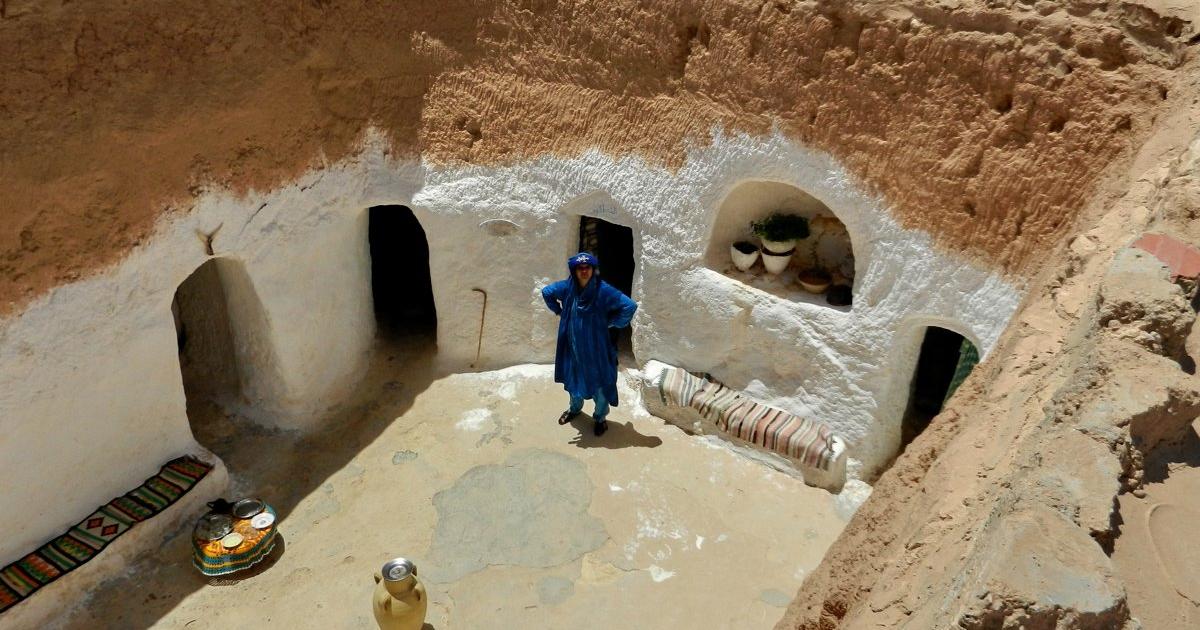
The house itself is called a houch, and its sunken courtyard is the mihras. According to Ben Abdeljelil, the courtyard is usually round, 5 to 10 meters (16 to 33 ft) across and about 10 meters (33 ft) deep, and its width has to be greater than its depth so that daylight reaches the rooms below.
Families enter through a tunnel called the sqifa, 1.2 to 2 meters (4 to 6.5 ft) wide, which bends on purpose so that no passerby can see into the courtyard. A small channel known as the saqiya runs along it and carries rainwater to a well in the courtyard, whose floor is gently domed to drain toward it.
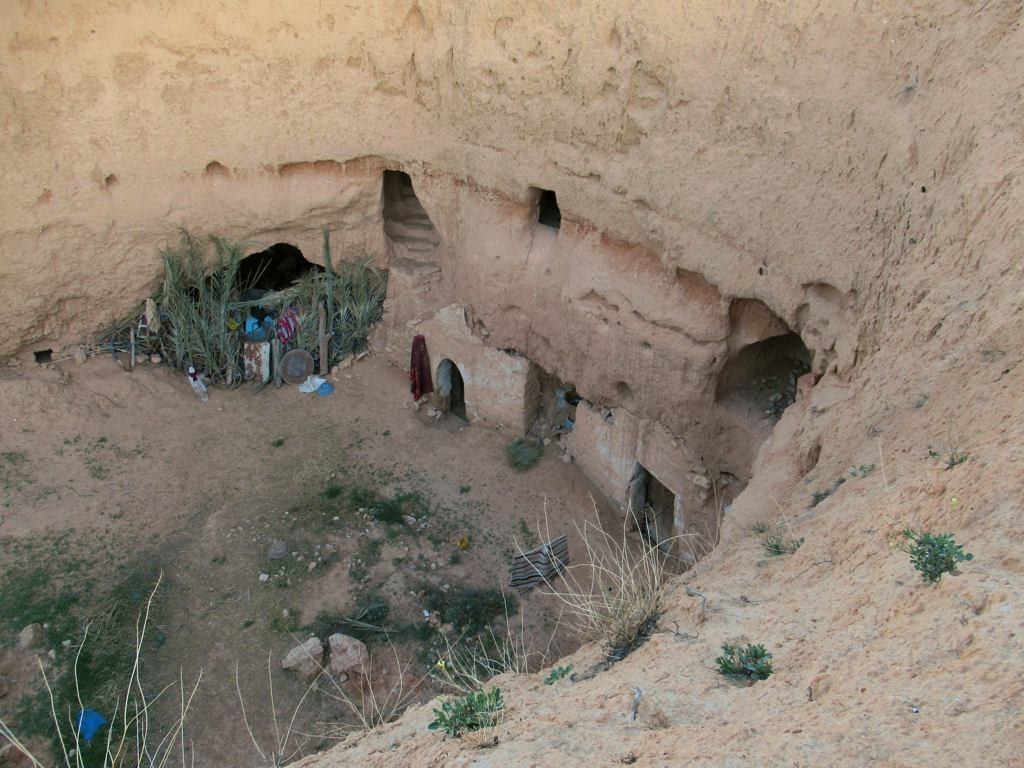
A Matmata pit dwelling seen from above, showing rooms cut into the walls of the open courtyard. (David Stanley/CC BY 2.0)
The largest rooms run 4 to 5 meters (13 to 16 ft) wide and 8 to 10 meters (26 to 33 ft) deep, under curved vaults that spread the weight of the earth above. Steps carved into the courtyard wall lead up to storerooms called ghorfas. A house grows one room at a time with the family, though rarely past eight.
What makes all this possible is the ground itself, a fine windblown silt that the UNESCO file calls clayey sand. Houda Driss and Fakher Kharrat, writing in Sustainable Mediterranean Construction, record loess deposits 10 to 20 meters (33 to 66 ft) thick in the Matmata hollows, and they explain why it suits a family with hand tools:
"It can be easily worked and dug using unsophisticated agricultural tools. The walls do not crumble under the influence of the hoe or the pickaxe."
The reward for all that digging shows up on the thermometer. Ben Abdeljelil cites a thermal study that recorded outside air at 6.6°C (44°F) in winter and 41.1°C (106°F) in summer, while the underground rooms held 15°C (59°F) and 25.5°C (78°F). On a July afternoon in 1997 at the Hotel Marhala, rooms stayed between 25.7 and 29°C (78 to 84°F) while the open courtyard reached 45°C (113°F).
How Old Are the Houses?
Established: the dwellings are real, they are dug into the ground around a courtyard pit, and they were made and lived in by Amazigh communities. Tunisia submitted them to the UNESCO Tentative List on January 10, 2020, as part of a wider file on the so-called troglodyte habitat and the world of the ksour of southern Tunisia.
Unverified: any specific age for the houses, including claims that they are thousands of years old. The published estimates differ by many centuries, and none of the sources cites dated material taken from the dwellings themselves. The UNESCO entry offers no construction date for Matmata at all, which leaves each writer reading the same pits in a different way.
At the oldest end, the earthen heritage archive ksour.org states that the pit dwelling form is "pre-Islamic in origin and continuously occupied through the Roman, medieval Islamic, and modern periods," though it cites no evidence, and its own catalogue entry for Matmata gives the period as the 13th century. IGNANT reports estimates that cave living in the region began in the 14th or 15th century, and possibly as early as the 11th.
Ben Abdeljelil places the existing houses much later, at the end of the 18th or the start of the 19th century. However, there is one firm date at Matmata, and it belongs to the soil. A team led by G. Coudé-Gaussen used radiocarbon and thermoluminescence dating to show that the loess built up between more than 43,000 and about 10,000 years ago.
That result dates the windblown ground, and it says nothing about when the first room was cut into it. So the soil is ancient, while the homes inside it may be far younger.
The Floods of 1969 and New Matmata
The floods of autumn 1969 hit southern Tunisia hard. H. Boudhraâ and C. Cudennec found that the south saw the heaviest rain compared with its seasonal average, with 100 to 200 mm (4 to 8 in) falling in the center and south, including Gabès, in early October.
However, theirs is a national study of the disaster, and it never mentions Matmata itself. Belhedi points to an earlier flood instead, telling IGNANT: "Their existence remained unknown until 1967, when severe flooding brought it to the attention of the Tunisian government." That date is his, and no other source cited here repeats it.
In the years that followed, many families moved out of the pits and into New Matmata, a newer settlement of built houses. No published study gives a firm date for its founding. Ben Abdeljelil writes that it was built after independence in 1956, in a haphazard way and without a plan, and Driss and Kharrat tie the abandonment of the old houses to the modernization drive that followed.
Driss and Kharrat also record that the Hotel Marhala, made from former traditional houses, became the first hotel in the region to welcome tourists in 1964. The digging has not stopped, either. Ben Abdeljelil reports seeing a man digging a brand new houch in 2020 on the road toward Tamezret, and the paper notes that the practice survives to this day.
A Footnote From a Galaxy Far Away
Many visitors arrive in Matmata knowing only one fact about it. Ben Abdeljelil notes that scenes from Star Wars Episode IV were filmed at Sidi Driss in 1976. It is one of several pit houses now converted into hotels for tourists who want to discover the secret of these buried homes.
The pit houses of Matmata were built by people who read their ground and climate with great skill, and who turned soft loess into cool, lasting family homes. When the first courtyard was dug remains an open question, and until someone dates the dwellings directly, there is still much to learn.
A sunken courtyard house in the Matmata area of southern Tunisia, with rooms opening off the walls of the pit. Photo: Tanya Dedyukhina, via Wikimedia Commons, CC BY 3.0
By Aris Manus
Sources
- UNESCO World Heritage Centre, Habitat troglodytique et le monde des ksour du Sud tunisien, Tentative Lists, ref. 6444 (submitted 2020)
- Racha Ben Abdeljelil, La maison troglodytique de Matmâta et la durabilité: un génie architectural à travers les siècles, Urban Art Bio Academic Journal 2, no. 1 (2023)
- Houda Driss and Fakher Kharrat, Thermal Performance of Vertico-lateral Cave Dwellings in Southeast Tunisia, Sustainable Mediterranean Construction, no. 12 (2020)
- G. Coudé-Gaussen, P. Rognon, A. Rapp and T. Nihlén, Dating of Peridesert Loess in Matmata, South Tunisia, by Radiocarbon and Thermoluminescence Methods, Zeitschrift für Geomorphologie 31, no. 2 (1987), abstract
- H. Boudhraâ and C. Cudennec, Autopsie des événements hydrométéorologiques extrêmes de 1969 en Tunisie, Proceedings of the International Association of Hydrological Sciences 369 (2015)
- ksour.org, Matmata, Atlas
- IGNANT, The Matmata Pit Dwellings Keeping the Tunisian Indigenous Past Alive (2020)
- Wikimedia Commons, Berber house cave Matmata, photo by Tanya Dedyukhina
- Wikimedia Commons, Matmata Pit Dwelling, photo by David Stanley