
Before China's Neolithic Fujia community was arranging its deceased, it already possessed something unusual: a social structure organized not around fathers, but around mothers.
Chinese researchers have now generated the first genomic evidence of a matrilineal prehistoric society in East Asia — a millet-cultivating, marine-based community that existed for 250 years, going about its business silently challenging the world's narrative of patriarchy.
Matrilineal, Not Mythical
The Fujia site in Shandong province and associated with the Dawenkou culture (around 2750–2500 BC) was previously researched for its ceramics, farming, and graves. But this new study, conducted by researchers from Peking University, the Shandong Provincial Institute of Cultural Relics and Archaeology, and overseas partners, provides more than that: tangible biological proof of a matrilineal society. Their findings have been published in Nature.
- Uncovering the Truth Behind Matriarchal Societies in the Ancient World
- Chinese civilization may have begun 2,400 years earlier than previously thought
Earlier theories of prehistoric matriliny had relied heavily on ethnography, mythology, and Marxist anthropology — Engels' notion most famously, that the emergence of private property ousted ancient matriarchies. But no hard evidence supported them. That is ended here.
By examining ancient DNA from 60 individuals who were buried in two spatially isolated cemeteries at Fujia, researchers discovered a revealing pattern: men and women buried in accordance with their mothers' lineage, not their fathers'.
The Genetic Signal: Science is Beautiful
The science is beautiful. Mitochondrial DNA — passed down exclusively from mothers — was almost identical in each cemetery. The 14 people in the northern cemetery all had mtDNA haplogroup M8a3; 44 of 46 in the southern cemetery had haplogroup D5b1b. Y-chromosome information — passed down from fathers — was highly diverse.
This is the reverse of what you might see in a patrilineal society, with Y-chromosomes grouping together and mtDNA differing. It's also totally unprecedented for East Asia. Previously, the only matrilineal system validated by genetics was the elite dynasty at Chaco Canyon in North America, which dates to only 1,300 years ago. Fujia is more than three thousand years earlier than that, reports a press release.
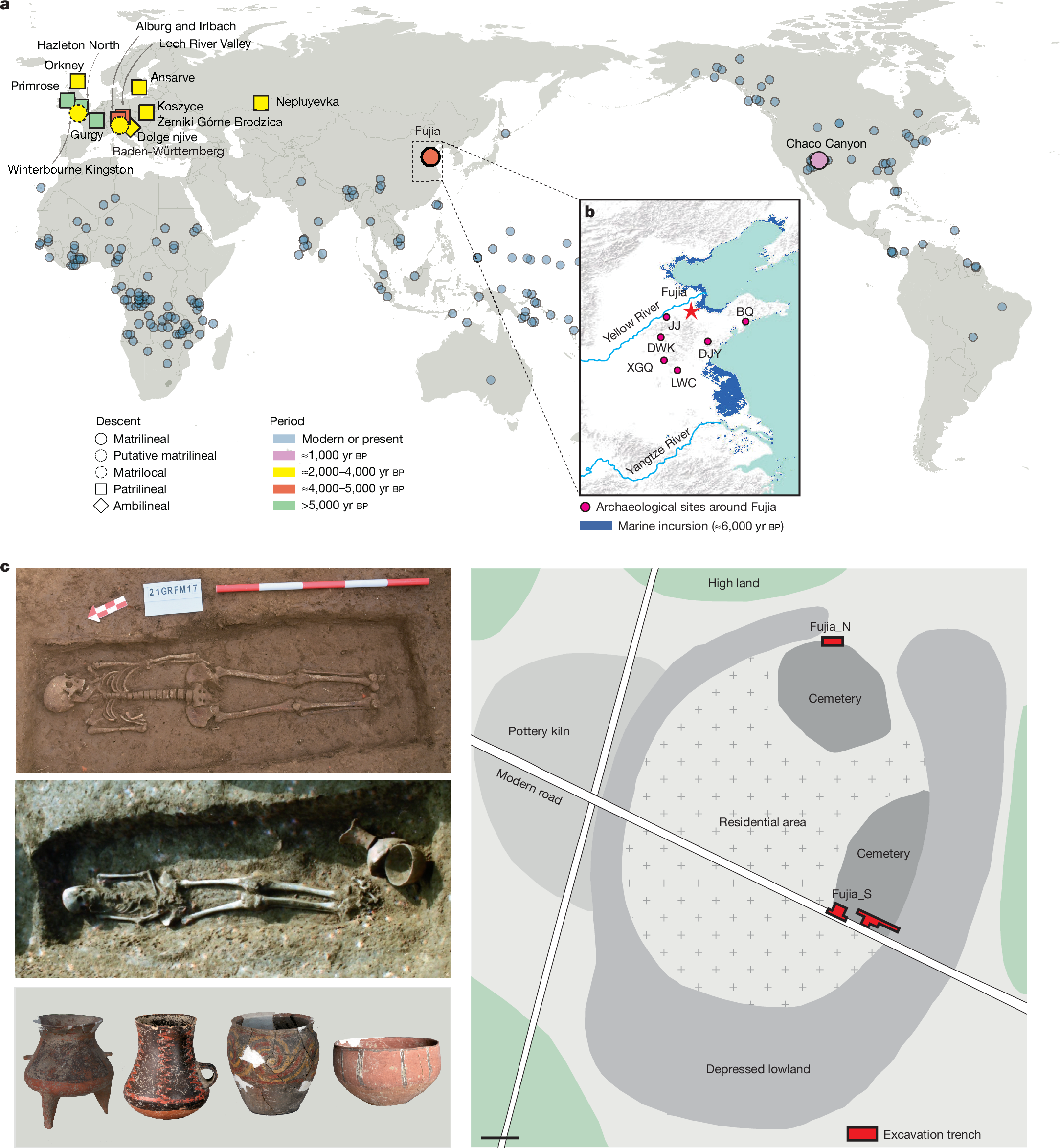
a. Spatial distribution of kinship organization in global populations. Kinship structures in ancient populations are represented using different colours and symbols, which differentiate various types such as matrilineal and patrilineal systems across different regions and time periods. b. Geographic location of the Fujia archaeological site in relation to the marine incursion around 6,000 years before present. Surrounding archaeological sites from the same period as Fujia, including Jiaojia (JJ), Dawenkou (DWK), Dongjiaying (DJY), Liangwangcheng (LWC), Xigongqiao (XGQ) and Beiqian (BQ), are marked to provide context. c. Painted pottery (bottom left) from the Fujia cemetery, as well as from the southern grave and northern grave. The right panel illustrates the layout and features of the Fujia archaeological site, highlighting residential areas, pottery kilns and the two cemeteries. (Nature, 2025)
But the tale does not end there. The researchers also discovered signs of complex clan organization — a "two-clanned matrilineal society," as they describe it. Genetic kinship spread throughout both cemeteries, with as much as sixth-degree relatives separated in burials — not due to physical distance, but due to strict rules of matriclan burial.
Even adolescent males and adult males were buried with the lineage of their mothers. There was no grave that reunited spouses or paternal relatives.
A Community with Borders: A Closed Society
This was not only a matrilineal society. It was a closed society. The genetic markers, combined with isotope data, indicate high levels of endogamy — marriage within the community — and a small effective population size (estimated as just 200–400 people). That is to say, they kept it in the family.
Stable isotope analysis also uncovered a close, millet-based diet, with some animal protein and probably marine or freshwater resources. Strontium isotope evidence verified low geographic mobility. These individuals were anchored — physically and socially — in their locations.
Unlike wealth-hoarding, hierarchical contemporaries in the vicinity, Fujia exhibits low inequality, minimal social stratification, and no indication of centralized authority. This is matriliny without monarchy, reports South China Morning Post.
The ramifications are massive. For centuries, the presumption has been that patrilineal descent — fathers transmitting land, authority, and name to sons — was the standard configuration of early complex societies. That has come largely from Neolithic and Bronze Age Europe, where patrilocality and patriarchal dominance have been demonstrated by genomic research. But Fujia reveals another path.
This was a healthy society, thriving for at least 10 generations, without apparent hierarchy, male dominance, or female displacement. What if the "matrilineal myth" was not a myth but real?
"We now have empirical evidence that matrilineal systems could not only exist, but thrive — even before the emergence of major states or institutionalized religion," said Zhang Hai, an archaeologist at Peking University and study co-author.
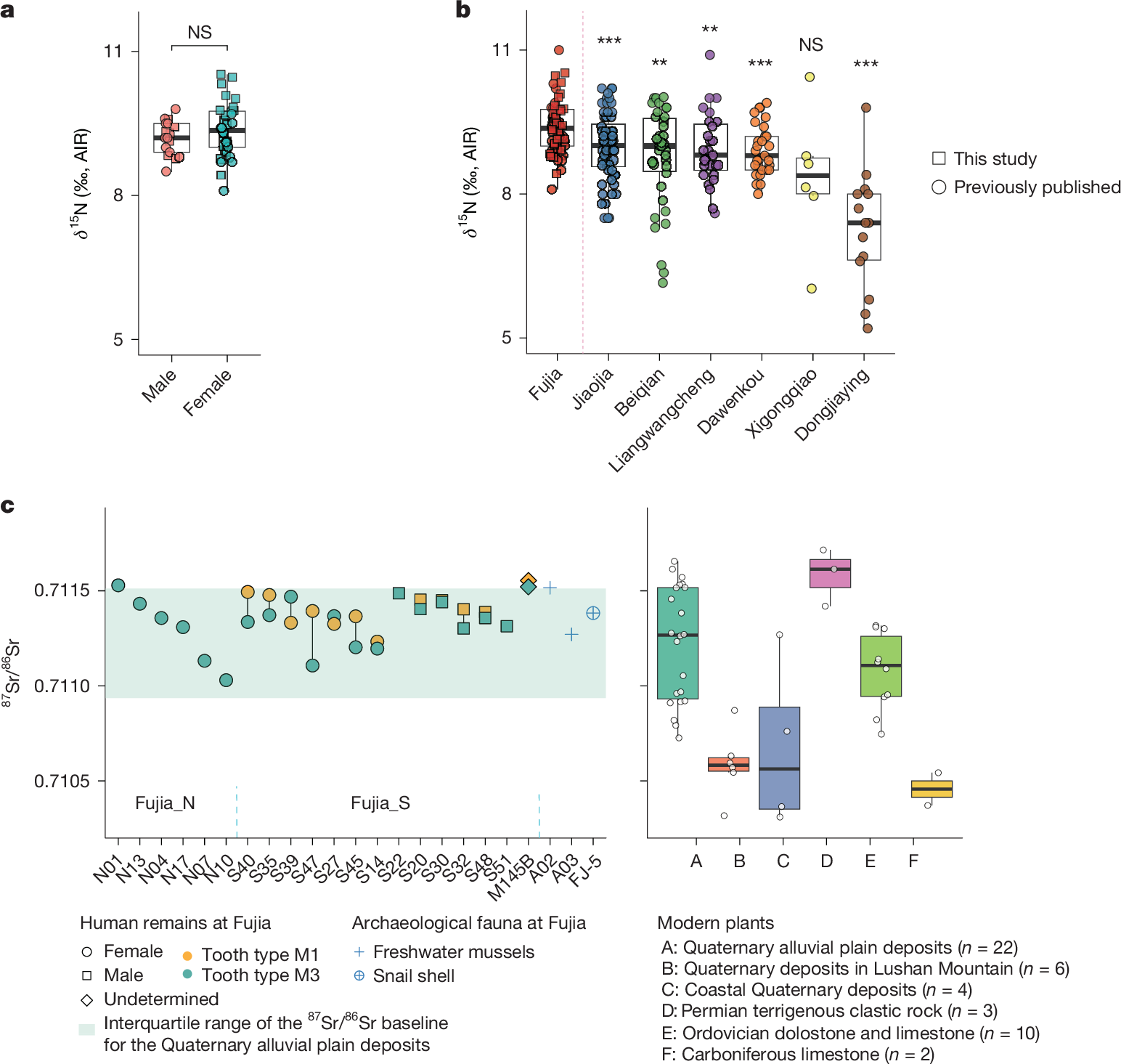
Stable isotope analyses of the Fujia individuals. (Nature, 2025)
A Window, Not an Exception
The researchers hold back crucially from declaring Fujia an outlier. The site is similar to other Dawenkou culture sites in the region in terms of its features — painted pottery, millet cultivation, and settlements of mid-size. The authors propose that Fujia could be part of a larger, regional trend of matrilineal organization that hasn't been identified elsewhere because not enough good DNA or burial data has been preserved.
- 4,000 Years Ago, Chinese Advances Were Fueled By Mass Beer Production!
- The Age-Old Bone-Rank Caste System of the Korean Kingdom of Silla
And they're not finished. The team is going to broaden studies into when and how China made the shift from matrilineal to patrilineal systems — and the role of agriculture, inheritance, and inequality in the transformation.
For the moment, the traditional anthropological suspicion — that early humans might have worshipped mothers first, and that matrilineal dominance was followed by patrilineal dominance — has its first reliably verified chapter in East Asia.
In a world that was once ruled by theory, Fujia talks no longer in myth, but in molecules.
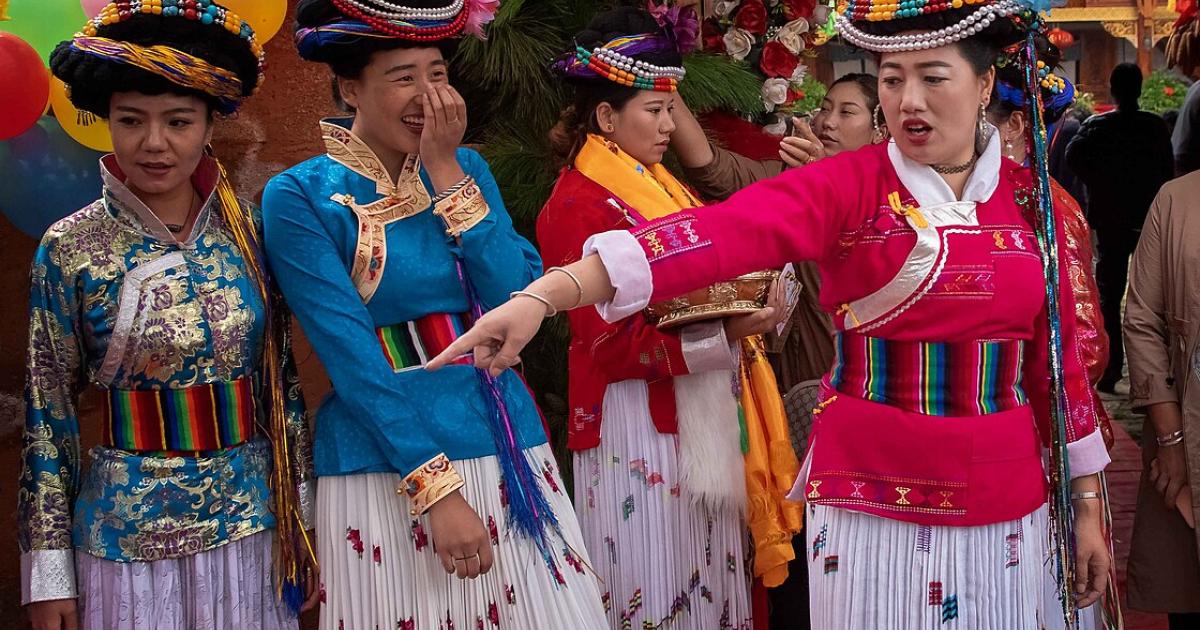
Top image: Mosuo matriarchal society, with strong east Asian genetics at play. Source: Rod Waddington/CC BY-SA 2.0
By Sahir
References
Chik, H. 2025. Ancient China was home to earliest known matrilineal society, Neolithic burials reveal. Available at: https://www.scmp.com/news/china/science/article/3313388/ancient-china-was-home-earliest-known-matrilineal-society-neolithic-burials-reveal.
Wang, J., Yan, S., Li, Z. et al. 2025. Ancient DNA reveals a two-clanned matrilineal community in Neolithic China. Nature. Available at: https://doi.org/10.1038/s41586-025-09103-x.