Archaeologists are investigating the site of a Roman military camp located near the town of Šurany in southwestern Slovakia. The site dates to the reign of Emperor Marcus Aurelius during the Marcomannic Wars, a series of conflicts fought between the Roman Empire and Germanic tribes from AD 166 to 180.
Find Adds to Historical Record of Roman Military Operations
According to the Institute of Archaeology of the Slovak Academy of Sciences and its research partner MH Invest, the camp is the most significant discovery in an industrial site of approximately 150 hectares, that is now part of the largest archaeological excavation ever done in Slovakia. Researchers estimate the size of the camp, the first in the Nitra region, at approximately 7.4 hectares. The research will add to the historical record of Roman military operations north of the Danube.
This Šurany site is unique in its shape, but it contains defensive features typical of Roman military camps, such as five entrance gates, ramparts, and ditches. One of the entrances is a clavicula–a curved ditch intended to slow down an attack. This feature has not been found in Slovakia before.
- Marcus Aurelius: Life of the Famous Roman Emperor and Philosopher
- The Roman Legions: The Organized Military Force Of The Roman Empire

Multiple human skeletons were excavated from a defensive ditch within the Roman military camp near Šurany, Slovakia. Dating to the reign of Emperor Marcus Aurelius during the Marcomannic Wars, the remains are believed to include Roman soldiers whose bodies were hastily deposited after the camp was abandoned following a military conflict. (Petra Chebenová, Marek Vojteček, Matej Ruttkay/Institute of Archaeology of the Slovak Academy of Sciences
Military Equipment Revealed
The site also contains many burial sites with human remains. Archaeologists have excavated complete skeletons and bone fragments from shallow graves, ditches, storage pits, and wells. Researchers believe that most of the dead are Roman soldiers, but the investigation is at an early stage. Excavations continue to reveal many examples of military equipment near the human remains. Fragments of helmets and pieces of scale armor rest among arrowheads, spearheads, legionary brooches, coins, and hobnails from caligae (military sandals). There are also common camp tools, such as axes, cutting tools, and gaming dice.

A probable Roman soldier lies within a former storage pit at the Roman military camp near Šurany, Slovakia. Excavated during one of Slovakia's largest rescue archaeology projects, the unusual burial is part of a larger group of skeletons found in pits, ditches, wells, and shallow graves dating to the Marcomannic Wars under Emperor Marcus Aurelius. (Petra Chebenová, Marek Vojteček, Matej Ruttkay/Institute of Archaeology of the Slovak Academy of Sciences)
Remains of Footwear Found to be Valuable
Laboratory analysis has begun on many artifacts. Rather than remove fragile objects from the soil, technicians have left the objects in blocks of soil for X-ray imaging. The remains of footwear are quite valuable since researchers can estimate individual shoe sizes. As the multi-year study progresses, the Institute of Archaeology will partner with radiocarbon dating technologists in Poland while scientists in Austria, Germany, the Czech Republic, and South Africa will do genetic, isotope, and soil analyses.
- Roman Helmet Hoard Reclassified as Medieval
- Archaeologists Discover a 2,000-year-old Roman Military Sandal with Nails for Traction
Why was Valuable Military Equipment Left?
The size of the site is particularly helpful for the camp excavation. Archaeologists will be able to investigate the entire camp site, unlimited by modern roads, structures, or negotiations with private landowners. Researchers plan to use laboratory analysis, scanning technology, and sediment studies to answer key questions about the encampment. Investigators hope to learn who the dead were and how they died. They wonder why human remains were placed in pits or wells rather than graves, and if disease might have caused the deaths. One significant issue is the valuable military equipment that was left beside the soldiers’bodies rather than being removed after the battle.
- Impressive Roman Military Base Found in Serbian Cornfield
- Undocumented Roman Army Camps Indicate Military Manoeuvres in the Arabian Desert
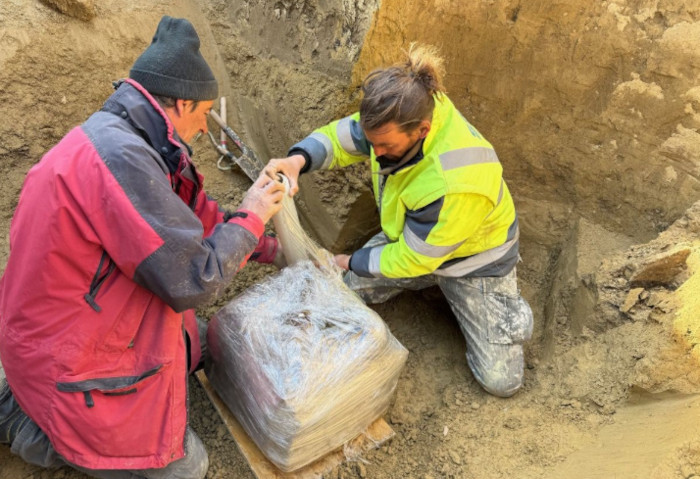
Archaeologists carefully wrap an intact soil block containing fragile Roman military artifacts during excavations at the Marcus Aurelius-era military camp near Šurany, Slovakia. The block was removed for laboratory conservation and X-ray analysis, preserving delicate equipment and footwear remains from the Marcomannic Wars. (Petra Chebenová, Marek Vojteček, Matej Ruttkay/Institute of Archaeology of the Slovak Academy of Sciences)
Conclusion
In addition to the camp, archaeologists have begun excavation of a Bronze Age settlement, an early medieval village from the seventh and eighth centuries, an Avar cemetery, and a site of many burials from the Bronze Age through the Early Middle Ages. The rich additions to the historical record will provide a unique journey through the life of the Nitra region over 3,000 years.
Top Image: Excavation of a probable Roman soldier buried in a shallow pit within the Roman marching camp discovered near Šurany, Slovakia. Dating to the Marcomannic Wars of Emperor Marcus Aurelius. Source: Marek Vojteček/Institute of Archaeology of the Slovak Academy of Sciences)
By Ramsey Hardin
References
Institute of Archaeology, Slovak Academy of Sciences. “Archaeologists Discover Roman Military Camp from the Time of Marcus Aurelius Near Šurany.” July 20, 2026. Accessed July 24, 2026. https://www.sav.sk/?doc=services-news&lang=en&news_no=13815&source_no=20
Kayra, Oğuz. “Roman Military Camp Found with Soldiers in Pits and Armor Left Behind in Slovakia.” Arkeonews. July 2026. Accessed July 24, 2026. https://arkeonews.net/roman-military-camp-found-with-soldiers-in-pits-and-armor-left-behind-in-slovakia/
Killgrove, K. July, 2026. . “‘Extremely Rare’ Roman Military Camp Found in Slovakia Holds Hastily Buried Remains of Marcus Aurelius’ Soldiers—with Some Dumped in Wells.” Live Science. Available at: Live Science article
MH Invest, s.r.o. “Archeológovia objavili pri Šuranoch pozostatky rímskeho vojenského tábora z čias Marka Aurélia” [Archaeologists Discovered the Remains of a Roman Military Camp from the Time of Marcus Aurelius]. July 17, 2026. https://www.mhinvest.sk/clanky/tlacove-spravy/archeologovia-objavili-pri-suranoch-pozostatky-rimskeho-vojenskeho-tabora-z-cias-marka-aurelia
Radley, Dario. “Roman Military Camp Found in Slovakia.” Archaeology Magazine. July 2026. Accessed July 24, 2026. https://archaeologymag.com/2026/07/roman-military-camp-found-in-slovakia/.
“Roman Camp from the Time of Marcus Aurelius and the Marcomannic Wars with Strange Legionary Burials Found in Slovakia.” La Brújula Verde, July 20, 2026. Accessed July 24, 2026. https://www.labrujulaverde.com/en/2026/07/roman-camp-from-the-time-of-marcus-aurelius-and-the-marcomannic-wars-with-strange-legionary-burials-found-in-slovakia/