
Fact Check verdict:
Mansa Musa made the hajj in 1324, passed through Cairo, and gave away and spent large amounts of gold there: Established
Gold fell in value against silver in Cairo after his visit: Established
The low gold price lasted about twelve years: Disputed
His spending crashed or wrecked Egypt's economy: Unverified
He was worth $400 billion: Unverified
He was the richest person who ever lived: Unverified
The verdict
A royal caravan heavy with gold rolled into Cairo in July 1324, and the pilgrimage of Mansa Musa of Mali has been retold ever since as the moment one king's generosity broke a market. Modern retellings attach two numbers to the story, $400 billion and twelve years of cheap gold. Verdict: Unverified. The hajj and the fall in gold are established, while the twelve years is disputed.
According to the earliest detailed account, written in Cairo in the late 1330s by the Syrian writer al-Umari, the king handed out gold across the city and its price fell against silver. Later Mamluk writers confirm a fall, while the dollar figure traces back no further than a 2012 website list.
- Established: Mansa Musa made the hajj in 1324, passed through Cairo, and gave away and spent large amounts of gold there. Reason: al-Umari describes it from people who saw the visit, and several other Mamluk-era writers mention it.
- Established: Gold fell in value against silver in Cairo after his visit. Reason: al-Umari says so, and three later Mamluk writers, Ibn Kathir, al-Maqrizi and Ibn Hajar, also record a fall, though they disagree on its size.
- Disputed: The low gold price lasted about twelve years. Reason: the twelve years comes from al-Umari alone, and the historian Warren C. Schultz argues from recorded exchange rates that a long-term disruption is not supportable.
- Unverified: His spending crashed or wrecked Egypt's economy. Reason: no source read for this check documents an economic collapse, and al-Umari himself says Cairo's traders made large profits from the visitors.
- Unverified: He was worth $400 billion. Reason: the earliest reports that could be found, from October 2012, trace the figure to an inflation-adjusted list by the website Celebrity Net Worth, whose method could not be found. It is a modern estimate with no historical basis.
- Unverified: He was the richest person who ever lived. Reason: historians quoted by Money and the BBC say his wealth cannot be put into a number, so there is nothing to rank against modern fortunes.
What the evidence says
The oldest detailed description comes from Shihab al-Din al-Umari, who was at home in Syria in 1324 and never saw the caravan, according to Schultz. Al-Umari later settled in Cairo, where residents were still eager to describe the visitors' spending and an emir told him of the king's wealth and piety. His account is secondhand, written about twelve years after the hajj.
Al-Umari presents the journey first as an act of devotion. Pressed to meet the Mamluk sultan, the king answered, in the Hopkins translation, "I came for the Pilgrimage and nothing else". He also "flooded Cairo with his benefactions", and "The Cairenes made incalculable profits out of him and his suite in buying and selling and giving and taking".
Before the visit, al-Umari writes, "The mithqal did not go below 25 dirhams and was generally above". At the time of writing "The mithqal does not exceed 22 dirhams or less", a drop of about three silver dirhams per gold coin. Al-Umari then writes the line that has traveled furthest: "This has been the state of affairs for about twelve years until this day".
According to the Gibb translation of his account, Ibn Battuta reached the city of Mali on June 28, 1352, nearly three decades after the pilgrimage, and stayed until February 27, 1353, when the king was Mansa Sulayman. A governor who had traveled with Mansa Musa to Mecca told him of a judge on the journey who tried to steal four thousand mithqals and was exiled for it.
His material on Musa is therefore secondhand too, and gives no gold price. Schultz, a historian of Mamluk money at DePaul University in Chicago, lists the other writers who mention the visit, including Ibn Khaldun and al-Maqrizi, who died in 1406 and 1442. Both are cited as reported in Schultz 2006.
According to Schultz, only three of those later writers record a fall in the value of gold. Ibn Kathir puts it at two dirhams, al-Maqrizi at six in two separate works, and Ibn Hajar gives no size at all. None of them supports the twelve years, which Schultz describes as "so far only known to be found in one source".
His table of recorded rates for roughly 1299 to 1349 shows 20 dirhams per gold coin as the most common figure, and a citation from the year after the pilgrimage records a return to that rate. A table built from scattered chronicle mentions is indicative rather than conclusive, yet it points away from a decade of cheap gold. He calls the dip "one of many short-term fluctuations" and concludes that a long-term disruption of gold's value "is simply not supportable in light of the wider spectrum of available information".
The dollar figure has a much shorter history, beginning on October 16, 2012, when NPR's Morning Edition gave his "Personal fortune: $400 billion", "according to a new inflation-adjusted list compiled by Celebrity Net Worth". Two days later the New York Daily News carried the same ranking.
Money revisited the list on July 30, 2015, and printed no number for Musa, only "Richer than anyone could describe", adding that "There's really no way to put an accurate number on his wealth". The BBC reported in March 2019 that "economic historians agree that his wealth is impossible to pin down to a number".
The alternative view
A strong case exists for taking al-Umari seriously, since Schultz writes that he "was a mature adult who resided in Cairo shortly after the events he described", and that this closeness must affect any judgment of his reliability. He also accepts that Musa's gold lowered the exchange rate between gold and silver in Mamluk Cairo in 1324.
He also floats the possibility that the twelve-year line worked as a veiled criticism of the sultan al-Nasir Muhammad, adding "Admittedly, this is speculation". The long version has also settled into teaching, since 12 of the world history textbooks Schultz surveyed mention economic disruption, and 8 of those describe it as long-term.
The broader claim, that Musa was extraordinarily rich, rests on firmer ground. Richard Smith, a history professor at Ferrum College, told Money that Mali was likely the largest producer of gold in the world, and that "one year of Malian gold production probably generated about a ton".
Rudolph Ware, a historian, told Money that "This is the richest guy anyone has ever seen, that's the point". He told the BBC that "Contemporary accounts of Musa's wealth are so breathless that it's almost impossible to get a sense of just how wealthy and powerful he truly was". That is where the $400 billion falls apart, because no medieval source gives a total that could be converted into modern money.
Where this leaves it
The pilgrimage happened, the gold was given away, and the price of gold in Cairo fell against silver. What the sources will not carry is a twelve-year slump, an economic collapse, or a fortune expressed in dollars. Al-Umari's own line about merchant profits points the other way.
So why has the longer story proved so durable? Partly because al-Umari wrote the twelve years himself, and partly because later versions, including the BBC's "for 10 years, wrecking the economy", turned a price movement into a ruined state. Treated as history, the $400 billion figure and the long slump remain less a measurement than a measure of how vividly Cairo remembered one pilgrim king.
How we checked this
Read in full for this check: al-Umari's Masalik al-absar in the Hopkins translation excerpt at Digital History, Ibn Battuta, trans. Gibb, 1929 (Mali section), Schultz's 2006 reappraisal, and the NPR, Daily News, Money and BBC reports.
Ibn Khaldun, al-Maqrizi, Ibn Kathir and Ibn Hajar were not read directly, since no open English translation could be found, and are cited as reported in Schultz 2006. The original 2012 Celebrity Net Worth page could not be found, so its method could not be checked. The Hamdun and King translation of Ibn Battuta was not available. No interviews were conducted, and earlier Ancient Origins coverage was not used as a source. Every quote was checked against a saved copy on October 23, 2026.
How we label claims: see How we check evidence.
More in this series: Göbekli Tepe, the Sphinx and Atlantis: what the evidence says.
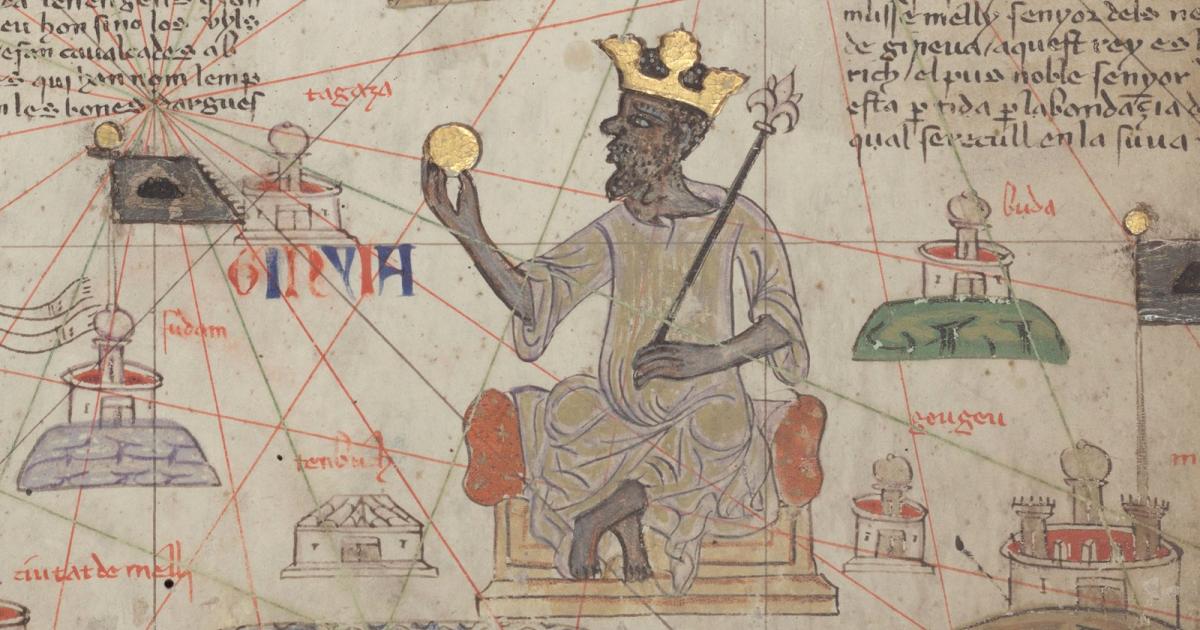
A seated ruler on a golden throne, conventionally identified as Mansa Musa, holds gold on the Catalan Atlas of 1375. Catalan Atlas (1375), attributed to Abraham Cresques, sheet 6 detail. Bibliothèque nationale de France, Espagnol 30, via Gallica and Wikimedia Commons. Public domain
By Aris Manus
Sources
- al-Umari, trans. J.F.P. Hopkins, in Levtzion and Hopkins (1981). Corpus of Early Arabic Sources for West African History, pp. 269 to 273, excerpt. Digital History, University of Houston. Read in full (excerpt).
- Ibn Battuta, trans. H.A.R. Gibb (1929). Travels in Asia and Africa 1325 to 1354, Mali section. Fordham Internet Medieval Sourcebook. Read in full (Mali section).
- Schultz, Warren C. (2006). Mansa Musa's Gold in Mamluk Cairo: A Reappraisal of a World Civilizations Anecdote. In Post-Mongol Central Asia and the Middle East: Studies in History and Historiography in Honor of Professor John E. Woods. Read in full.
- Montagne, Renee (2012). Who's The Richest Person In History? NPR Morning Edition. Read in full.
- Ortiz, Erik (2012). King Mansa Musa of Mali named richest person of all time. New York Daily News. Read in full.
- Davidson, Jacob (2015). The 10 Richest People of All Time. Money. Read in full.
- Mohamud, Naima (2019). Is Mansa Musa the richest man who ever lived? BBC News. Read in full.