Archaeologists have uncovered a remarkable network of medieval tunnels beneath northern Israel's Gan Ha-Shelosha National Park that once powered the thriving sugar industry of the Mamluk Empire. The sophisticated hydraulic system, carved into soft tufa rock along Nahal 'Amal between the 14th and 15th centuries, reveals how ingenious engineers transformed brackish spring water - unsuitable for drinking or irrigation - into the mechanical force that drove one of the region's most lucrative medieval industries.
The discovery, led by Professor Amos Frumkin of the Hebrew University of Jerusalem, emerged during modern infrastructure work that exposed five parallel tunnel openings along the northern bank of the stream. Their precise alignment and engineered features immediately distinguished them from natural formations, prompting a detailed investigation that would reshape understanding of Mamluk industrial technology in the southern Levant.
- A Brief Overview of the Mamluks, the Elite Slave-Soldiers
- Engineering Secrets of Barbegal Mills, The World's First Industrial Complex
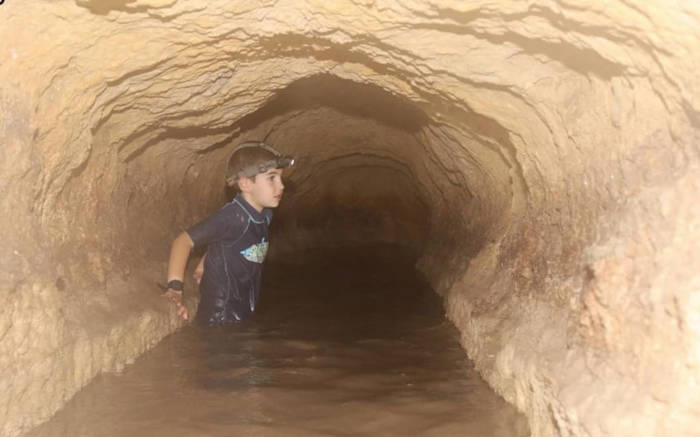
One of the Mamluk-era tunnels carved into tufa rock at Nahal 'Amal, revealing the sophisticated hydraulic engineering that powered medieval sugar production. (Azriel Yechezkel / A. Frumkin et al., Water History)
Engineering Innovation in a Water-Scarce Landscape
Unlike the open aqueducts typical of Roman and Byzantine construction, these channels were deliberately carved underground - crucial adaptation to both the valley's unique geology and the chemical composition of its springs. According to the research published in Water History, the En 'Amal spring discharged approximately 2,480 cubic meters of water per hour during the Mamluk period, but with salinity levels of 870-970 mg chloride per liter, rendering it undrinkable.
The Mamluks, who ruled an empire stretching from Egypt to Syria between the mid-13th and early 16th centuries, recognized opportunity where others saw limitation. By channeling this saline water through carefully engineered tunnels, they created a renewable energy source that powered paddle wheels driving sugar-crushing mills downstream. The gradient and flow marks preserved within the tunnels indicate precise hydraulic calculations designed to maintain sufficient water pressure for continuous operation.
Radiometric uranium-thorium dating of stalactites that formed inside the tunnels shortly after their excavation placed construction firmly in the late Mamluk era. This timing corresponds with the height of sugar production across the eastern Mediterranean, when the fertile Bet She'an Valley emerged as one of the major regions where sugarcane was cultivated and processed for export.
- A History of Sugar – the food nobody needs, but everyone craves
- Ten Amazing Subterranean Structures From the Ancient World
From Sweet Prosperity to Flour Production
The mills extracted juice from harvested cane using horizontal paddle wheels housed in barrel-vaulted chambers. Water entering through sloping chutes—wider at the top than the bottom to increase pressure—struck the paddle wheels with enough force to rotate vertical crushing stones positioned in chambers above. The upper millstone, called the "runner," revolved around a fixed lower stone shaped like a bowl with a raised lip, crushing the cane and collecting the precious juice for refining into sugar crystals.
Archaeological evidence from the site, including a Mamluk oil lamp discovered at one of the mills, corroborates this interpretation. Historical records indicate that sugar from this region was traded throughout the Mediterranean, making it one of the Mamluk Empire's most valuable export commodities. The 14th-century Egyptian historian Al-Nuwayri specifically mentioned that sugar mills in the Syria region operated using water power or oxen.
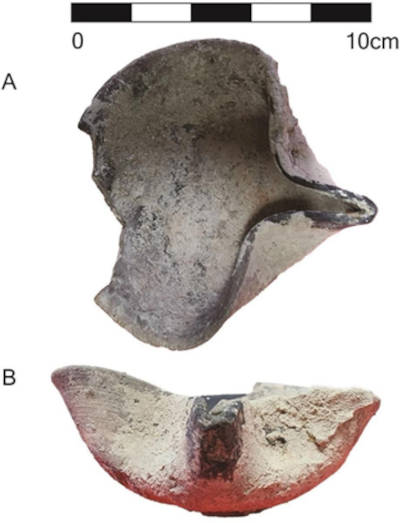
A late Mamluk lamp used until the sixteenth century, discovered at the eastern mill. (A. Frumkin et al., Water History)
The system's design demonstrates remarkable foresight in water management. Carving tunnels directly into the region's tufa rock minimized evaporation losses and maintained consistent water pressure, ensuring reliable mechanical power regardless of surface conditions. This approach contrasted sharply with exposed aqueducts that suffered from evaporation in the arid climate and required extensive maintenance.
Legacy of Adaptive Engineering
After sugar production declined in the region, the same hydraulic infrastructure was repurposed during the Ottoman period to power flour mills, with some continuing operation until the mid-20th century. This continuity demonstrates not only the durability of Mamluk engineering but also the adaptability of their industrial designs to changing economic needs.
The discovery challenges perceptions of the medieval Levant as technologically stagnant. Instead, it portrays the Mamluks as pragmatic innovators who transformed environmental constraints into economic opportunities. By converting saline water unsuitable for agriculture into industrial power, they created an infrastructure that connected rural production with global trade networks spanning from Egypt to Asia.
Professor Frumkin's team documented the tunnels using advanced cave-surveying techniques, measuring distances, directions, and gradients with laser rangefinders to create detailed three-dimensional maps. The project revealed that at least three mills operated within the park grounds, forming part of a larger industrial landscape that characterized the Bet She'an Valley during Mamluk rule.
The find adds a new dimension to understanding the Mamluk Empire, already renowned for monumental public works including aqueducts, bathhouses, and mosques. The Nahal 'Amal tunnels now demonstrate their sophisticated approach to industrial infrastructure, integrating geology, hydrology, and commerce to sustain one of their most valuable export industries.
Top image: Reconstruction showing how water from the tunnels powered crushing mills. Source: A. Frumkin et al., Water History (2025)
By Gary Manners
References
Frumkin, A., Yechezkel, A., Segal, D. et al. 2025. Water tunnels at Nahal 'Amal (Israel): evidence of a water-based sugar industry in the Mamluk period? Available at: https://link.springer.com/article/10.1007/s12685-025-00368-7
Radley, D., 2025. Hidden Mamluk-era tunnels reveal a hydraulic system that powered the medieval sugar industry. Archaeology News. Available at: https://archaeologymag.com/2025/10/hidden-mamluk-era-tunnels-sugar-industry/