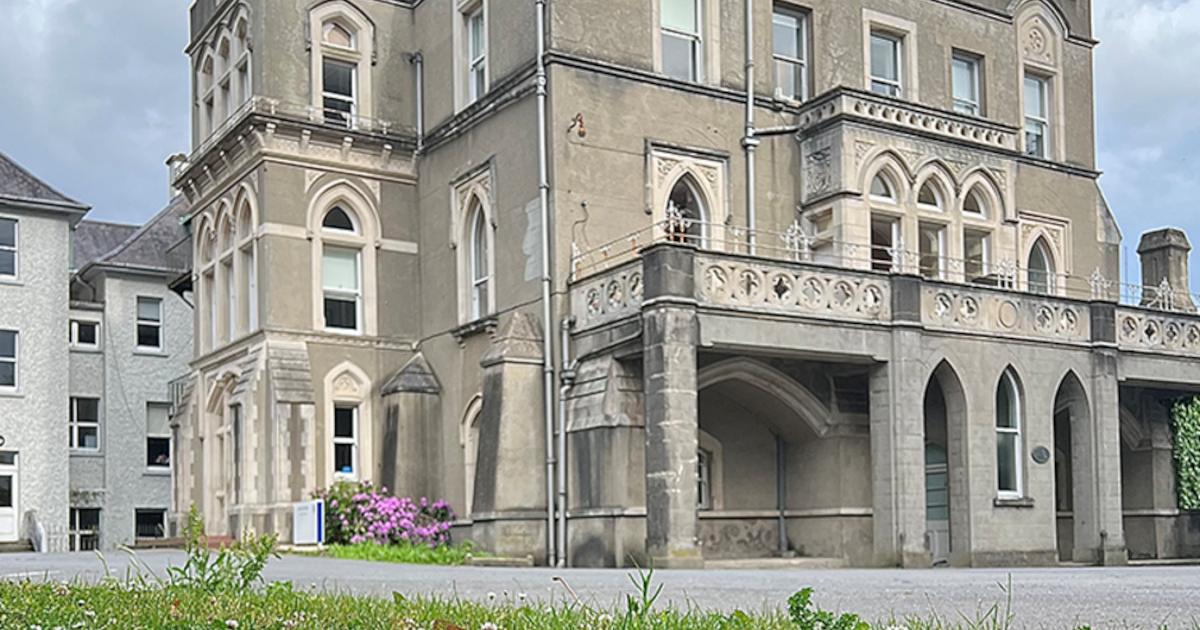

A Norman fortress long thought to have vanished has been found hiding inside University College Dublin’s Roebuck Castle. New evidence shows there are considerable remnants of medieval walls, architectural features, and even the old courtyard resting below subsequent Georgian and Victorian additions, making this a story not just about a building that had disappeared, but of a medieval castle that was quietly absorbed into a modern campus. The discovery gives a whole new history to a familiar university building of Dublin.
Hidden in Plain Sight
While researching this building and its historical photographs, Professor Tadhg O’Keeffe from the UCD School of Archaeology, who specializes in medieval architectural history, discovered the remaining fabric of the structure. According to Professor O’Keeffe in the UCD announcement:
“From the outside, the present building looks to be entirely Victorian. Inside, though, the walls of the old castle are preserved.”
Underneath the plaster, one can find some medieval features of the castle, and the courtyard at the rear of the current building corresponds to the layout of the ancient structure.
- Secret Room Discovered in Ireland’s Historic Johnstown Castle in Wexford
- Norman Artifacts Indicate Long-lost Monastery Has Been Found in Ireland
A Fortress on the Road to Medieval Dublin
Roebuck Castle played a significant role as a fortification along a route to proceed to medieval Dublin. Historical records date its building to within living memory of the Norman invasion of Ireland in 1169, although the precise date is not fully established. O’Keeffe believes the earliest part is from the 13th century. The period can be characterized by both the stone fortress of Dublin Castle, and the fact that such a type of castle was meant for the defense and a demonstration of power of its owner.
During the Middle Ages, Roebuck Castle underwent significant changes and was connected to many famous people including the medieval Lord High Chancellor of Ireland; it was also believed that the deposed James II stayed in the castle in 1689. However, although these facts are part of history, they do not prove that everything mentioned in the stories related to Roebuck is true.
- The Rock of Dunamase: Vikings, Anglo-Norman Nobles, and Oliver Cromwell
- Dublin Castle, Encapsulating the Beauty and History of Ireland
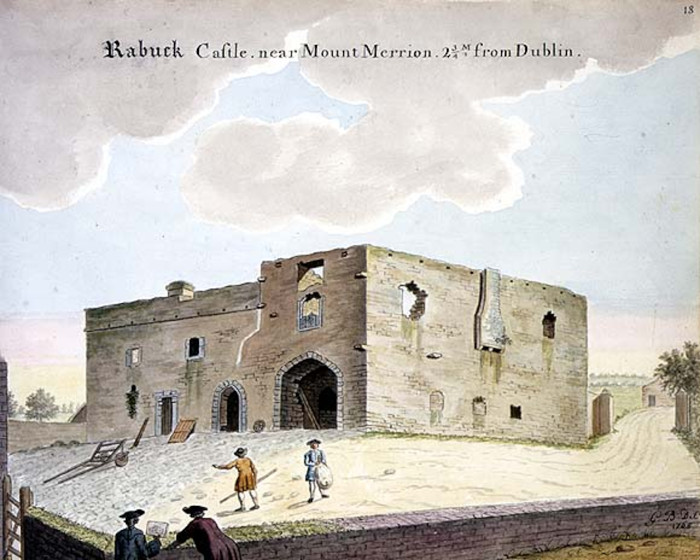
Beranger's 1765 watercolor of Roebuck Castle, viewed from the north-west. (Courtesy of the National Library of Ireland, Gabriel Beranger/Public domain)
The Watercolor Evidence
Roebuck Castle was a ruin by the 1700s. It was widely believed that it had been destroyed completely during later restorations, but artist Gabriel Beranger painted the castle in watercolors circa 1765 and left behind architectural clues allowing O’Keeffe to compare its form with the present building. Those images turned a seemingly vanished castle into a building that could be tested against surviving evidence.
The comparison is important due to the fact that lots of castles built in medieval times in south Dublin were destroyed in the 17th century, as their stone was used for the building of more modern and comfortable buildings. For this reason, Roebuck offers a rare survival story, resembling the discovery of buried layers uncovered during the work at Johnstown Castle, than conventional excavations of free-standing ruins. The walls were not kept because of the fact that the site was left untouched, but because later people constructed their buildings around those walls that already existed.
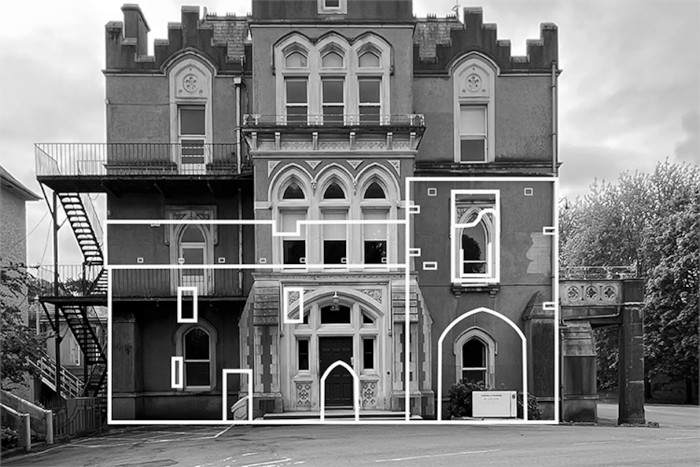
The facade of Roebuck Castle, with Beranger's drawing of the castle superimposed in outline. (University College Dublin)
A Medieval Courtyard on a Modern Campus
The finding changes the very way the structure should be understood. The present-day Roebuck Castle is not strictly medieval in character, but later construction work has preserved and enclosed important features of the former castle rather than destroying them. This approach to architecture explains how the ancient edifice remained hidden in plain sight, just like the Norman monastery found in Ireland buried deep in the ground remains a testimony to the changed landscape.
Further archaeological research is needed to establish the exact date and extent of the medieval fabric. Like the lost castle identified through modern landscape research, Roebuck shows how old structures can remain legible when historians combine written records, images and the buildings that still stand. “It is wonderful to be able to welcome back Roebuck’s medieval castle,” O’Keeffe said in the UCD Research report, “and to know that it won’t get lost again.”
Top image: Present day Roebuck Castle building. Source: University College Dublin
By Gary Manners
References
Archaeology Magazine. 2026. Medieval Castle Found Inside Dublin University Building. Available at: https://archaeologymag.com/2026/09/medieval-castle-inside-dublin-university-building/
Beranger, G. c. 1768. Roebuck Castle by Gabriel Beranger. Available at: https://commons.wikimedia.org/wiki/File:Roebuck_Castle_by_Gabriel_Beranger.jpg
Falde, N. 2023. Secret Room Discovered in Ireland’s Historic Johnstown Castle in Wexford. Available at: /news-history-archaeology/johnstown-castle-0019110
Kearns, D. 2026. ‘Lost’ medieval castle found hiding inside UCD building. Available at: https://www.ucd.ie/newsandopinion/news/2026/september/18/lostmedievalcastlefoundhidinginsideucdbuilding/
O’Keeffe, T. 2026. Remains of Medieval Castle identified on UCD Campus. UCD Research. Available at: https://www.ucd.ie/research/news/2026/remainsofmedievalcastleidentifiedonucdcampus/
Whelan, E. 2020. Dublin Castle, Encapsulating the Beauty and History of Ireland. Available at: /ancient-places-europe/dublin-castle-0013540