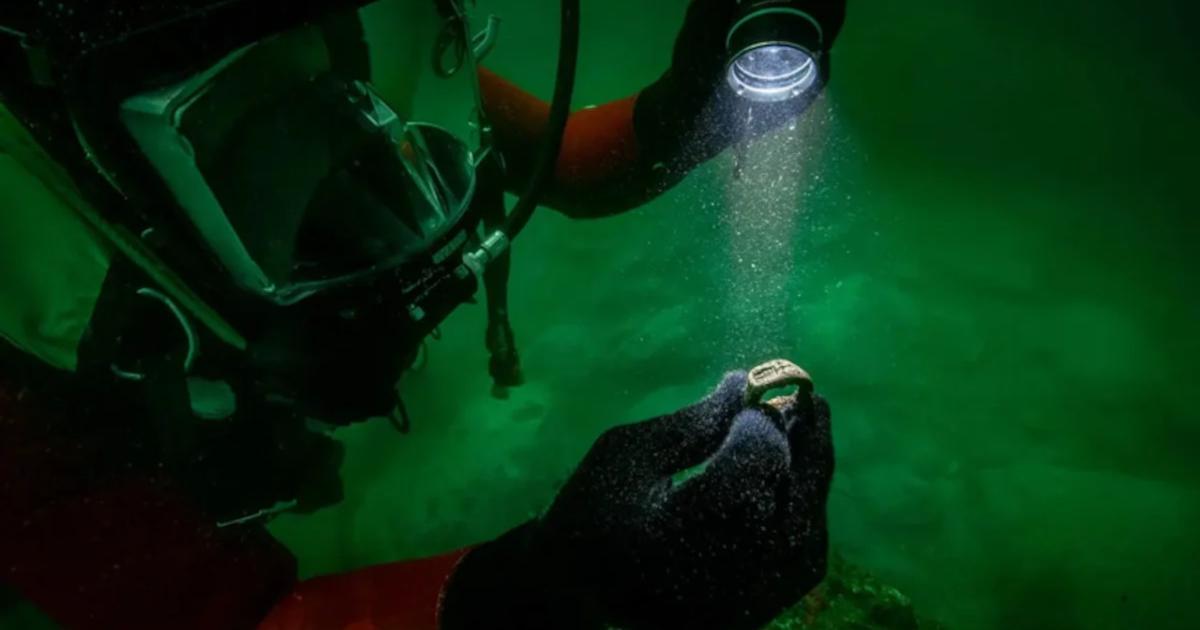

A bronze seal ring engraved with an image of the Lighthouse of Alexandria has been lifted from the sunken royal quarter of the city's Eastern Harbor. Egyptian authorities say it is the first known representation of the famous Pharos ever found on a seal ring, and the small object may tell us as much about the people who ran Alexandria's port as about the vanished wonder itself.

The ring engraved with an image of the Lighthouse of Alexandria. (C. Gerigk / F. Goddio / Hilti Foundation/MOTA)
A Wonder Shrunk to the Size of a Ring
The announcement came from Hisham El-Leithy, Secretary-General of Egypt's Supreme Council of Antiquities, during a visit by Tourism and Antiquities Minister Sherif Fathy to the underwater excavations, according to La Brújula Verde. The ring had been recovered days earlier on Antirhodos, the submerged royal island that once formed part of the Portus Magnus, Alexandria's great harbor. Its design closely resembles depictions known from coins minted in the second century AD, although the ministry has not given the ring a firm date.
El-Leithy called the discovery exceptional because, in his words, it is the first time the Lighthouse has been found engraved on a signet ring. This is significant because of what such an object did. A signet ring worked as a personal signature: its face was cut so that, pressed into wax or soft clay, it left a raised impression used to close letters, seal amphorae of wine and oil, and validate documents.
The Pharos became one of the Seven Wonders of the Ancient World, and for centuries its silhouette was the emblem of the city. Here, though, the monument has been reduced to something small enough to wear on a finger.
- Massive Blocks from the Lighthouse of Alexandria Recovered
- Alexandria Divers Uncover 2000-Year-Old Royal Pleasure Boat
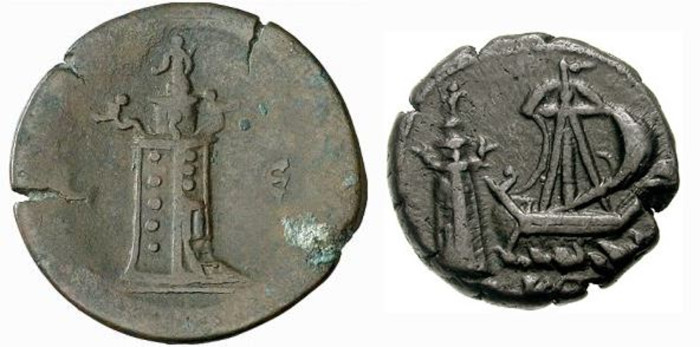
Coins minted at Alexandria in the second century AD show the Pharos with a statue on top and Tritons at the corners of its first level — the same scheme seen on the newly found ring. (CC BY-SA 3.0)
An Island of Palaces Beneath the Waves
Antirhodos now lies a few meters below the Mediterranean a little off the modern seafront, but in antiquity it was the private royal quarter of the Ptolemies. Strabo, who visited Egypt between 29 and 25 BC, described "an island lying off the artificial harbor, which has a royal palace and a small port", adding that Mark Antony later built a lodge there called the Timonium.
The season is run by the European Institute for Underwater Archaeology (IEASM) with Egypt's General Department of Underwater Antiquities, and covers four areas of the Eastern Harbor: the Temple of Isis, the palace and western hill of Antirhodos, the remains of an obelisk, and the Timonium. Archaeology Magazine reports that alongside the ring excavators recovered pottery and glass spanning roughly eight centuries, from the fourth century BC to the fourth century AD, including tableware, amphorae, bottles and oil lamps.
The island has been explored since 1992 under Franck Goddio, whose team has documented a Ptolemaic palace linked to Cleopatra VII. Its name means "rival of Rhodes", a nod to another ancient wonder, the Colossus.
- Finding the Lost City of Heracleion: Encountering Myth Under the Waves
- Ancient Submerged Cities: Rethinking Our Ancestry
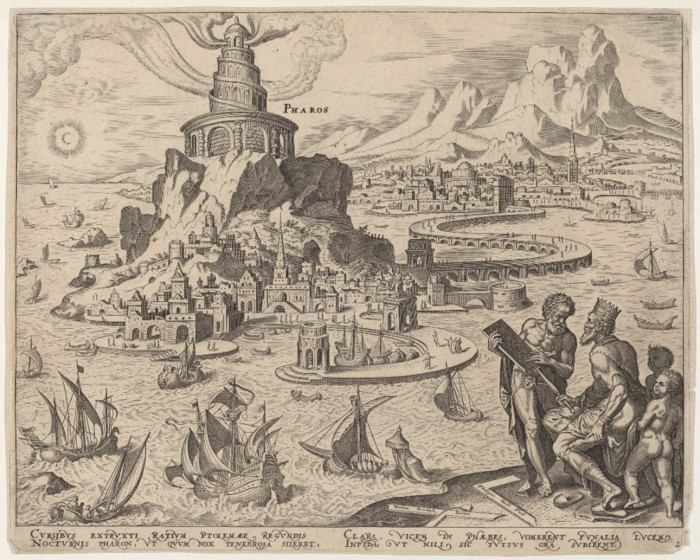
The Lighthouse at Alexandria, Philip Galle, after Maerten van Heemskerck (National Gallery of Art/CC0)
What the Ring Can, and Cannot, Say
Because seals carried authority, the Pharos image may have signaled an institutional role connected with the harbor, maritime communications, or the lighthouse itself. Egyptian authorities suggest the palace on Antirhodos may have remained in administrative use into the second century AD, perhaps in connection with managing the lighthouse. The ministry writes that cautiously, and no sealed document or inscription identifying a lighthouse office has yet surfaced.
Other specialists urge patience. The researcher Andrew Michael Chugg has noted a Roman seal of blue glass in Vienna's Kunsthistorisches Museum and a Byzantine gemstone in the British Museum, both bearing images of the tower, though neither is described as a ring. The date, size and owner of the new find all remain unknown.
The building it depicts was vast, rising to roughly 120 meters, and its architect Sostratus of Cnidus dedicated it to the safety of sailors. Earthquakes in 1303 and 1323 finally felled it. In 2025 a separate team raised 22 of its blocks from the seabed for digital reconstruction, Ancient Origins reported. When this season closes, Goddio's mission moves to Abu Qir Bay, near the sunken cities of Canopus and Thonis-Heracleion.
Top image: The Lighthouse of Alexandria ring at the time it was found with underwater archaeologist. Source: C. Gerigk / F. Goddio / Hilti Foundation
By Gary Manners
References
Archaeology Magazine. 2026. Ancient Alexandria Lighthouse Image Found on Bronze Seal Ring. Available at: https://archaeologymag.com/2026/10/alexandria-lighthouse-image-on-bronze-seal-ring/
Arkeonews. 2026. First-Ever Seal Ring Showing the Lighthouse of Alexandria Found in the Sunken Royal Quarter. Available at: https://arkeonews.net/first-ever-seal-ring-showing-the-lighthouse-of-alexandria-found-in-the-sunken-royal-quarter/
Goddio, F. 2026. Alexandria – The Ancient Portus Magnus. Franck Goddio / European Institute for Underwater Archaeology. Available at: https://www.franckgoddio.org/projects/sunken-civilizations/alexandria/
Greek Reporter. 2026. Ancient Ring From Cleopatra's Sunken Harbor May Show Lost Lighthouse of Alexandria. Available at: https://greekreporter.com/2026/10/07/ring-cleopatra-sunken-harbor-lost-lighthouse-alexandria/
La Brújula Verde. 2026. A Bronze Ring Engraved with the Lighthouse of Alexandria Has Been Found in Cleopatra's Sunken Harbour. Available at: https://www.labrujulaverde.com/en/2026/10/a-bronze-ring-engraved-with-the-lighthouse-of-alexandria-has-been-found-in-cleopatras-sunken-harbour/