
Archaeologists investigating China’s Fanshan cemetery have reconstructed three timber buildings that may have stood beside the graves of Liangzhu’s highest-status rulers around 5,000 years ago. The discovery of 120 postholes has revealed the outline of a substantial oval structure and two smaller buildings, raising the possibility that the Liangzhu cemetery was also a carefully planned ceremonial precinct. Researchers stress, however, that the largest building’s ritual function remains a proposal rather than a proven conclusion.
Three buildings emerge from the ground
As Xinhua News Agency reported, excavations at Fanshan resumed in 2024 after archaeologists identified a rectangular enclosure outside the cemetery. Carbon-14 dating of its eastern and southern walls places their construction in roughly the same period as Tomb M12, where the celebrated “King of Cong” and “King of Jade Yue” were found. The enclosure may therefore have marked the boundary of a dedicated burial ground.
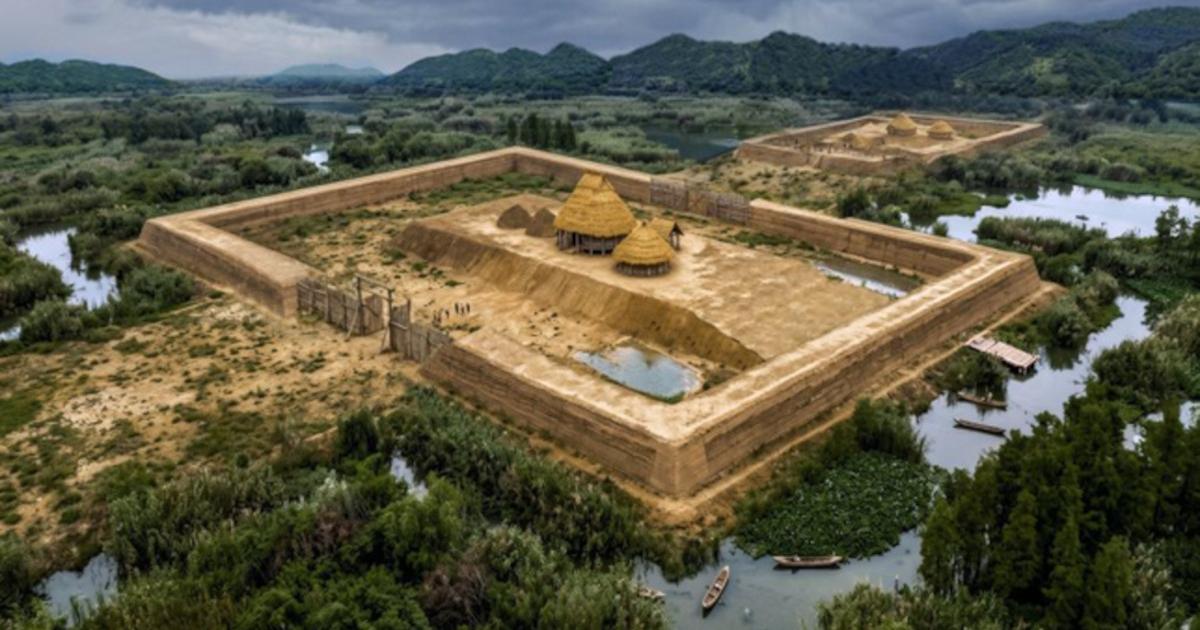
In 2025, building traces appeared east of the cemetery, and this year researchers reconstructed them from the surviving postholes. The largest, labelled F1, had an oval plan about 25 meters long and 16 meters wide. Two smaller buildings stood nearby, one close to circular and the other nearly square; together, the 120 postholes indicate a planned group rather than isolated houses.
- Elaborate Jade ‘Cong’ and ‘Bi’ as Grave Goods of the Liangzhu Culture
- The Enigmatic Chinese Cong Relics
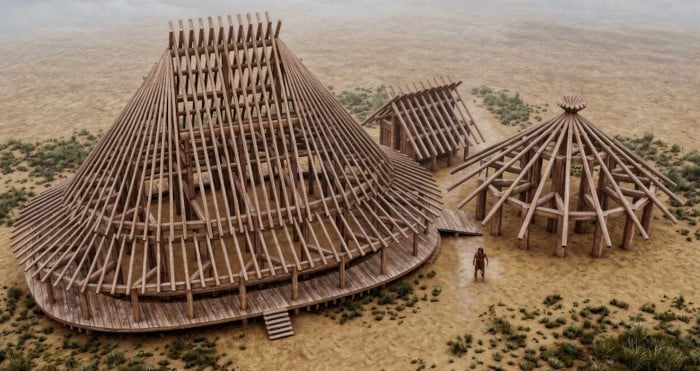
A representation of the three buildings. (Xinhua News Agency)
A possible hall for the dead
The reconstruction is based not only on measurements of the holes, but also on timber remains and architectural motifs incised on Liangzhu pottery. Researchers suggest that F1 may have been a raised-floor, ganlan-style building with three rings of posts and a two-tier roof. On the current reconstruction, it would have reached about 15 metres, while the smaller structures were probably simpler thatched buildings.
Its position is the key clue. The buildings lay beside the elite graves, leading Wang Ningyuan of the Zhejiang Provincial Institute of Cultural Relics and Archaeology to suggest that F1 may have been a xiangdian—a hall used for ceremonies honouring deceased rulers or ancestors. Independent coverage by HeritageDaily and ArkeoNews likewise presents the ritual interpretation as plausible, not settled.
- The Mysterious Origin of the Jade Discs
- 5100-year-old Hydraulic System Found in China is the Oldest in the World
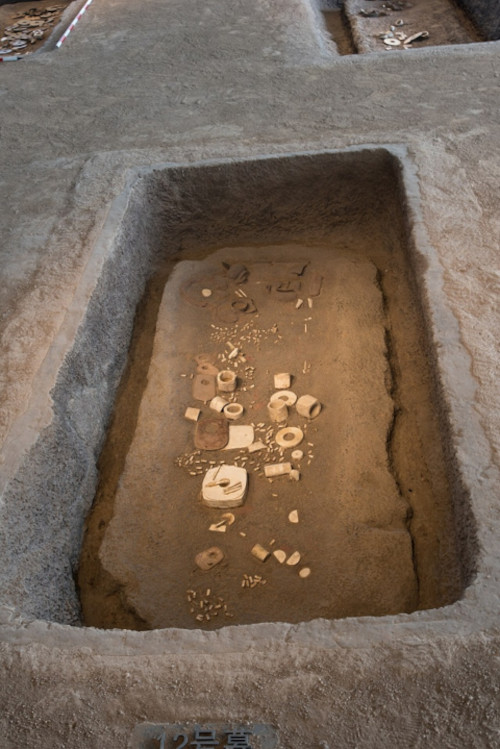
Fanshan M12 reconstruction display, associated with the discovery of the “King of Cong” and “King of Jade Yue.” (Siyuwj / CC BY-SA 4.0)
Fanshan and the rise of Liangzhu power
Fanshan first drew major attention in 1986, when its richly furnished graves produced extraordinary quantities of jade. Cong—square on the outside and round within—and bi discs are widely associated with Liangzhu ritual and status, although their precise meanings remain unknown. The concentration of such objects in elite graves is one reason Ancient Origins has described Liangzhu jade as a marker of hierarchy.
The wider site helps explain why the new buildings matter. The UNESCO World Heritage Centre describes Liangzhu, which flourished about 3300–2300 BC, as an early regional state with rice agriculture, planned settlements, water-control works and socially differentiated cemeteries. Earlier work on its hydraulic system, and newer research into unusual mortuary practices such as systematic human bone modification, show a society whose organization extended well beyond its famous jades.
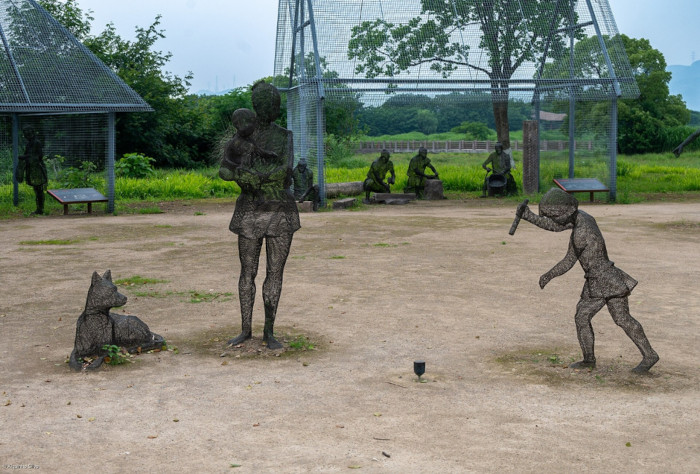
The Archaeological Ruins of Liangzhu City, dating back to 3300-2300 BC, are a testament to the ancient urban civilization in the Yangtze River Delta of China. (xiquinhosilva/CC BY 2.0)
A new funerary landscape
If future excavation finds hearths, food remains or household rubbish, the buildings may prove residential rather than ceremonial. If instead they yield evidence of repeated offerings or controlled access, F1 could become one of the earliest known examples of architecture designed around a ruler’s tomb. For now, the enclosure, elite graves and reconstructed buildings suggest that the Liangzhu cemetery was not simply a place of burial, but part of a landscape where power, ancestry and ritual were made visible.
Top image: Fanshan ritual reconstruction . Source: Xinhua News Agency
By Gary Manners
References
ArkeoNews. 2026. Possible 5,000-Year-Old Ritual Building Discovered Beside Royal Tombs in China. Available at: https://arkeonews.net/possible-5000-year-old-ritual-building-discovered-beside-royal-tombs-in-china/
Feng, Y. 2026. Liangzhu Archaeology Finds Buildings Beside the “Royal Tombs,” Possibly Ritual Halls. Available at: https://www3.xinhuanet.com/politics/20261020/32b2bae54553439fbce5f5e9463cdb62/c.html
HeritageDaily. 2026. 5,000-Year-Old Ceremonial Complex May Have Stood Beside Royal Tombs in Ancient China. Available at: https://www.heritagedaily.com/2026/10/5000-year-old-ceremonial-complex-may-have-stood-beside-royal-tombs-in-ancient-china/159741
Manners, G. 2025. Systematic Human Bone Modification Found in Neolithic Liangzhu Culture. Available at: /news-history-archaeology/human-bone-modification-liangzhu-00102181
UNESCO World Heritage Centre. 2019. Archaeological Ruins of Liangzhu City. Available at: https://whc.unesco.org/en/list/1592/
Wu, M. 2016. Elaborate Jade ‘Cong’ and ‘Bi’ as Grave Goods of the Liangzhu Culture. Available at: /artifacts-other-artifacts/elaborate-jade-cong-and-bi-grave-goods-liangzhu-culture-005428