
The bronzes of Scandinavia's Late Bronze Age had to start somewhere as rock. A new study suggests that some of that copper may have come from southwestern Spain.
The paper, published online in the journal Antiquity on October 26, 2026, reports the results of fieldwork at Las Minillas, a copper mine near Granja de Torrehermosa in the province of Badajoz, Extremadura. The lead author is Juan Latorre-Ruiz of Durham University, writing with nine colleagues from Durham and the universities of Seville, Gothenburg and Lund. Their radiocarbon dates place mining at the site in the Late Bronze Age, and their chemical and lead isotope tests find 11 Scandinavian bronzes that are consistent with its ore.
A trench along a vein of ore
Las Minillas is a 300 meter long outcrop of copper ore, according to the paper. Systematic investigation began in 2020, with major field campaigns in 2020, 2021 and 2023, as a precursor to the Maritime Encounters project.
The paper describes the Late Bronze Age workings as trenches dug along the ore vein, now filled with debris. Using excavation, ground penetrating radar and geotechnical drilling, the team found that the trenches reached depths of 8.2 meters and widths of 2 to 4 meters. A drill hole near one trench produced charcoal at 8.2 meters down.
Charcoal also turned up concentrated at the base of another trench. The authors write that this suggests "the use of fire-setting to fracture the ore." La Brújula Verde explains the technique as "an old mining trick in which a fire is lit against the rock face so the heat cracks it and makes it easier to break."
Hammers by the hundred
The team documented 892 stone tools, including 735 grooved stone hammers like those found at Chinflón and other Bronze Age mines. La Brújula Verde describes each hammer as having "a groove around the middle so it could be tied to a handle."
Near the workings, the excavators found the remains of a circular hut with postholes and fireplaces, along with handmade Late Bronze Age pottery. The paper interprets it as "a short-lived hut likely part of a seasonal mining encampment."
On the strength of the scale of the workings, the many radiocarbon dates and the abundance of tools, the authors describe Las Minillas as "the largest securely dated Late Bronze Age copper mine excavated in Iberia to date."
When the mine was worked, and when it was not
The dates come from charcoal. Nine samples from the mining trench, including from drilling to its base, and eight from the hut area give radiocarbon dates spanning approximately 1350 to 750 BC, which corresponds to the Late Bronze Age.
One part of the site tells a different story. A metallurgical area produced copper droplets, about 300 kilograms of nodular slag and a partly preserved circular structure that may have been a furnace. The excavators first attributed that structure to the Late Bronze Age. However, the radiocarbon results did not support that. All five charcoal dates from this area are more recent: four fall in the Roman period, in the second to fourth centuries AD, and one in the Islamic period. A reddened clay fragment, possibly a piece of furnace wall, was dated by optically stimulated luminescence to a span that La Brújula Verde summarizes as "between the Late Bronze Age and the Iron Age."
So the possible furnace cannot be tied to the Bronze Age. As La Brújula Verde puts it, "When the ore was smelted at Las Minillas therefore remains an open question."
Reading the fingerprint in the lead
To trace where the metal went, the team turned to lead isotope analysis. La Brújula Verde explains that the lead at Las Minillas is varied because its ores formed at different moments in geological time. The paper notes that this method has been used for about four decades to study Bronze Age metal provenance and that, combined with chemical analysis of ores and ancient metals, it "can provide a good indication of the geographical origin of copper."
The researchers analyzed ores, slags and copper droplets from Las Minillas. Their lead isotope ratios fall outside the known overlap between Spanish ores and those of the Trentino Alto Adige mines in the Italian Alps, and they are also distinct from Sardinian copper ores. That matters, La Brújula Verde explains, because inside that overlap "the two sources are hard to tell apart, and Las Minillas does not sit there."
The team then compared these results with published data on more than 300 Late Bronze Age bronze objects from across Scandinavia. Eleven artifacts of various types emerged as "isotopically and chemically consistent" with the material from Las Minillas. Like the Spanish samples, they show a similar large range of antimony and silver. On average, the Scandinavian bronzes contain less nickel than the Las Minillas samples, though still within the range of some of the ores and droplets.
The timing lines up in part. Seven of the 11 bronzes belong to Period V of the Nordic Bronze Age, 900 to 700 BC, which the authors say "closely corresponds with the latest documented phase of exploitation" at the mine. Two belong to Period VI, 700 to 500 BC, and so postdate the final phase of mining there. It is not yet clear how their metal came to match.
A small mine among many
On its own, Las Minillas was not a giant. The paper gives output estimates ranging from an optimistic 738 tonnes to a cautious 197 tonnes, with a minimum of 49 tonnes. By comparison, the copper mining boom at Great Orme in Wales is estimated to have produced between 202 and 756 tonnes during 1600 to 1400 BC, and the Mitterberg district in the Austrian Alps approximately 23,000 tonnes.
The authors place Las Minillas within what they call the Southern Iberian Copper Mining Complex. More than 100 potential prehistoric mines have been identified in southern Iberia, though few have been systematically investigated. At present, six mining sites can be securely attributed to the Late Bronze Age, including Las Minillas and the ancient mines of Rio Tinto at Corta del Lago. "If active contemporaneously," the authors write, "their combined output may have rivalled that of other major European mining districts."
The search for Iberian metal in the North
A University of Gothenburg release on EurekAlert from February 2026, about a separate survey that recorded six more Bronze Age mining sites around Cabeza del Buey in Badajoz, says earlier analyses of Scandinavian Bronze Age artifacts had shown "that much of the metal likely originated in southwestern Spain." That work, led by Johan Ling, has been reported before, including in coverage of Bronze Age weapons found in Sweden made with metal from far away.
In that release, Ling, a professor of archaeology and one of the Antiquity authors, said, "These discoveries demonstrate that metal extraction in southwestern Europe was far more extensive and organized than previously recognized, and they provide a concrete archaeological context for the chemical and isotopic analyses that point to long-distance connections during the Bronze Age."
However, the new paper is careful about what it claims. It "advances a hypothetical model" in which Late Bronze Age Iberia complemented copper sources in the Alps, Wales and Sardinia, supplying local, Atlantic and Nordic, and western Mediterranean communities mainly by sea. The authors also write that limited lead isotope and chemical data "hinder provenance studies" and that many Iberian mines have poorly defined dates.
What remains open
An isotope match means the metal in those 11 bronzes is consistent with copper smelted at Las Minillas. La Brújula Verde stresses that compatible does not mean proven. The study does not say who moved the metal, by what route, or how many hands it passed through on the way north. The authors say the site's complex geology and further comparisons will be reported in future publications.
How we label claims
Established: the size and depth of the trenches, the tool counts, the hut, the radiocarbon range of about 1350 to 750 BC, the later Roman and Islamic dates from the metallurgical area, the output estimates and the comparisons with Great Orme and Mitterberg, all as reported in the Antiquity paper. Disputed: that copper from Las Minillas reached Scandinavia. Eleven bronzes match its ore in lead isotopes and chemistry, but a match shows compatibility rather than proof, the Scandinavian bronzes carry less nickel on average, and two of them date after mining at the site ended. Unverified: the authors' model of southern Iberia as a major supplier, which they call hypothetical. Unverified: who carried the metal and by which route.
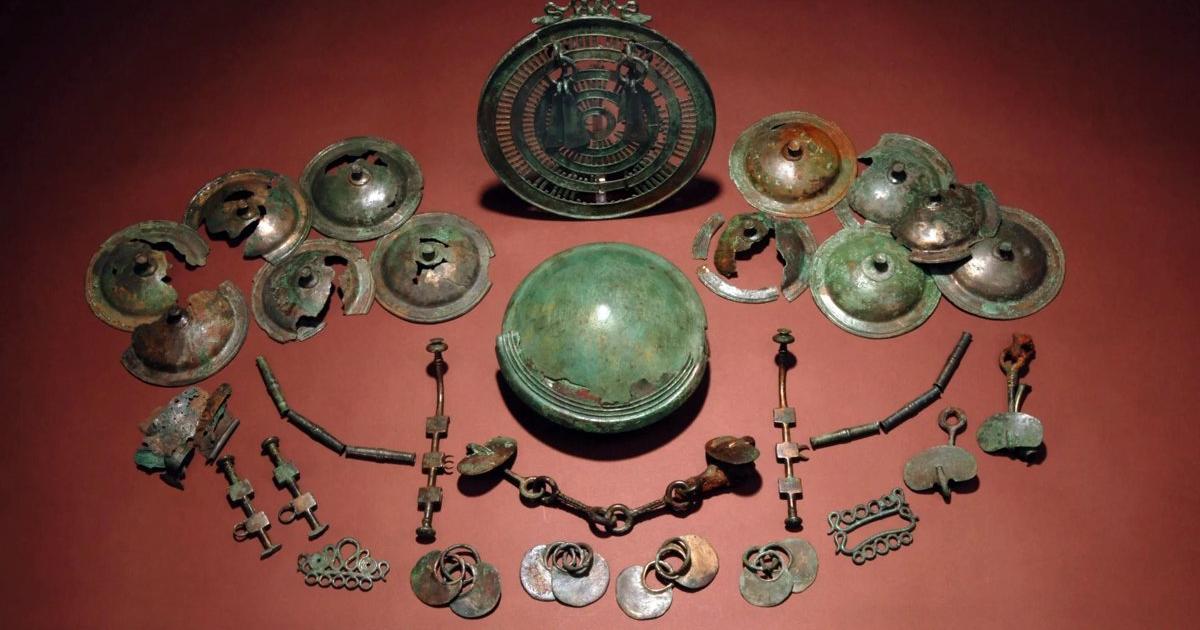
Bronze equestrian gear from Sweden, dated by the Swedish History Museum to the Nordic Bronze Age, around 900 to 500 BC. These objects are shown for period context. They are not identified as any of the 11 bronzes in the new study. Photo by The Swedish History Museum/SHM, via Wikimedia Commons, CC BY 4.0.
By Aris Manus
Sources
- Juan Latorre-Ruiz, Mark A. Hunt Ortiz, Zofia Anna Stos-Gale, Aurélien Burlot, Jacobo Vázquez-Paz, Miguel Ángel de Dios Pérez, Manuel Grueso-Montero, Mikael Fauvelle, Marta Díaz-Guardamino and Johan Ling, Iberian copper and Bronze Age Europe: Late Bronze Age mining and supply at Las Minillas (Badajoz, Spain), Antiquity, published online October 26, 2026
- Six newly discovered Bronze Age mines in Spain may explain the origin of Scandinavian Bronze, University of Gothenburg via EurekAlert, February 24, 2026
- 3,000-year-old Spanish copper mine hints at an Iberian hub in Bronze Age Europe, reaching as far as Scandinavia, Archaeology News Online Magazine, October 29, 2026
- A 3,000-year-old Spanish mine rivaled the Alps for Europe's Bronze Age copper. Metal may have reached Scandinavia, La Brújula Verde, October 28, 2026