
The conventional theory is that humans and Neanderthals interbred between 40,000 and 50,000 years ago, with Neanderthals going extinct not long after that. But a new study has determined that the skeleton of a child with both human and Neanderthal traits found in central Portugal three decades ago is approximately 28,000 years old, which is well outside that timeline.
For the first time, advanced radiocarbon dating has provided a precise age assessment for the “Lapedo Child,” one of the most intriguing prehistoric human skeletons ever unearthed—and the possible implications of that assessment are profound.
Were Neanderthals alive and still interbreeding with their human cousins as recently as 26,000 BC? The answer to this question is unclear at the moment, but it is not as farfetched as it might sound, given the unusual traits this child possessed.
- Geneticists Show How Neanderthals Never Really Went Extinct
- Neanderthal Child Development Was Faster than Humans, Study Reveals
Unearthing the Lapedo Child
The Lapedo Child's skeleton was first uncovered in 1998 in the Lagar Velho rock shelter, located in Lapedo Valley, Portugal. The remains, belonging to a young child about four to five years old, were found in a burial site that seemed to indicate a ritualistic burial practice.

Lagar Velho rock shelter, Lapedo Valley, Portugal. (João Zilhão/Science Advances).
Upon closer inspection, the child’s physical traits revealed a blend of Neanderthal and modern human characteristics. For example, the child’s lower limbs were much shorter than those of a modern human, resembling a Neanderthals, while the skull carried a classic human shape and dimensions, particularly the teeth and inner ears. At the same time, a pitted occipital region again revealed the presence of Neanderthals DNA.
At first, the idea of interbreeding between Neanderthals and early humans was dismissed by many scientists. This was before the Neanderthal genome had been sequenced, and hybridization seemed controversial. However, genetic studies have since confirmed that humans and Neanderthals did indeed interbreed multiple times, with traces of Neanderthal DNA still being found in modern human populations outside of Africa.
Revolutionary Radiocarbon Dating of the Lapedo Child
For years, dating the Lapedo Child’s remains has been challenging. Previous attempts using traditional radiocarbon dating methods produced varying results, ranging from 20,000 to 26,000 years ago.
- Neanderthals and Humans Were at War… For 100,000 Years!
- Shock Discovery - Humans First Interbred with Neanderthals 250,000 Years Ago
A new approach, known as compound-specific radiocarbon analysis (CSRA), has now been used to give a more accurate age: between 27,780 and 28,850 years ago. As the international team of researchers involved in the new study explain in Science Advances, this technique isolates amino acids from the collagen in the bones, minimizing the risk of contamination from modern substances that can skew results, especially in poorly preserved fossils.
In addition to dating the child’s skeleton, the team examined other materials found near the burial site, to investigate the possibility that rituals had been performed.
Items such as rabbit bones, red deer bones, and charcoal were found alongside the child’s remains. While the rabbit bones appeared to be contemporaneous with the child, the red deer bones and charcoal were older, suggesting they were not deliberately placed as part of the burial. The researchers propose that the rabbit bones may have been part of a symbolic offering placed before the grave was sealed, given their similarity to the red ocher pigment found on the burial shroud.
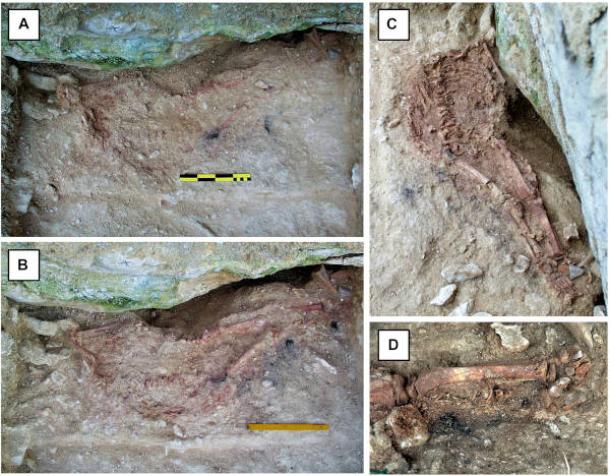
Charcoal in the grave, at four different spots around the child’s body. (João Zilhão/Science Advances).
One key finding from the study is that the burial site was abandoned after the child’s interment. It is hypothesized that the death of the child may have led the area to be regarded as taboo, and the site was then left undisturbed for over 2,000 years. This could shed new light on the burial customs and social practices of both Neanderthals and early humans, who likely attributed symbolic or spiritual significance to such locations following significant events like death.
A New Perspective on Neanderthal Extinction
The dating of the Lapedo Child’s remains offers compelling evidence that Neanderthals may have survived much longer than previously thought. Genetic evidence suggests that interbreeding began at least 49,000 years ago and lasted for approximately 7,000 years, after which Neanderthal extinction came relatively quickly. However, if the Lapedo Child, a hybrid individual, lived around 28,000 years ago, then questions arise as to whether genetic exchanges lasted longer than previously thought, or whether hybrid traits appeared in later generations, popping up out of the human gene pool randomly from time to time.
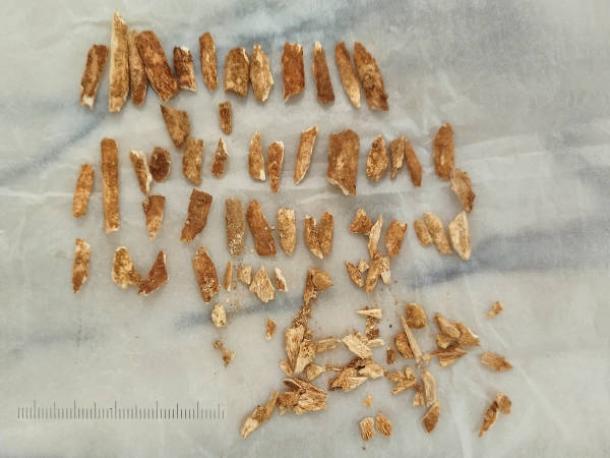
Pieces of the deceased child’s shattered radius bone, used to obtain the new radiocarbon dating results. (João Zilhão/Science Advances).
Those who are committed to a much earlier Neanderthal extinction are naturally championing the latter idea. But it seems more likely that a child with clear and distinct hybid traits would have picked them up from human and Neanderthal ancestors who lived relatively recently.
This groundbreaking study not only provides a more precise dating of the Lapedo Child but also opens new avenues for future paleontological research. The authors of the study believe the method of radiocarbon dating they used could prove valuable for dating other significant Paleolithic human remains, offering further insights into the complex relationship between Neanderthals and early humans—which may very well have lasted for thousands of years longer than was once thought, throwing the conventional story of the Neanderthals’ disappearance into doubt.
Top image: Model of Homo neanderthalensis child in the Natural History Museum, Vienna.
Source: Jakub Halun/CC BY-SA 4.0.
By Nathan Falde