Pythagorean Pyramid
It is well-known that Pythagoras’ ancient Greek equation for right triangles: a2+ b2= c2 , is older than ancient Greece. We also know that in Khufu’s pyramid the height equals the radius of a circle that has the circumference of the sum of the pyramid’s four sides added. That is, if we use the value 22/7 for p (pi), usually ascribed to Archimedes.
The much neglected subterranean chamber in Khufu’s pyramid reveals more ancient geometry.

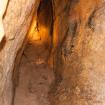
It is quite understandable why the subterranean chamber in Khufu’s pyramid was thought to be unfinished and abandoned as burial chamber. (John & Morton Edgar photo from: Great Pyramid Passages and Chambers, Vol. I, 1910.)
In the interpretation of this author, the subterranean “unfinished cave” was neither unfinished nor abandoned; on the contrary, it was designed to fit perfectly into a system in which the vertically arranged chambers are meant to be rungs of a ladder to the sky for the deceased King Khufu’s spirit.
Each chamber can be seen as representing, or honoring, one of the five famous nature element gods from nearby Heliopolis. Earth, ‘water’ (rain & mist), and air gods define the three known chambers. The subterranean chamber likely honors the earth god Geb and his most massive material - stone. Naturally it would be good to find evidence that points to this.
In this respect, the chamber’s form, dimensions and connection with the upper chambers are truly fascinating to study.

This old photo of the cleared chamber shows the flat elevated plateau in the west end and its sloping front. (John and Morton Edgar: Great Pyramid Passages and Chambers, Vol. I,1910.)
‘Earth’ in the Subterranean Chamber
The drawing below shows how a short square wooden pipe, placed vertically in the well, with water hoisted up and poured onto the chamber floor, would create a scenery matching what the Greek historian Herodotus was told when he visited Egypt two thousand years after Khufu lived: that the king lay buried under his pyramid, on an island surrounded by water coming from a canal. Suddenly it all gives meaning - the blind canal, the water well and the “island”. It was a staged symbolic tableau.

A short wooden pipe is all that is needed to turn the chamber into a burial chamber reflecting Herodotus’ description. (Author provided)
Square
In later ages and cultures the quadrangle, especially the quadrat (square), and the number four have been earth element symbols.
Since the Heliopolitan nature elements and the later Greek elements appear to be rather similar, perhaps it is not impossible that the Egyptian Earth-god Geb’s element predates the later earth element in square/quadrat and number 4 symbolism. It is worth checking.

A hexagon inscribed in the Queen’s chamber – which I believe was Tefnut’s rain and mist (water) chamber, constructed with the depressed floor as a low basin for water. (Author provided)
Queen’s Chamber and “6”
A hexagon can be inscribed vertically in the Queen’s chamber (likewise traditionally regarded as unfinished), the middle of which is exactly in 1/6 of the pyramid’s altitude. The side walls have six layers. Apparently they took that form and number serious. I refer to my earlier Ancient Origins article “A Watery Solution to the Enigmas of Khufu Pyramid’s Queen’s Chamber” for details.
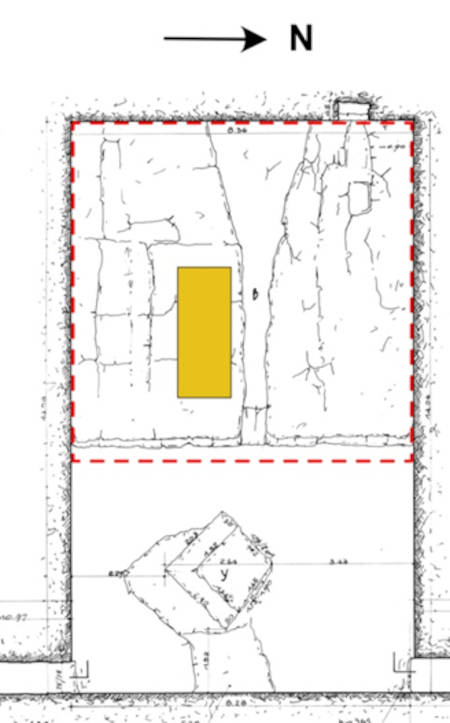
The elevated – most ‘earth’ filled - part of the chamber is near-to quadratic.
This and following illustrations are based on Maragioglio & Rinaldi’s fine survey drawings.
(Maragioglio & Rinaldi: L’architettura delle Piramidi Menfite, parte IV, tavole, 1965) (Author provided)
Quadrat
The Maragioglio & Rinaldi fine survey drawing (with my indication of a sarcophagus) depicts the most
‘Earth filled’ – western part of the chamber as a square, just a little too short to the eastern side to be a perfect quadrat. Photos like the ones in the start of this article reveal that the plateau’s side slopes slightly outwards-downwards, so its difficult to define bottom ‘edge’ must be a little longer to the east than the top edge. The whole mass of bedrock should be included in our 3D vision of the block of Earth in this chamber’s west end. It is all inside the quadrat.
Once you spot the square it is almost impossible to ignore it again, accurate quadrat or not.
The Number 4
Maragioglio and Rinaldi measured the chamber width to be 8.36 m at the west wall. In the ancient Egyptian unit the royal cubit (=0.5236 meter) this distance is very close to 16 cubit = 8.3776 meter. Less than 2 centimeter difference. The Edgar brothers mentioned (1910) that the rough surfaces in this chamber made precise measuring difficult.
Presuming 16 cubit was the intended size, you may reflect on that 16 is a square number (4x4). 4 is even a square number itself (2x2) as well as the number of sides in a square.
Furthermore, in the vertical section 4x4 cubit squares – four of them – strongly indicate that the king’s built-in sarcophagus was placed on a flat plateau a quarter of the chamber width (4 cubit) below the ceiling.
In comparison to the nice quadrate 16 cubit width the Queen’s chamber measures precisely 10x11 cubit and the King’s chamber precisely 10x20 cubit.
The length of the subterranean chamber is close to 27 cubit (north and south walls measured to be 14.06 and 14.08 meter – c. 2617/20 cubit).

In the vertical section squares 4x4 cubit seem to define the plateau’s level. (Author provided).
Diagonal: not ‘the divine proportion’, but a ‘half-divine’ one
Let us for a moment visualize this burial chamber split into two sections. The earth square part, and the rest.
The diagonally turned well may hint to an interesting explanation to the size of the chamber’s eastern part. Namely the diagonal understood with the symbolism we know from later ages. So perhaps this symbolism originated in ancient Egypt?

Left: An old tarot card showing how the compass is the architect’s tool for transforming heavenly circle-wisdom into square buildings. Jacques Viéville tarot deck, c. 1650 (By the way: notice the building has five floors!). Right: Square and compass freemason’s logo from the Copenhagen loge building.
Much later the Italian renaissance architect Andrea Palladio (1508-1580) listed in his Quattro Libri dell’ Archittura several especially beautiful proportions for rectangles - among them the rectangle with one side length the size of the square’s diagonal. This new side length is easily drawn on paper with the help of a compass. Or constructed on a building site with a rope. Thinking about why he found it beautiful, the circle was regarded heavenly and the quadrat material, so the combination symbolically expressed divine-human collaboration (which was to become an ideal for freemasonry, reflected in their square-compass logo).
Today the format is used in A-format paper: A1, A2, A3, A4…

A square with sides 5.93 m has a diagonal as long as the chamber’s north-south width. Notice the diagonally turned well that almost urges us to think in diagonals. The square that defines this eastern part of the chamber has side lengths that combines square/earth and circle/heaven – extremely well-planned If it was intended to be a symbolic platform for the king’s spirit to ascent from.
Now take the chamber width and turn it with the help of a compass to become diagonal of a smaller square. This new square is near to fittting the space between the chamber’s western part and the east wall. Not exactly, it is a little bit larger, but look at the drawing with two such squares to fill the A-format space and all diagonals drawn: the diagonals seem to rather precisely define the well’s sides. This can hardly be a coincidence.
Might we then actually have a confirmation from the diagonally turned well that the ancient Egyptians saw the diagonal-defined square as a combination of both earth and sky, or earth and sun?
A symbolic explanation for the two different square formats combined in the subterranean chamber - quadrat in west, A-format in east - is that the chamber held two functions: 1) the west part containing the whole quarry-resembling mass of bedrock was meant to be caring for the king’s physical corpse, and 2) the east part had the purpose of servicing his spirit’s coming and going.

Here I have tried to separate the two square formats that seem to be intersecting a bit. (Author provided).
The circle-section I have drawn shows how the 16 cubit long diagonal matches a quadrat width of 5.93 meter, or c. 11⅓ cubit (a quadrat’s diagonal is = 1.4142 times bigger than its sides).
It seems however that they planned the east part square with whole-digit measures, 11 cubit. If you look at the pyramid chambers from above in a transparent view, such a whole number quadrate drawn in the middle is near to coincide with the subterranean west-part quadrate’s east side, and it coincides exactly with the King’s chamber’s north wall and the Queen’s chamber’s south wall. Suddenly there is a visual connection between the waterfilled east part of the subterranean chamber and the likewise watercovered floor of the Queen’s chamber. They have the same 11 cubit length.
Somehow a whole-number 11 cubit quadrate seems to have been central for the planning of how the three chambers were distributed around the central well.
What is the explanation for why the central quadrate does not have the exact size we had figured out? I do not know. Maybe, in Egyptian understanding, squares created with the help of heaverly circles does not even have to be exact A-formats. Or is it because they did not calculate in decimals but in fractions, and probably did not know square roots?
The assumption seems right, however, that the eastern part of the subterranean chamber is central for helping the king’s spirit to move from one level to the next on his ascent to heaven and back.

The well is placed in the middle of the three known chambers. Notice how the Queens chamber (Tefnut’s watery chamber) has the same east-west length as the area in the subterranean chamber that was covered with water.
From Underworld to Sky
All in all it is satisfying that the search for earth square and number 4 symbolism in the subterranean chamber was succesfull. It even gave us the diagonal A-format in the eastern part, and the thereby defined square was apparently central for the layout of all the known chambers.
This quadrate layout seems to have facilitated the king’s spirit’s ascent to the other chambers, and further to the sky. Perhaps the well was even seen as a portal to the sun barque’s nightly journey through the underworld. It is all connected!
Top image: The Great Pyramid, Inset; The restored Subterranean Chamber. Source: Ministry of Tourism & Antiquities (inset; Supreme Council of Antiquities)
References
The Maragioglio & Rinaldi survey can be downloaded for free from Internet Archive or here:
https://gizamedia.rc.fas.harvard.edu/images/MFA-images/Giza/GizaImage/full/library/maragioglio_piramidi_4tav.pdf