

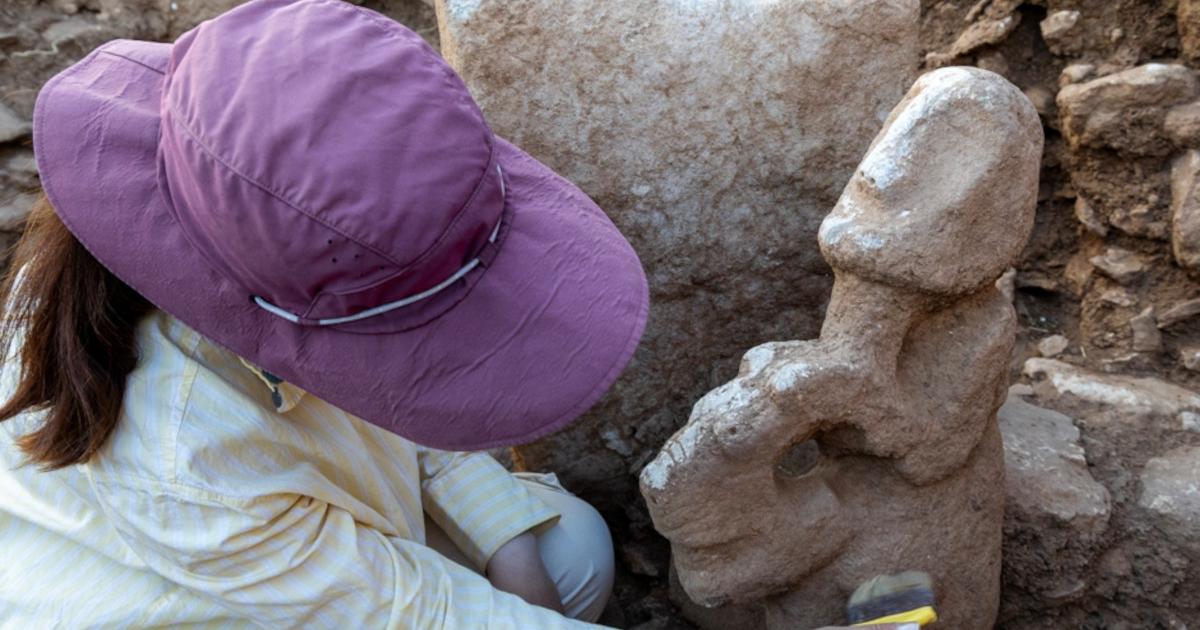

Archaeologists at Karahantepe in southeastern Turkey have uncovered an approximately 11,000-year-old sculpture of a human seated on a leopard, a composition not previously documented at the site. The 70-centimeter (28-inch) Karahantepe statue was found where it had been left on a stone bench inside a small, stone-paved building, according to an official announcement from Turkey’s Ministry of Culture and Tourism and Daily Sabah report. Its unusual pairing of a person and predator adds a striking new scene to Karahantepe’s expanding collection of Neolithic art. Explaining what it meant, however, must await detailed archaeological study.
- Early Artistic Skills Amaze at Turkey’s Neolithic Karahantepe Site
- New Statues and Fresh Insights from Karahan Tepe and Göbekli Tepe

Close-up of the human figure seated on the leopard, photographed in the excavation trench. (Republic of Turkey Ministry of Culture and Tourism)
Karahantepe Statue Found Where It Was Left
The discovery was made during the 2026 excavation season under Turkey’s Heritage for the Future project. According to the Ministry, this sculpture was placed on a bench that was situated next to the wall of a structure that had approximately a 3-meter (9.8-foot) diameter and flat stone flooring. Its placement is significant in that it maintains a connection or relationship with the architecture as opposed to being an isolated carving that has been uncovered by archaeologists. Through the excavation process at Karahantepe, several instances have been observed where sculptures are integrated into public places, such as human heads, figures, columns and benches.
Culture and Tourism Minister Mehmet Nuri Ersoy called the work a composite sculpture in a style not encountered before.
“I believe this discovery, which opens the door to new questions about the earliest periods of human history, will resonate widely in the scientific world.’ he said in the announcement.
No formal excavation report detailing the stone, carving method, precise date or interpretation had been published when the find was announced.
- Breakthrough Discovery: Karahan Tepe is Older Than Göbekli Tepe
- Guardian of Gobekli: Human Figure Found Entombed in World’s Oldest Temple
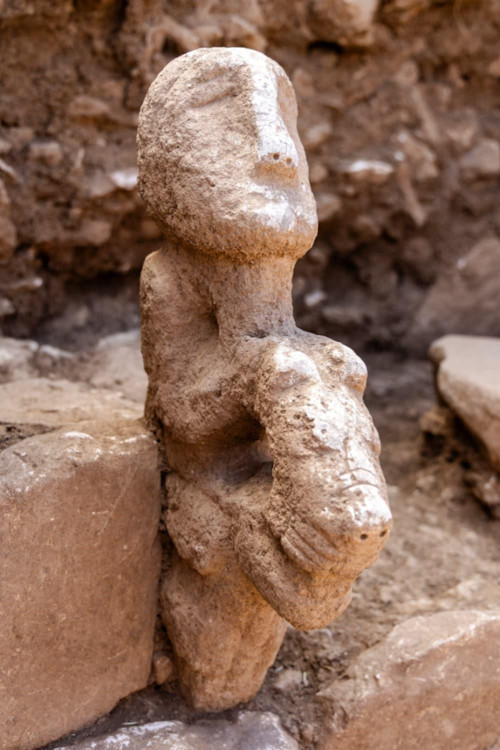
The leopard’s carved muzzle and the seated human figure are visible in this detailed view. (Republic of Turkey Ministry of Culture and Tourism)
Leopards in Neolithic Stone
While leopard motifs have been well established within Karahantepe's iconography, this newest arrangement seems to represent the opposite theme to previous ones. Earlier representations at Karahantepe demonstrated leopards being carried upon backs of human figures, while the current representation shows a man seated upon his leopard. As stated by excavation director Professor Necmi Karul, these other representations emphasized leopards as alive and alert, rather than passive (dead) animals. This reversal may indicate a change in the meaning of the associated scene, but any claims that the connection represents divine statements and/or magical/mystical associations would go beyond the evidence presently available.
The other location that has similar connections and theme is Sayburç, another site located within the Taş Tepeler regional archaeological sites. Recent open access studies in the Antiquity publication describe a 9th millennium BC relief depicting a male figure with two leopards at his side. Another human figure is seen facing a bull in this same relief. Eylem Özdoğan suggests that the figures combine to create a narrative, demonstrating how humans relate to animals around them, and ultimately proposes that the new Karahantepe sculpture reflects the same association, but at this stage cannot be linked to the establishment of a definitive narrative.
A Settlement Built for Shared Life
Karahantepe is located in the limestone hills within the Tek Tek Mountains National Park (Şanlıurfa), approximately 55km away from the city center. The official Taş Tepeler project page records that the archaeological site has been studied since 1997, and an international research team began excavating in 2019 on behalf of Istanbul University. During this time researchers found evidence of private residences alongside the remains of what may have been community structures. Many pillars and benches have been recovered with intricate carvings adorning them. The wider setting indicates that this statue may have been used in conjunction with other structures, with historical ties to people settling down as a society.
Additionally, the 2023 discovery of a 2.3-meter tall seated human statue at Karahantepe placed in a bench adjacent to a vulture sculpture has drawn parallels to previous findings found at nearby sites such as Göbekli Tepe, where images of living beings were intentionally incorporated into the walls of the enclosures and added to their historical records.
The discovery timeline continues to expand as new figures are located. Each brings forth the history of the body, animal, and communal areas all combined into one. The individual riding the leopard does not provide a clear answer - only the insight that there were stories taking shape in rock long before they had been recorded in written form.
Top image: An archaeologist cleans the human-on-leopard sculpture in the place where it was discovered at Karahantepe. Source: Republic of Turkey Ministry of Culture and Tourism
By Gary Manners
References
Altuntaş, L. 25 August 2026. A Unique 11,000-Year-Old Statue of a Human Sitting on a Leopard Unearthed at Karahantepe. Available at: https://arkeonews.net/a-unique-11000-year-old-statue-of-a-human-sitting-on-a-leopard-unearthed-at-karahantepe/
Daily Sabah. 25 August 2026. 11,000-Year-Old Sculpture Unearthed at Türkiye’s Karahantepe. Available at: https://www.dailysabah.com/life/history/11000-year-old-sculpture-unearthed-at-turkiyes-karahantepe
Ersoy, M. N. 25 August 2026. Karahantepe’de 11 Bin Yıllık Benzersiz Bir Heykeli Gün Yüzüne Çıkarttık. Available at: https://x.com/MehmetNuriErsoy/status/2092145042634817809
Karul, N. No date. Karahantepe. Taş Tepeler. Available at: https://tastepeler.org/en/yerlesmeler/karahantepe
Özdoğan, E. 8 December 2022. The Sayburç Reliefs: A Narrative Scene from the Neolithic. Antiquity, 96(390 ), 1599–1605. Cambridge University Press. Available at: https://doi.org/10.15184/aqy.2022.125
Republic of Türkiye Ministry of Culture and Tourism. 25 August 2026. Karahantepe’de 11 Bin Yıllık Benzersiz Heykel. Available at: https://basin.ktb.gov.tr/TR-472351/karahantepede-11-bin-yillik-benzersiz-heykel.html






















