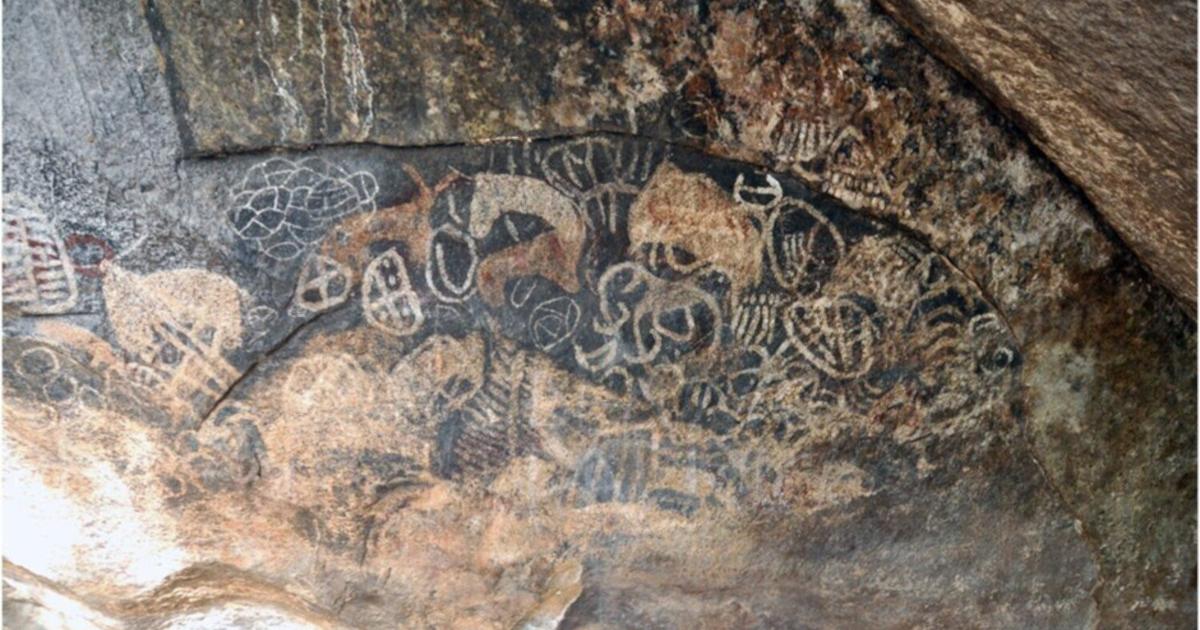

The research, led by Dr. Catherine Namono and published in the journal Azania: Archaeological Research in Africa, provides the first millimeter-accurate recording of the Kakapel panels. By carefully separating the dense layers of pigment, the team uncovered a chronological sequence that mirrors the profound demographic shifts in eastern Africa, transitioning from early hunter-gatherers to later cattle-keeping societies.
- Ancient DNA is Revealing the Origins of Livestock Herding in Africa
- Earliest Evidence of Plant Farming Unearthed in East Africa
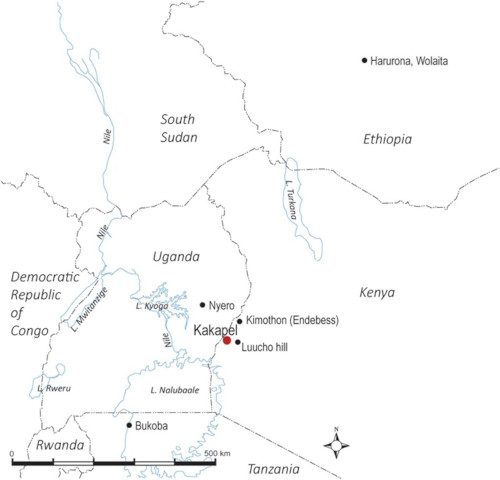
Map showing location of Kakapel in relation to other sites. (Credit: Namono et al. 2026/CC BY-NC-ND 4.0)
Four Layers Tell a Longer Story
The oldest layer of art at Kakapel features faded red and white geometric designs, including circles and divided shapes. Researchers have linked these abstract forms to hunter-gatherer-fisher communities who inhabited the site thousands of years ago. This early artistic expression connects to a broader eastern African tradition often associated with "Twa" forager groups reports Science X. Ancient DNA evidence from a skeleton found at the site indicates these early painters shared a significant genetic affinity with present-day Pygmy groups from Central Africa, such as the Mbuti.
A subsequent layer introduces at least 25 depictions of cattle characterized by long horns and no humps. Painted in side profile with horns in twisted perspective, this style echoes the "Ethiopian-Arabian" rock art tradition found in the Horn of Africa. Interestingly, researchers attribute these paintings not to the early farmers who occupied the site, but to later Nilotic-speaking agropastoralists who arrived in the area much later.
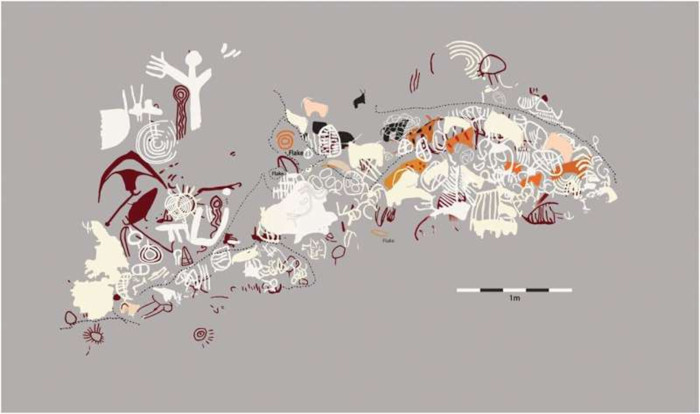
Retracing of Kakapel rock art, showing all four layers of art. Tracings by C. Namono and B. Smith, redrawn by W. Voorveld and colored for publication by K. Vena. (Namono et al. 2026/CC BY-NC-ND 4.0)
DNA and Archaeology Support the Findings
The study's conclusions are bolstered by a multidisciplinary approach that extends beyond art analysis. By comparing the rock art sequence with excavation results and ancient DNA extracted from human remains at Kakapel, the researchers were able to directly link the changing artistic styles to specific populations.
For instance, the genetic analysis of two Later Iron Age skeletons supports the attribution of the cattle art to individuals closely related to Western Nilotic speakers. The older of these skeletons retained a small ancestry component from Pastoral Neolithic populations, while the younger skeleton appeared fully Western Nilotic, likely ancestral to today's Luo people. This later population is believed to be responsible for the final layers of rock art, which include thick white and yellow-white geometric designs, as well as fine white marks.
- The Mystery of San Bushmen Rock Art
- Laas Geel Complex and The Magnificent Ancient Rock Art of Somalia
Preserving a Connection to the Past
While the precise meanings and motivations behind the ancient art of Kakapel remain a subject of ongoing investigation, the site holds profound significance for the local community. Dr. Namono explained that rock art is often recognized by African communities as the work of their ancestors, providing a tangible connection to the past and a strong motivation for its preservation [3].
Prof. Benjamin Smith, a co-author of the study, noted that there are living traditions and ceremonies in Kenya that may shed light on the creation of these paintings. By studying these contemporary practices, researchers hope to unlock the deeper cultural and spiritual significance of the Kakapel rock art. As sites like Kakapel face threats from environmental changes and human activity, this research underscores the importance of collaborative heritage management to protect these invaluable records of human history.
Top image: Kakapel Rock art panel. Source: Catherine Namono/CC BY-NC-ND 4.0
By Gary Manners
References
Namono, C. et al. 2026. The rock art of Kakapel, Kenya: a millimeter-accurate recording and new chronological sequence. Azania: Archaeological Research in Africa. Available at: https://www.tandfonline.com/doi/pdf/10.1080/0067270X.2026.2652709
Oster, S. 2026. Kakapel rock art traces millennia of painters in Kenya. Science X. Available at: https://sciencex.com/news/2026-04-kakapel-art-timeline-reveals-years.html
Pappas, I. 2026. Scientists Solve 9,000-Year-Old Rock Paintings Mystery in Kenya. Greek Reporter. Available at: https://greekreporter.com/2026/04/25/rock-paintings-mystery-kenya/