
Fact Check verdict: Unverified. A written account of Jesus rising from the dead was identified in a 2,000-year-old manuscript.
The Daily Mail ran a headline this week that reads "Written account of Jesus rising from the dead identified in 2,000-year-old manuscript, study suggests." The story behind it concerns the lines on Jesus written by the Jewish historian Flavius Josephus. So, has a 2,000-year-old manuscript really been found?
This Fact Check tests only the wording of that headline. It offers no verdict on matters of faith, and the Resurrection of Jesus is not under review here. What is checked is what the study is, what the text says and how the press described it.
The short answer is that no new manuscript has turned up. The study compares known versions of a passage that Josephus wrote in the first century. That passage does record that Jesus "appeared to them alive again the third day", and the headline is right that this is a written account by a historian who was not a Christian.
What the evidence says
The passage is known as the Testimonium Flavianum, and it sits in Book 18 of Jewish Antiquities. The Daily Mail itself explains that Josephus wrote this history "around AD 93 to 94". In William Whiston's public domain translation of 1737, it begins "Now there was about this time Jesus, a wise man, if it be lawful to call him a man".
Whiston's text goes on to say that "when Pilate, at the suggestion of the principal men amongst us, had condemned him to the cross, those that loved him at the first did not forsake him". It then gives the line at the heart of the headline, "for he appeared to them alive again the third day". The passage closes, "And the tribe of Christians, so named from him, are not extinct at this day."
Here, then, is a Jewish historian writing at Rome in the first century about the crucifixion under Pontius Pilate, who names Jesus, his execution and the testimony of his followers that he appeared to them alive on the third day.
Josephus mentions Jesus a second time in his history, and in Book 20 he describes how the high priest Ananus brought before the Sanhedrin "the brother of Jesus, who was called Christ, whose name was James". This short notice of James is widely trusted, and the new study notes that this passage has drawn "almost none of the suspicion" given to Book 18, and it reports the judgment of the scholar Louis Feldman that few have doubted its authenticity.
What the study actually did
The research behind the headline is a preprint by the independent researcher Jesús Fernández-Pedrera Correa, posted on the open repository Zenodo on August 15, 2026, under the title "The Testimonium Flavianum in Four Transmission Lines: Greek, Latin, Arabic, and Syriac". It deserves to be read on its own terms, and its argument is careful.
He sets the Greek text of Josephus beside three other ways the passage reached later readers. These are the Latin of Jerome, written about 392, the Arabic history of Agapius of Hierapolis from the tenth century and the Syriac Chronicle of Michael the Syrian from the twelfth century. All four carry the appearance on the third day. Jerome's Latin reads "Apparuit enim eis tertia die vivens", and the Daily Mail gives this in English as "he appeared to them the third day alive."
In the Arabic form, as the study summarizes Shlomo Pines's English rendering, Jesus "appeared to them three days after the crucifixion, alive". That matches the third day recorded in the Greek, the Latin and the Syriac, so every line of transmission the study follows keeps the account of Jesus appearing alive again.
His wider conclusion is a strong one for the passage. He writes that the idea of total interpolation "remains poorly supported" and that the core of the passage "stands as first-century non-Christian testimony to the existence of Jesus and to his execution under the Roman prefect." He also records that the scholarly debate about the passage is "by now largely settled in favor of the third option" among the three positions he lists, total authenticity, total interpolation or partial authenticity. Partial authenticity is the view that Josephus wrote a genuine core.
Where the headline goes wrong
The problem lies in two words, "manuscript" and "identified". No copy of Jewish Antiquities in Josephus's own hand survives, which is the normal position for ancient books. The study states that the oldest Greek manuscript of the work, "Codex Ambrosianus 370 (F 128), is an eleventh-century book." That date is ordinary background for a text of this age. Like most classical histories, Jewish Antiquities reached the present through copies made by later scribes.
The Daily Mail's own article makes this clear further down the page, noting that "The study examines later copies and retellings of Josephus’s work, rather than a surviving manuscript from his lifetime." The passage itself was not newly identified either. Eusebius of Caesarea quoted it in his Ecclesiastical History around 324, the study notes, and readers have studied it ever since.
What is new in the study is therefore the argument. Fernández-Pedrera Correa reads the Latin, Arabic and Syriac witnesses together and argues that they help show the shape of what Josephus wrote.
Where this leaves it
The headline gets the substance right and the object wrong. There is no newly found 2,000-year-old manuscript. There is a first-century history by a Jewish writer, preserved in later copies, which records Jesus, his crucifixion under Pilate and that he "appeared to them alive again the third day", together with a new study that argues for the genuine core of that passage.
For readers interested in Josephus as a witness, that is the story worth sharing. The same historian also wrote about John the Baptist, a few chapters later in the same Book 18.
How we checked this
Ancient Origins read the Daily Mail article of October 29, 2026, the Zenodo record and the full text of Fernández-Pedrera Correa's preprint, and William Whiston's translation of Jewish Antiquities in the Project Gutenberg edition. Scholars named by the study, including Louis Feldman, Alice Whealey, John Meier and Shlomo Pines, were not read directly and are reported only as the study describes them.
How we label claims: see How we check evidence. More Fact Checks: Göbekli Tepe, the Sphinx and Atlantis, the evidence hub.
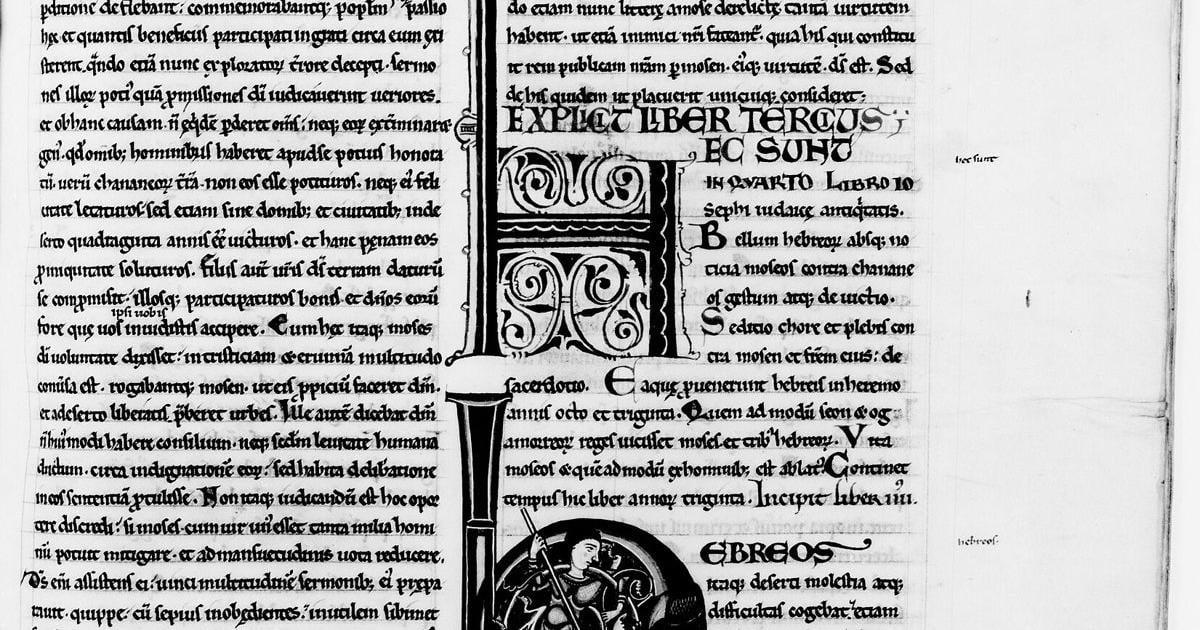
A page from a 12th-century Latin copy of Josephus's Jewish Antiquities and Jewish War, Bibliothèque nationale de France, Latin 8959 (detail). Image: Bibliothèque nationale de France, via Wikimedia Commons. Public domain.
By Aris Manus
Claim by claim
- Unverified: A written account of Jesus rising from the dead was identified in a 2,000-year-old manuscript. Reason: the study compares known later copies and versions of a passage quoted since the fourth century, and the Daily Mail itself says no manuscript from the lifetime of Josephus survives.
- Established: Josephus wrote in Jewish Antiquities that Jesus "appeared to them alive again the third day". Reason: the passage stands in Book 18 in William Whiston's 1737 translation.
- Established: Josephus also names James as "the brother of Jesus, who was called Christ". Reason: the passage stands in Book 20, and the study reports that few scholars have doubted it.
- Established: The Greek, Latin, Arabic and Syriac forms of the passage all record the appearance on the third day. Reason: the study sets out all four, from Jerome's Latin of about 392 to the Syriac of Michael the Syrian.
Sources
- Liberatore, Stacy (2026). Written account of Jesus rising from the dead identified in 2,000-year-old manuscript, study suggests. Daily Mail, October 29, 2026. https://www.dailymail.co.uk/sciencetech/article-16249597/ancient-jesus-…
- Fernández-Pedrera Correa, Jesús (2026). The Testimonium Flavianum in Four Transmission Lines: Greek, Latin, Arabic, and Syriac. Preprint, Zenodo, August 15, 2026. https://zenodo.org/records/21945637
- Josephus, Flavius. The Antiquities of the Jews, Books 18 and 20. Translated by William Whiston. Project Gutenberg eBook 2848. https://www.gutenberg.org/ebooks/2848