
One Woman, Two Ancestries
About 30,000 years ago, a woman whose bone was later recovered from Isturitz Cave in southwestern France carried a genetic mix that earlier models did not allow for in that region. Her genome now anchors a new study that reshapes, at least in part, how geneticists picture people moving across Ice Age Europe before the coldest phase of the last glaciation.
According to the paper, published on October 23, 2026, in Science Advances by Pere Gelabert of the University of Vienna and colleagues, the Isturitz genome is "now the oldest genome-wide dataset from a modern human in SW Europe". The team also reported genetic data from Chufín Cave in Spain and from Ostuni in southern Italy.
The people in question belonged to the Gravettian, a culture that spread across Europe from about 34,000 to 25,000 years ago. Its tools, burials and carved figures look broadly similar across much of Europe, and archaeologists have long read that similarity as a sign of wide social networks reaching across the continent.
Earlier genetic studies told a different story, since ancient DNA has pointed to two fairly stable groups, the Fournol cluster in the west and the Věstonice cluster in central Europe and Italy. The authors write that "Unexpectedly, this pattern of widespread cultural interaction is not mirrored in the genetic background of these populations."
A Pulse of Gene Flow From the East?
The new genome from Isturitz blurs that line in a measurable way. Most of the Isturitz woman's ancestry matches the western Fournol group, yet the team found an extra share linked to the population that gave rise to the Věstonice cluster. That share is the eastern signal at the heart of the study.
In the abstract, the authors state that "Our analyses reveal previously undetected gene flow between eastern and western early Gravettian populations in southwestern Europe, challenging models of regional genetic continuity from the Aurignacian to the Solutrean". What's more, a similar, weaker signal turned up in an earlier genome from Ormesson in northern France.
Gelabert put it more plainly in a University of Vienna press release, which Courthouse News Service also quoted. He said that eastern and western European populations "were not as genetically isolated as previously assumed." He added that gene flow across such distances "adds a new dimension" to how Gravettian groups were connected.
When the researchers estimated the timing of the mixing, they arrived at "a highly probable admixture pulse occurring between 32,500 and 31,500 cal yr B.P.", which is about 32,000 years ago. That figure rests on a stated condition, since the paper adds that it holds only "assuming that the identified gene flow corresponds to a single pulse" of mixing.
The date estimate is also thinner than the round figure suggests, because only the Isturitz model reached statistical significance. The paper notes that the Ormesson estimate "did not reach statistical significance," although its range largely overlapped, so the timing of the pulse is Unverified for now.
Travelers or an Older Inheritance?
The authors offer two possible explanations for the eastern signal in her genome. Either groups from the east mixed with western populations during the Gravettian itself, or the signal is an older layer of ancestry that was already present among the earlier Aurignacian people of western Europe.
They favor the first option, partly because Isturitz looks like a place where people gathered, and they describe the site as "a key hub of cultural and biological exchange during much of the Upper Palaeolithic". Isturitz has yielded some of the richest collections of portable art in southern Europe.
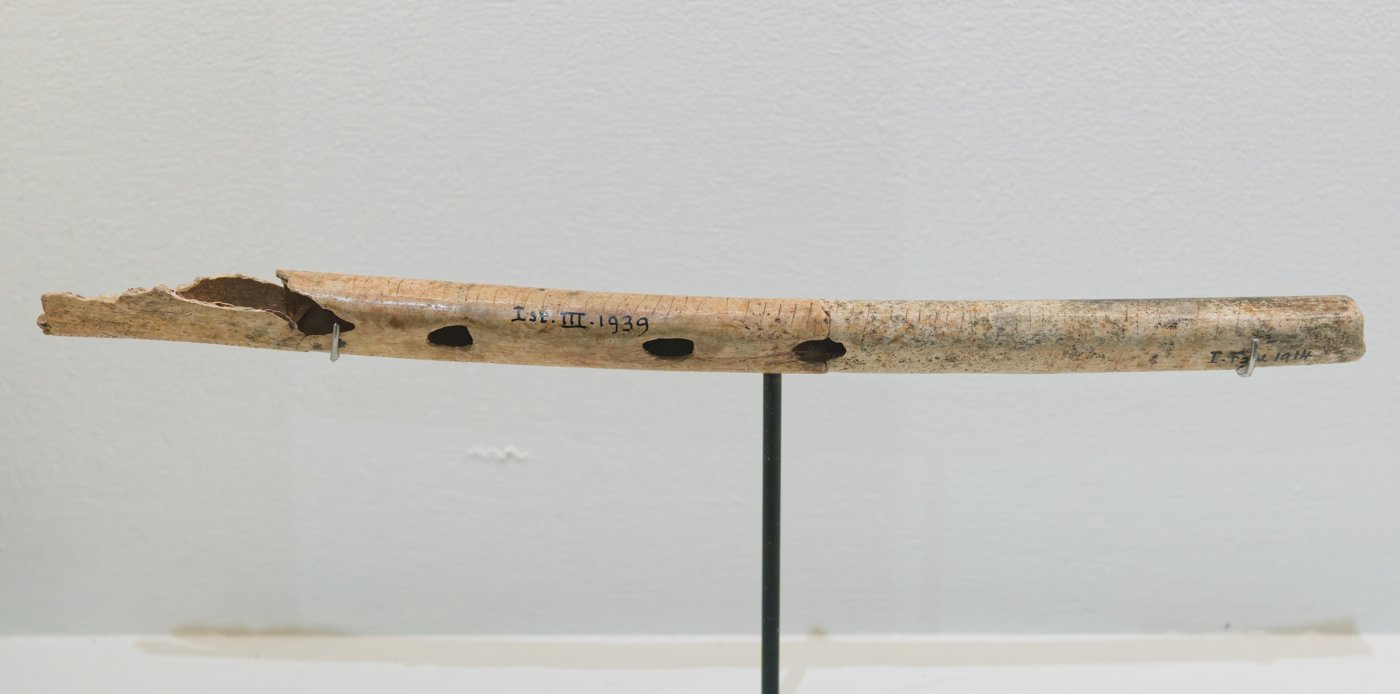
A Gravettian flute made from vulture bone, found at Isturitz Cave and held at the Musée d'Archéologie nationale in France. It is not part of the new study. Photo: Marie-Lan Taÿ Pamart, via Wikimedia Commons, CC BY 4.0
Still, the team admits a basic limit in its own evidence. No Aurignacian genome has yet been recovered from the southwest, so the older-inheritance option cannot be ruled out, and the idea of Isturitz as a meeting place for distant groups stays Unverified. The paper concedes that "The absence of any Aurignacian genome from the SW does not allow further interpretations."
Of course, the extra eastern affinity in the Isturitz genome is statistically strong in several tests, though one comparison using the ancient Kostenki 14 genome from Russia came out nonsignificant, and the clearest result rests on a single person. With the evidence pulling in more than one direction, gene flow as the source of the Isturitz woman's eastern ancestry is Disputed.
The paper also pushes back on other research. A dental study had proposed a population turnover around 28,000 years ago, and the genetic team calls its data "contradicting the 28-ka turnover inferred from dental phenotypes." With teeth and genomes pointing in different directions, that turnover is Disputed.
DNA From Cave Dirt at El Mirón
The second part of the study looks at a period with almost no bones. During the Last Glacial Maximum, roughly 26,500 to 19,000 years ago, the authors describe "a period for which human skeletal remains are extremely rare," so they turned to sediment instead of skeletons.
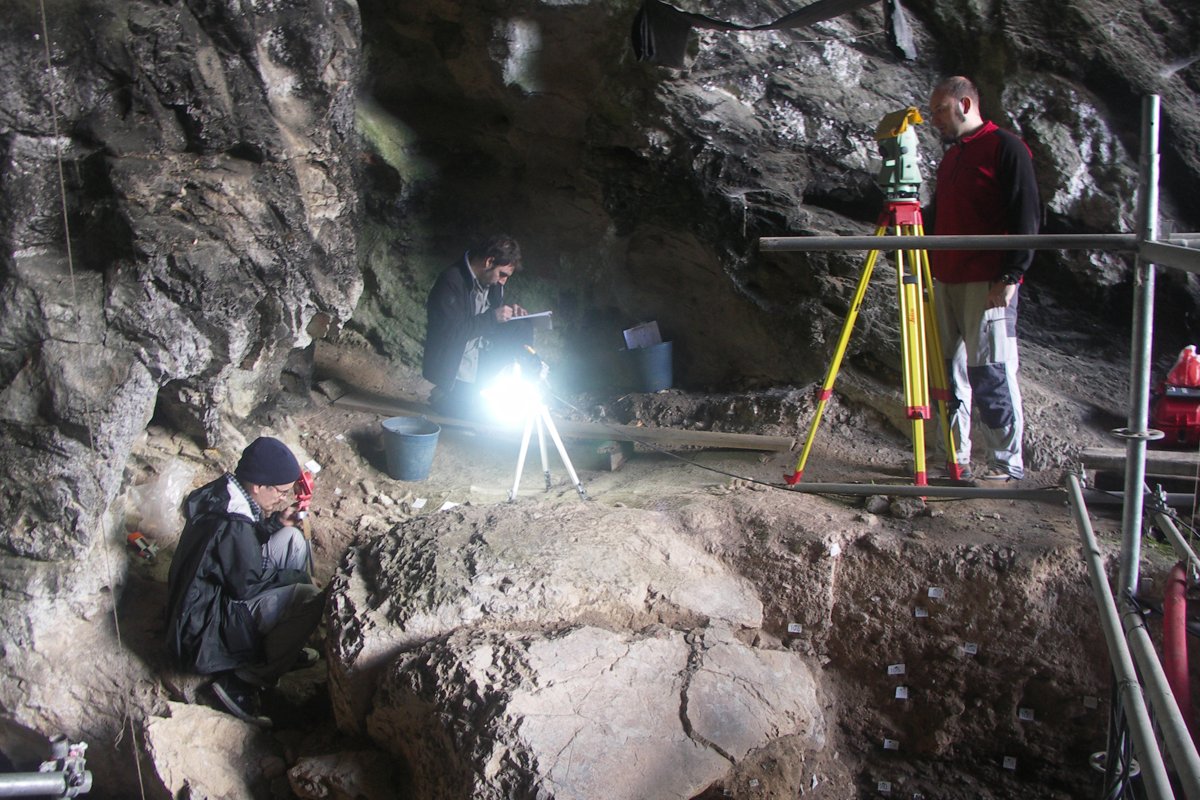
Excavators at work inside El Mirón Cave in Cantabria, Spain, in June 2010. The photo does not show the sediment layer tested in the new study. Photo: Gabinete de Prensa del Gobierno de Cantabria, via Wikimedia Commons, CC BY 3.0
At El Mirón Cave in Cantabria, northern Spain, the team sequenced human DNA from a Solutrean layer dated to about 22,100 to 21,730 years ago. They retained 14,737 genetic markers, which they describe as "sufficient genomic data to directly link the archaeological package of the cave with a specific genomic ancestry".
Ron Pinhasi, the study's senior author, spoke about the method in the same university statement. He said sediment DNA can "recover genetic information from periods where human remains are missing". The El Mirón data matched the western Fournol group, which suggests that this ancestry lasted in the region through the coldest phase of the Ice Age.
Sediment DNA has its own problems, and the authors list "the potential mixing of genetic material from multiple individuals" among them. A soil sample may hold traces of several people, so the persistence of Fournol ancestry at El Mirón is Unverified, even though it fits the Chufín result and an earlier genome from La Riera.
What a Fetus From Ostuni Adds
The third new genome comes from southern Italy, where Ostuni1b is a male fetus linked to an adult woman known as Ostuni 1, whose genome was published earlier. The team identified him as a first-degree relative who is "most likely her son", a kinship finding that is Established.
By comparing mother and son, the researchers concluded that the father probably came from the same population. The University of Vienna statement adds that the parents were not closely related, which it reads as a sign of mating habits that kept inbreeding low, an interpretation that remains Unverified.
The skeletons and the sediment also yielded predicted physical traits. The paper reports features "such as dark skin, dark hair, and brown eyes" for Ostuni1b, and the same traits for Chufín, Isturitz and the El Mirón sample. The Chufín tooth was badly degraded, however, which limited what could be said about that woman's ancestry.
How Far Does the Evidence Go?
Taken together, the findings are indicative rather than conclusive. Three skeletons and one sediment sample are a small base for claims about a whole continent across thousands of years. The authors call for more genomes and more sediment work, especially from older Aurignacian layers at Isturitz itself.
Their own summary is that population structure in western Europe during the Gravettian was "more complex and dynamic than previously assumed." For now, the eastern thread in the Isturitz woman's ancestry remains less a mapped migration than a strong genetic hint.
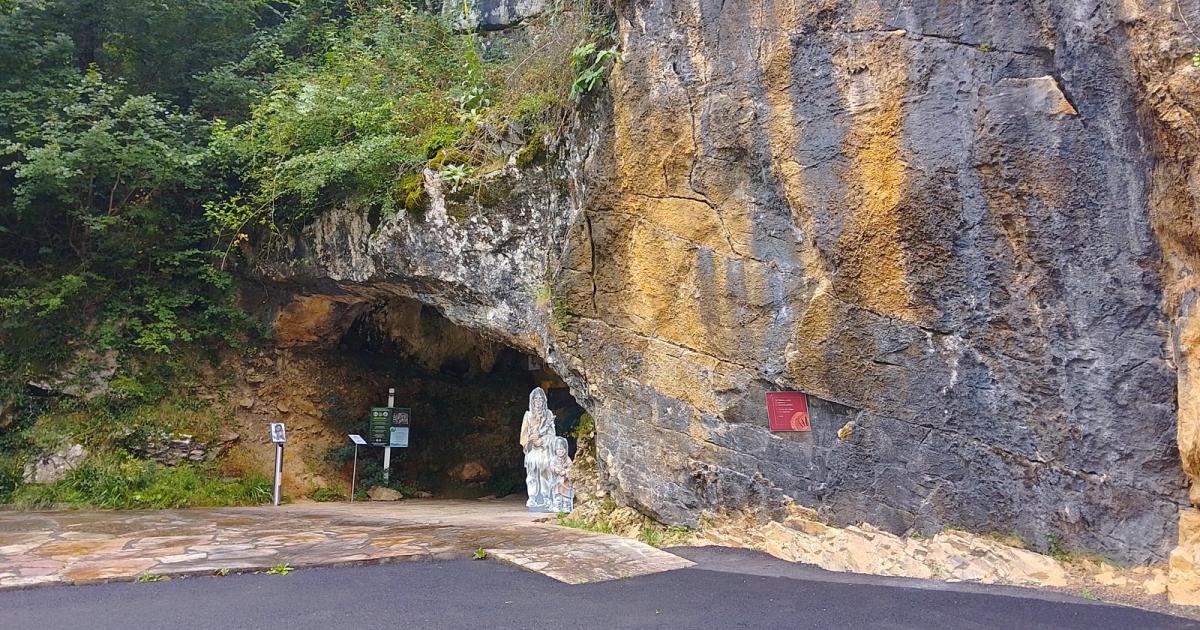
The entrance to the Isturitz and Oxocelhaya caves in the French Basque Country, photographed in July 2024. The Gravettian woman's bone in the new study came from Isturitz Cave. Photo: Michel Bakni, via Wikimedia Commons, CC BY 4.0
By Aris Manus
Sources
- Pere Gelabert and colleagues, "Early Gravettian genomic data from Western Europe reveal population movements before the LGM," Science Advances 12(43), 2026
- Jeremy Yurow, "DNA from French cave suggests Ice Age Europeans were well traveled," Courthouse News Service, October 23, 2026
- University of Vienna, press release on the Gelabert et al. study, October 23, 2026
- Wikimedia Commons, entrance of the Isturitz and Oxocelhaya caves, photo by Michel Bakni
- Wikimedia Commons, Isturitz bone flute, photo by Marie-Lan Taÿ Pamart
- Wikimedia Commons, excavation at El Mirón Cave, photo by Gabinete de Prensa del Gobierno de Cantabria