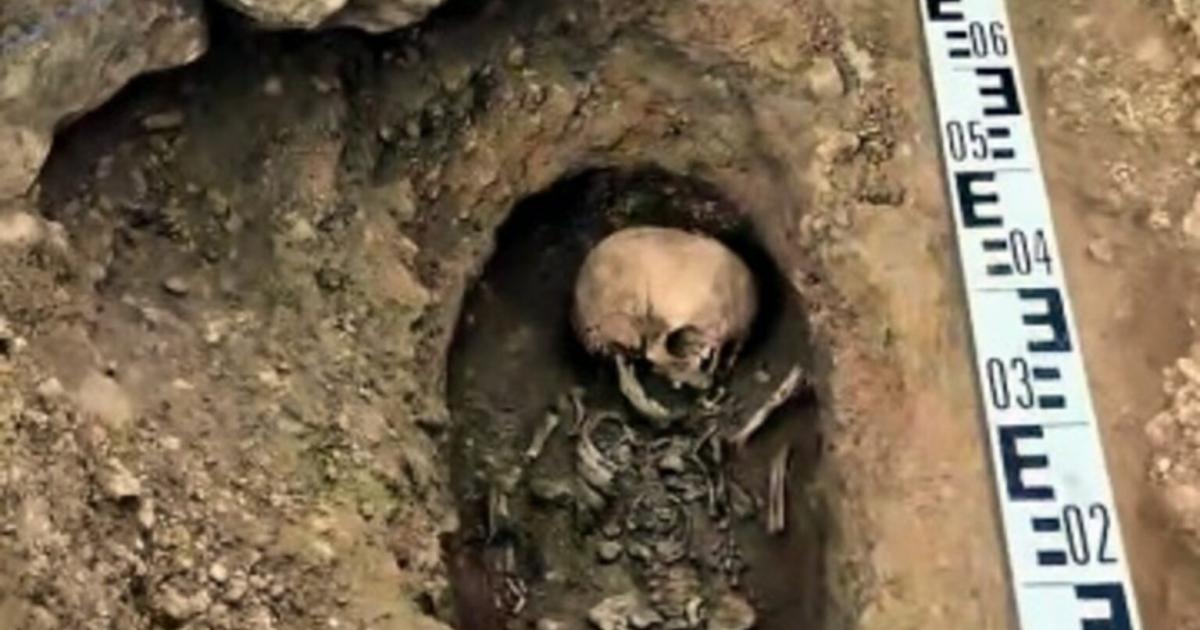

The discovery of an infant burial beneath the foundation of Artezian’s ancient Greek fortress is the first of its kind from the Classical Period along Crimea's Azov coast, highlighting its archaeological importance.
- Herma as Guidance and Protection for Travelers in Ancient Greece
- Hellenistic Elite was Buried on a Bronze Bed with Gold in Her Mouth
Archaeologists Date the Burial to 80-70 BC, Before the Construction of the Temple
As archaeologists opened the area beneath an altar near the north wall of the Temple of Zeus Genarches and Soter (“Zeus the Progenitor and Savior”), they unearthed the infant’s remains. After dating the remains, researchers determined that the burial occurred between 80 and 70 BC, before the temple’s construction began. The dates suggest that the grave was placed in the altar area during the laying of the temple’s foundations. However, there was a previous Mithridatic temple on the site, and the burial might have been part of that temple’s structure. Grave goods found at the grave site included a bronze bracelet and a necklace of small beads, signs of a formal burial. Unfortunately, rodent burrows had disturbed the grave, pushing bones and grave goods aside.
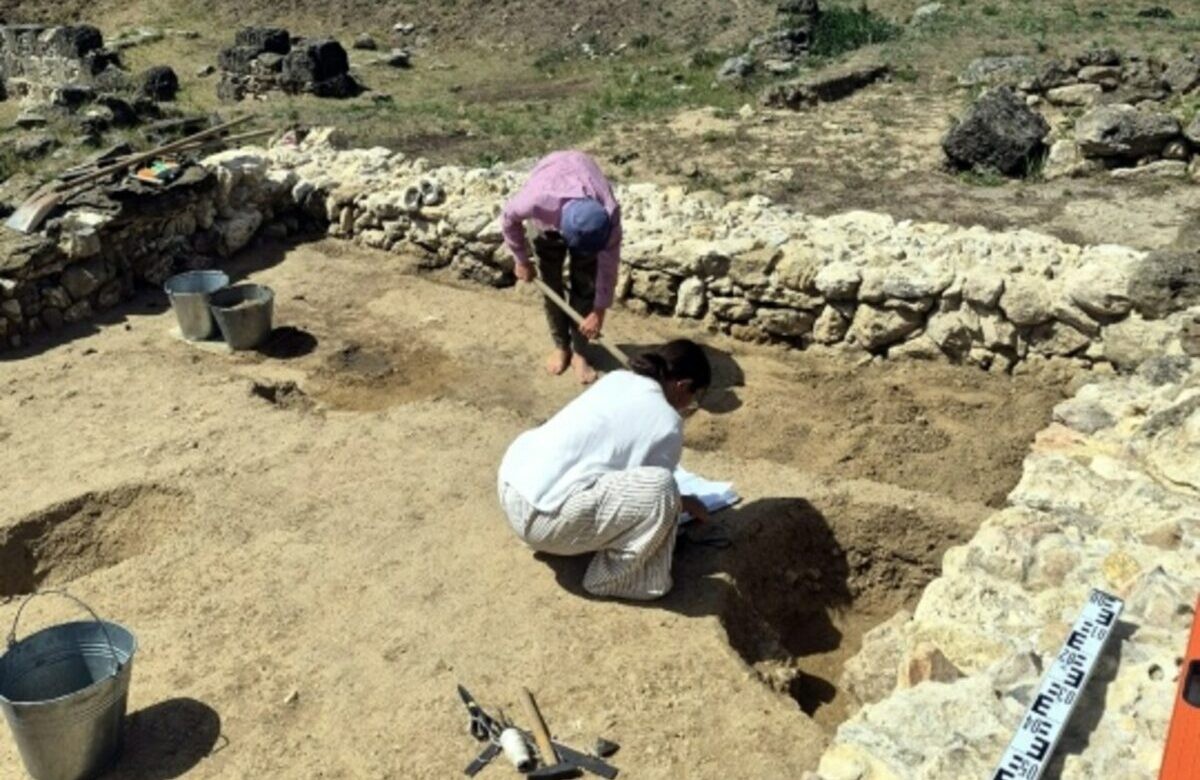
Archaeologists excavating the sacred complex associated with the Temple of Zeus Genarchos and Soter at the ancient settlement of Artezian in Crimea. (Artezian Archaeological Expedition/VK)
Why Was the Infant’s Grave Beneath the Temple?
There are several possible reasons for the grave’s location. First, the infant may have been buried in the sacred area as part of a foundation ritual. During this ritual, the remains of a human or animal were placed beneath an important building as a request to the gods for divine protection and the building's success. The placement of the infant’s body is an additional sign of a ritual burial, but positioning does not imply human sacrifice. The upper skeleton is on its left side, oriented toward the southeast, suggesting careful planning typical for rituals.
- Wonder of the Ancient World: The Grand and Powerful Statue of Zeus
- Herma as Guidance and Protection for Travelers in Ancient Greece
Researchers also theorize that the infant’s death was natural, noting that the shape of the skull indicated signs consistent with hydrocephalus. This condition, often fatal in the ancient world, was caused by fluid buildup around the brain. If the death was natural, the burial could be a funeral rite rather than a sacrifice. An additional complicating factor is the identification of leg bones that may belong to another child. More investigations are planned to examine this theory and other factors.
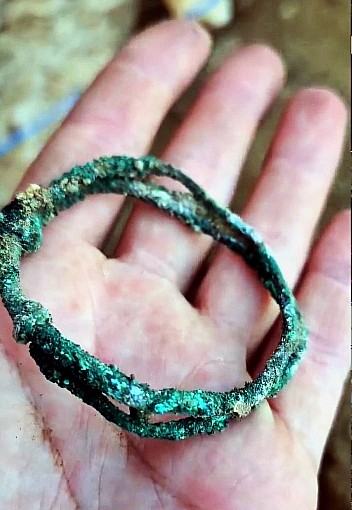
A corroded metal bracelet recovered in association with the infant burial discovered beneath the Temple of Zeus Genarches and Soter at Artezian. (Artezian Archaeological Expedition/VK)
The Temple of Zeus was a Center of Artezian’s Religious Life.
The Temple of Zeus Genarches and Soter was first identified as a key historical site in 2023 on the settlement’s southern sacred precinct. The dedicatory inscription indicates that the surviving temple was built under Bosporan king Pharnaces, who ruled from 63-51 BC. Beneath it was an earlier temple dating to the rule of Mithridates VI Eupator, destroyed in the earthquake of 63 BC. Artezian, the site of a fortified Bosporan settlement, has been the scene of archaeological excavations since 1988. Researchers view it as a prominent religious center. The builders carefully aligned its altars with the equinox, marking the points where the sun rises and sets. Located at a strategic point along the coast of the Sea of Azov, Artezian occupied an important position within the European territory of the Bosporan Kingdom, whose capital was Panticapaeum. Its fortifications became caught up in the Roman-Bosporan War of 45-49 AD. The early fortress was destroyed in a major fire around 46-47 AD.
- Coin Hoard Linked to Sudden Attack on Ancient City of Phanagoria
- Medieval Fortress Found in Southwestern Crimea’s Layered Defensive Network
Further Investigations Will Continue to Probe the Mystery of the Burial and Preserve the Historical Site
Excavations continue to examine the fortress walls, storage buildings, and burned occupation layers, with researchers studying animal bone deposits that may be linked to ancient ritual activity. The research team is also engaged in conservation efforts at both the palace of Mithridates Eupator and the Temple of Zeus to open sections of the site to visitors. The team is concerned about nearby quarrying activity that has damaged water infrastructure at the excavation site. Artezian is a rich resource for archaeologists investigating religious rituals, funeral practices, military procedures, and construction techniques in the frontier settlements of Crimea.
Top Image: Infant burial discovered beneath the Temple of Zeus Genarchos and Soter at the ancient settlement of Artezian. Source: (Artezian Archaeological Expedition/VK)
By Ramsey Hardin
References
Abramzon, M., and N. Vinokurov. 2017. Gold Staters of Aspurgus and Mithridates III and New Complexes with Coins and Jewelry Items from the Artezian Settlement. Ancient Civilizations from Scythia to Siberia 23 (1): 1–41. Brill. Available at:
https://brill.com/view/journals/acss/23/1/article-p1_1.xml
Kayra, O. August 6, 2026. Child Burial Discovered Beneath the Temple of Zeus in Crimea — Was It a Sacrifice? Arkeonews. Available at: https://arkeonews.net/child-burial-discovered-beneath-the-temple-of-zeus-in-crimea-was-it-a-sacrifice/
Vinokurov, N. I., and V. P. Yailenko. 2022. The Second Epitaph from the Artesian Settlement (The Crimean Azov Region). Problems of History, Philology and Culture 2 (76): 31–52. Available at:https://pifk.magtu.ru/en/journal/66-no-2-76-%2C-2022/1257-31.html
Vinokurov, N. I., D. V. Matsnev, and A. V. Fesenko. 2024. Temple of Zeus Genarch at the Artezian Settlement: The Problem of Astronomical and Spatial Orientation. Problems of History, Philology and Culture 3 (85): 150–164. Available at:https://pifk.magtu.ru/en/journal/84-no-3-85-%2C-2024/1573-150.html
Vinokurov, N. I., and V. P. Yaylenko. 2024. Temple of Zeus Genarches with Dedicatory Inscription of King Pharnaces at the Artezian Settlement (The Crimean Azov Region). Problems of History, Philology and Culture 4 (86): 231–271. Available at:https://pifk.magtu.ru/en/journal/86-no-4-86-%2C-2024/1621-231.html
Zahid, N. August 6, 2026. 2,100-Year-Old Infant Burial Beneath Ancient Greek Temple Puzzles Archaeologists. The Greek Reporter. Available at: https://greekreporter.com/2026/08/06/infant-burial-ancient-greek-temple/