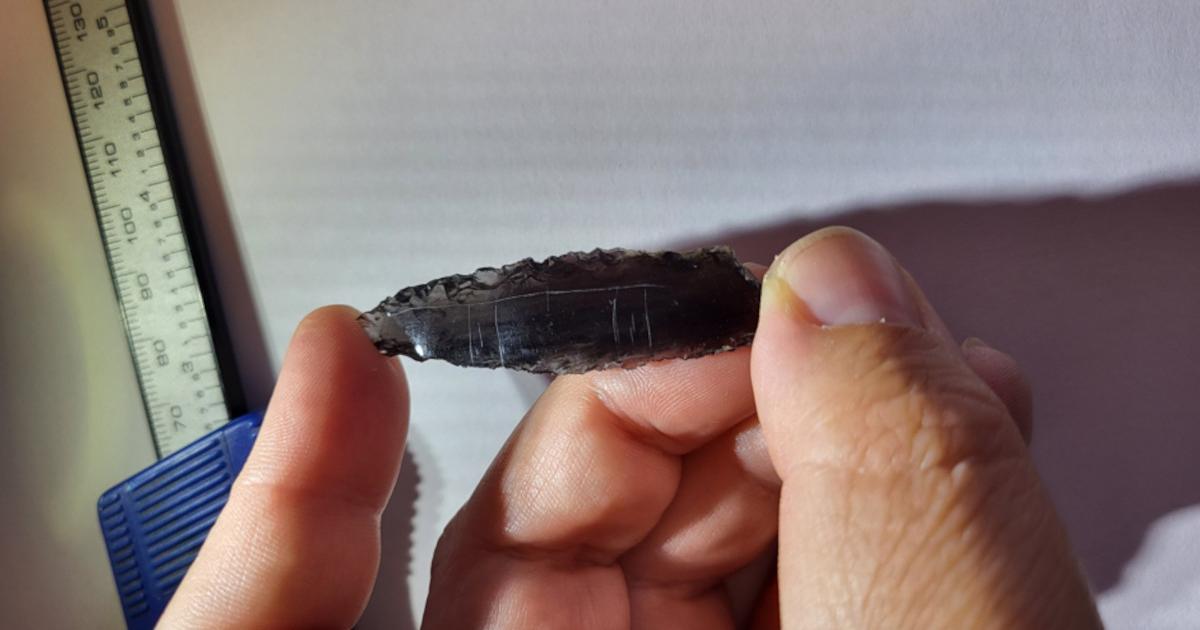

When a group of eleven rare obsidian arrowheads, recently uncovered at Tepecik-Çiftlik in Central Turkey, were added to the existing collection of 54 example arrowheads from the Neolithic period, archaeologists were left with many unanswered questions, including whether or not the engraved markings had any significance or meaning. The newly discovered arrowheads showed evidence that the makers intentionally carved patterns into the volcanic glass (obsidian) at two different times: either prior to completion of the arrowhead or after its completion. The fact that these designs appear to share a common origin and/or tradition suggests that there was a single cultural group who carved these designs into their arrowheads; however, there is no indication that the engraved designs represent any form of written language.

Arrowhead #8 with incisions composed of two repeated V-shaped lines on the mesial section of the ventral face. (Vinet and Guilbeau, PLOS One, CC BY 4.0)
Eleven New Pieces from Cappadocia
Alice Vinet and Denis Guilbeau reported in a new scientific report published by PLOS One describing what they have discovered. The settlement of Tepecik-Çiftlik is situated on the flat land of the Melendiz Plain, which is part of Cappadoci’s volcanic landscape. It was occupied by farming and herding communities from approximately 7100 - 5800 BC. Only 12 out of the 740 recorded arrowheads from Tepecik-Çiftlik carry the incisions they found.
The pieces are not dramatically different from the site’s other arrowheads. Most of the arrowheads found in Tepecik-Çiftlik are made from locally sourced obsidian (obsidian can be found at Göllüdağ and Nenezi Dağ) and the one with marks left on them were found in the ordinary settlement deposits, not within burial sites or a ritual setting. That makes the finds particularly difficult to interpret: they were unusual enough to receive extra work, but not so unusual that archaeologists can assign them a separate function.
- The Unmatched 9,500-Year-Old Honeycomb City of Çatalhöyük
- Paleolithic weapons factory was a rich source of obsidian tools from 1.4 million years ago
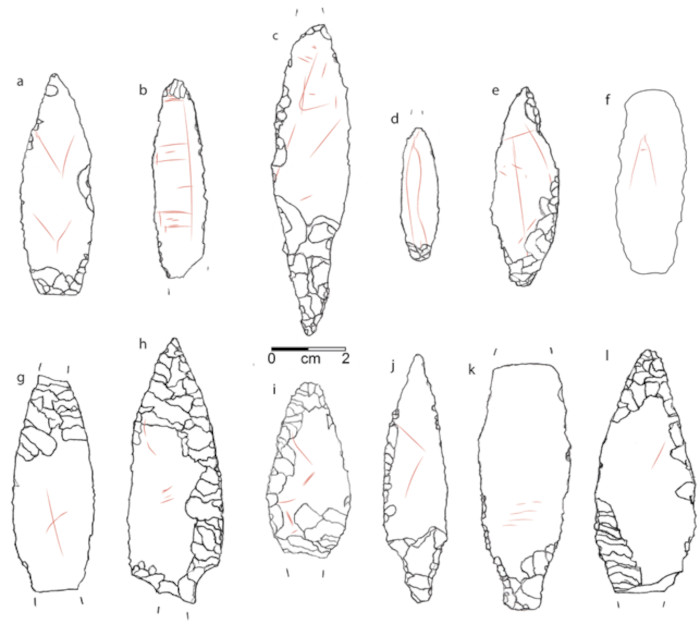
Drawings of the 12 incised arrowheads from Tepecik-Çiftlik, with the added lines marked in red. (Vinet and Guilbeau, PLOS One, CC BY 4.0)
Marks Made with Care
Microscopic examination indicates that the lines were not random scratches created during manufacture or burial. Many were repeated two or three times, apparently to remove enough of the dark surface to leave a conspicuous pale line. One especially elaborate point required at least 20 strokes to form three squares joined by a line, while other arrowheads bear only a few simple cuts.
The researchers also tested how to create the design. Obsidian would have been able to withstand the effects of a second obsidian tool, while the hardness of a flint edge was sufficient to create the same kind of marks as the ancient artifacts.
Since less than 1% of the flaked stone from Tepecik-Çiftlik is flint, it is reasonable to assume the purpose for choosing flint to make arrowheads was purposeful and not simply an incidental part of the production process.
- Ancient Obsidian Artifacts Reveal Vast Aztec Trade Network
- Over 500 Pre-Hispanic Obsidian Mine Shafts Uncovered in Central Mexico
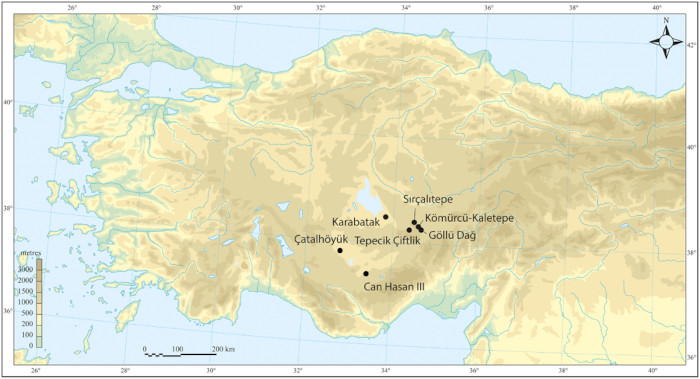
Map showing Tepecik-Çiftlik and other Central Anatolian sites where incised arrowheads have been reported. (Vinet and Guilbeau, PLOS One, CC BY 4.0)
A Sign, a Signature, or Something Else?
The marks vary in position and design. No two are identical. Even so, comparisons with finds from Çatalhöyük, Can Hasan III, Sırçalıtepe, and other sites reveal broad similarities, pointing to what the authors call a shared but flexible iconographic repertoire. The pattern is striking because Cappadocian obsidian traveled far beyond the region (including into the southern Levant) while marked arrowheads remain known only from Central Anatolia.
One long-standing suggestion is that they were “hunter marks.” Such marks might identify the person who made or used an arrow and allow a successful hunter to claim an animal. As Ancient Obsidian Artifacts Reveal Vast Aztec Trade Network shows, volcanic glass could later carry economic, political, and religious meanings, but the Tepecik-Çiftlik evidence does not prove a single symbolic role. The marks may have expressed personal identity, group affiliation, decoration, ritual ideas, or a practice whose meaning has been lost.
“We were very happy,” Vinet told Phys.org, describing the moment the team recognized the newly identified points. The researchers now hope that a marked arrowhead will eventually be found with a burial, where its relationship to a particular person or set of grave goods could provide a crucial clue.
For now, the expanding corpus makes the mystery more intriguing rather than less. Like the long-distance movements discussed in Rapa Nui Obsidian Discovery: Did the Islanders sail to America?, the Tepecik-Çiftlik points show that material can travel widely while a local custom remains geographically bounded. The 11 new incised arrowheads offer evidence of persistence, craftsmanship, and communication—but not yet a translation.
Top image: Marked obsidian arrowhead from Tepecik-Çiftlik, with close-up views of the deliberate incisions. Source: Vinet and Guilbeau, PLOS One, CC BY 4.0
By Gary Manners
References
Archaeology News Online Magazine. 2026. 9,000-year-old obsidian arrowheads in Turkey bear mysterious marks with no known meaning. Available at: https://archaeologymag.com/2026/08/obsidian-arrowheads-bear-mysterious-marks/
Oster, S. 2026. Archaeologists uncover 11 rare marked arrowheads at Tepecik-Çiftlik whose purpose remains a mystery. Available at: https://phys.org/news/2026-08-archaeologists-uncover-rare-arrowheads-tepecik.html
Vinet, A. and Guilbeau, D. 2026. Intentional incisions on Neolithic Obsidian arrowheads from Central Anatolia: A techno-functional and iconographic approach. PLOS One. Available at: https://doi.org/10.1371/journal.pone.0354715