
- World's Oldest Matrilineal Society Unearthed in China's Shandong
- Blood for the Gods: Ritual Sacrifice in the Ancient World
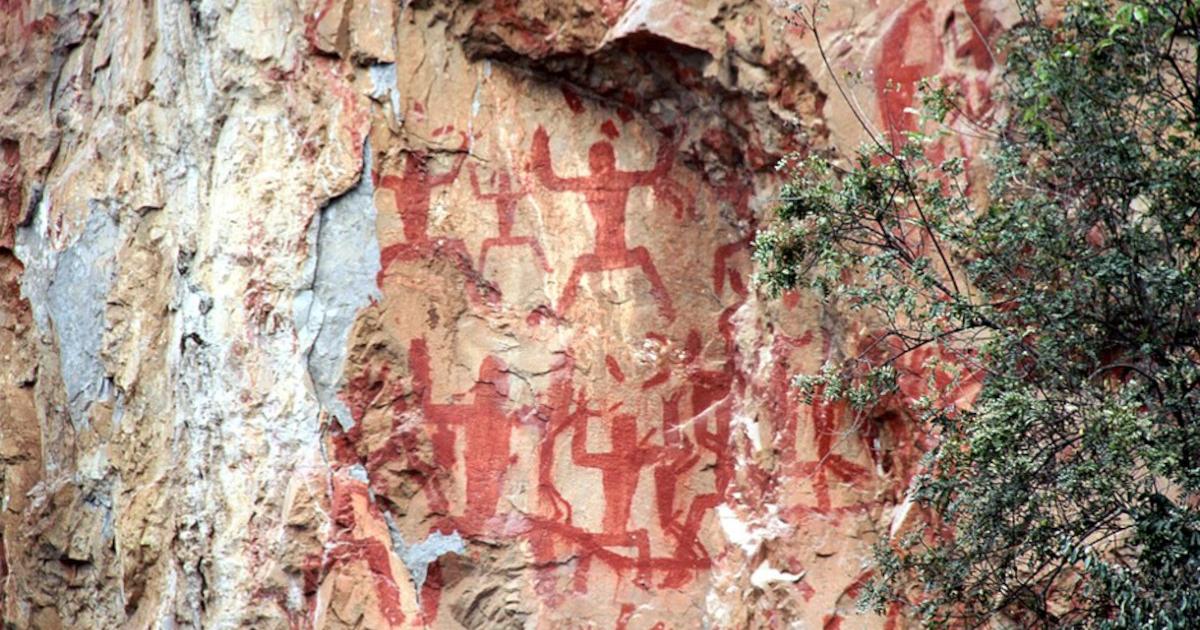
The Zuojiang Huashan Rock Art Cultural Landscape is a UNESCO World Heritage site located in Guangxi Zhuang Autonomous Region, Southern China, and represents a stunning archeological wonder. With a length of 260 kilometers along the Zuojiang River and its tributaries, the site boasts over 80 known sites, and features thousands of drawings. The largest montage can be found on Mount Huashan and is made up of approximately 1,900 drawings and measures around 8,000 square meters in size. The rock paintings were produced between the 5th century BC and the 2nd century AD by the Luoyue people, and depict human beings, animals, boats, arms, and bronze drums engaged in what seem to be ceremonial or ritualistic events.
The endurance of the ancient rock art panels in the constituencies of a challenging climate has been a puzzle for investigators for a long time. Common organic binders could not have stood the extreme conditions. In order to find the answer, a study published in Journal of Archaeological Science has analyzed several fallen pieces of rock art from Gaoshan, Daningshan, and Tunpingshan using sophisticated means of analysis like Raman spectroscopy and proteomic analysis (examining the present proteins).
- Ancient Peruvian Gold Mask Was Painted with Human Blood!
- Lost Bronze Age Town Full of Treasures Unearthed in China
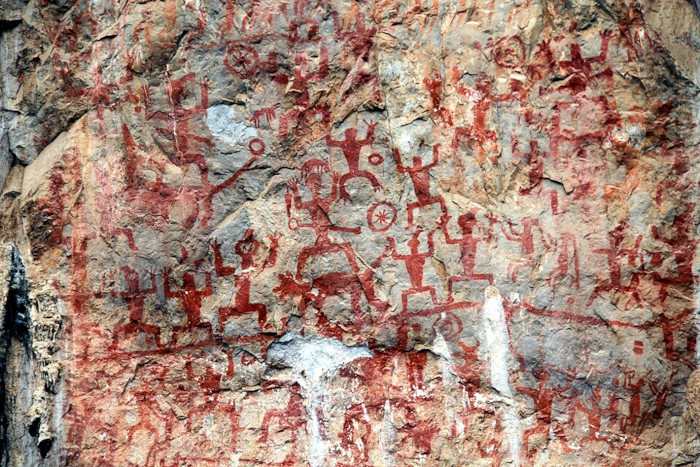
View of the red figures painted on the Huashan cliffs. (Rolfmueller / CC BY-SA 3.0)
The research indicates that the makers of the artwork did not merely combine pigments with glue, but engineered a complex, multi-layered composite material. The glue component consisted of a form of mortar made up of slaked lime, phosphate and blood. When the pigment containing small amounts of hematite was applied to the wet mortar, a chemical reaction took place. The lime absorbed carbon dioxide and turned into calcium carbonate, while the proteins present in the blood contributed to the formation of mineral crystals. Therefore, the pigment was captured in limestone with such a strong bond that scientists needed an electric drill to separate the painted layer from the rock in the lab.
The proteomic analysis yielded the most surprising results. Alongside animal proteins, the researchers detected human serum proteins, including two specific proteins—prolactin-inducible protein and lactotransferrin - associated with female reproductive biology, pregnancy, and breastfeeding. Because the samples lacked casein, the primary protein in milk, the authors hypothesized that the human blood used in the mortar may have been collected during childbirth or the postpartum period, rather than being breast milk.
While this interpretation remains a hypothesis, it aligns with historical and cultural contexts. The Luoyue people, the presumed creators of the Huashan rock art, are believed by some historians to have lived in a matrilineal society. In such a culture, blood associated with childbirth might have held deep symbolic significance, representing fertility, life, and ancestral continuity. Incorporating this powerful substance into the paint would have infused the ceremonial images with profound ritual meaning.
This discovery fundamentally changes our understanding of prehistoric artistry in Bronze Age China. The creators of the Huashan paintings were not just artists; they were sophisticated materials engineers. They understood how to process limestone, source phosphates, and utilize the chemical properties of blood to create a durable, weather-resistant ancient lime mortar. Their technical ingenuity ensured that their vibrant legacy would survive for millennia, permanently etched into the towering cliffs of the Zuojiang River.
Top image: The Huashan Rock Art Cultural Landscape features thousands of red figures painted on limestone cliffs above the Zuojiang River. Source: Rolfmueller / CC BY-SA 3.0
By Gary Manners
References
Arkeonews. 2026. 2,000-Year-Old Chinese Rock Art May Owe Its Survival to Blood from Childbirth. Available at: https://arkeonews.net/2000-year-old-chinese-rock-art-may-owe-its-survival-to-blood-from-childbirth/
Wu, M., Hu, P., Zhai, K., et al. 2026. Blood-induced biomineralized calcium carbonate used for binding in the Huashan rock art of Guangxi, Southern China. Journal of Archaeological Science. Available at: https://www.sciencedirect.com/science/article/abs/pii/S0305440326001809