
Archaeologists at Huaca Pucllana in Peru have uncovered a ceremonial practice of the ancient Lima culture that links a possible human offering to an ancient canal, a well, and an unusual collection of ceramics and animal remains. The discovery offers a rare glimpse into the complex rituals practiced by the Lima culture, suggesting how water, marine resources, ritual offerings, and carefully constructed ceremonial spaces may have been woven together more than 1300 years ago.
Possible Human Offering Reveals New Evidence of Lima Ritual Practices
Archaeological excavations led by Gladys Paz Flores revealed the remains of an adult who appears to have been placed as an offering in an underground channel leading to a ceremonial well during a religious ceremony that closed the canal. According to an English translation of Paz Flores’ statement:
“The discovery of this human offering, associated with the closure of the ceremonial channel, has been one of the most significant moments this season. I believe that this context provides new evidence to understand ritual practices of Lima Society and allows us to reconstruct ceremonies performed in Pucllana more than 1,300 years ago.”
The excavations at Huaca Pucllana are conducted through the Huaca Pucllana archaeological research, conservation, and enhancement project, an ongoing program operated jointly by Peru’s Ministry of Culture and the Municipality of Miraflores. The work is centered at the Museo de Sitio Pucllana (Huaca Pucllana Site Museum) and involves a multidisciplinary archaeological team.
- Four Pre-Inca Burials Discovered at 1500-year-old Site in Peru
- Ancient Pyramid Cities of Peru: A Catalogue of Swift Decline
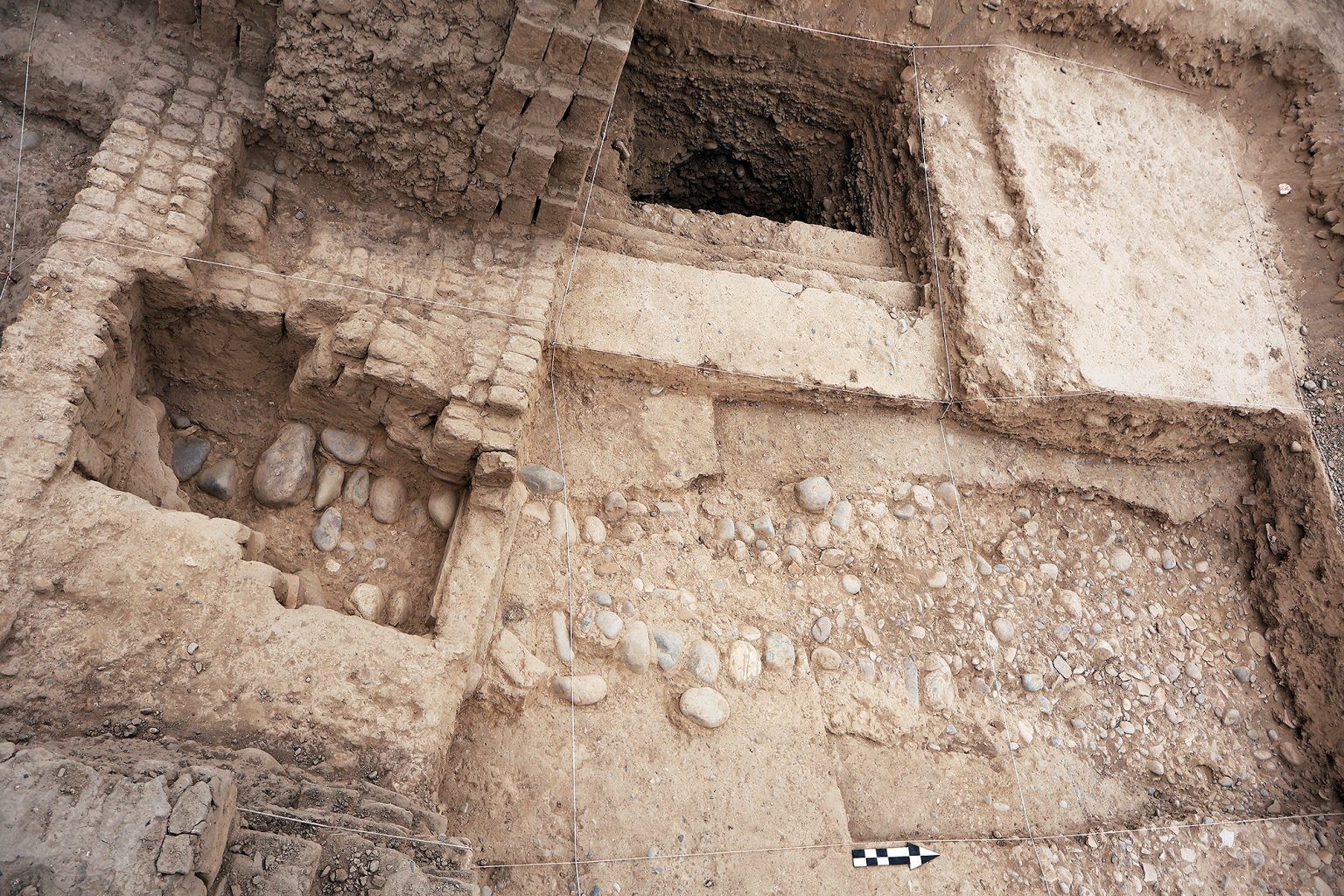
Excavated ceremonial architecture at Huaca Pucllana in Lima, Peru, including the stone-lined features associated with an underground canal. Archaeologists believe the canal was ritually closed approximately 1,300 years ago, apparently accompanied by the deposition of a human offering. (Municipalidad de Miraflores)
Human Remains Deliberately Positioned Toward the Pyramid and Sea
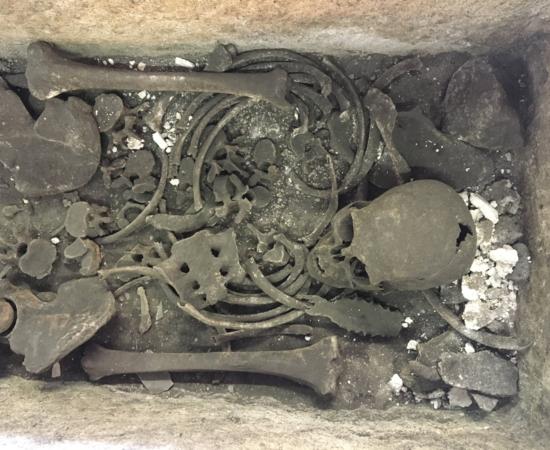
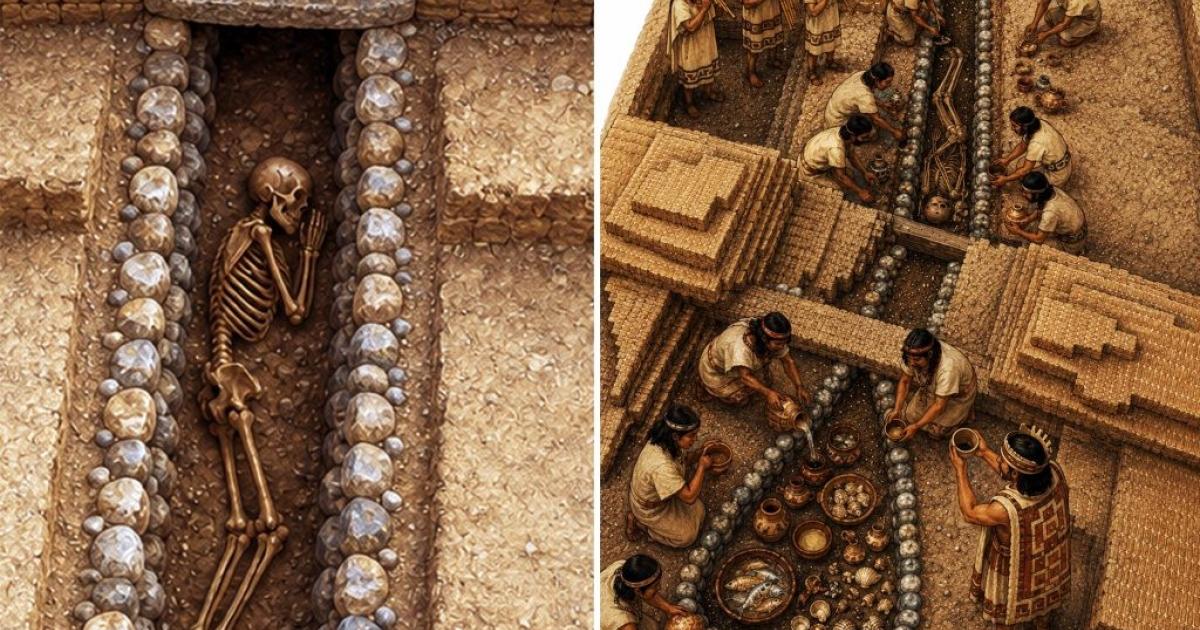
The human remains were found spread out along the canal and oriented from north to south with the body lying on its left side. When the skull was found, its gaze was oriented toward the pyramid of Huaca Pucllana and the sea (west), suggesting an intentional positioning directly linked to the ritual closing of the structure itself. One of the most significant elements was the ceremonial well's architecture. Although other structures at Huaca Pucllana are built with small mud bricks, the well pit was built with boulders.
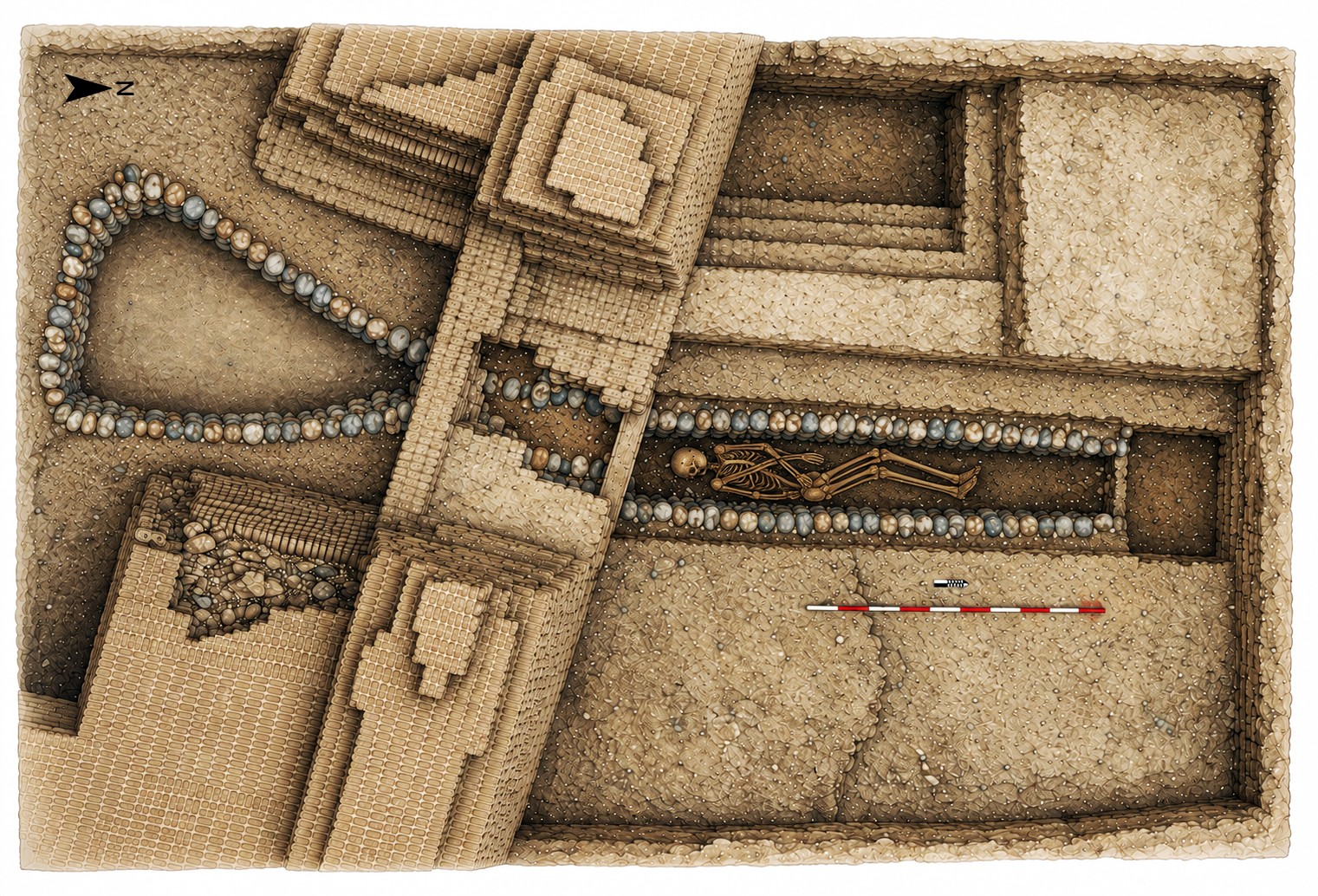
Artistic representation of the layout of the canal and position of the human offerings found there. (Municipalidad de Miraflores)
Ceramics, Quartz, and Animal Remains Reveal Ancient Ritual Activity
This construction technique is unusual for the site and helps explain the diversity of architectural solutions and ceremonial practices in the Lima culture. The direct links between the well, the underground channel, and the potential human offering reinforce the complex's ritual nature. Archaeological investigation of this particular ceremonial feature began in 2020, when excavation of the ceremonial well commenced. Since then, researchers have recovered various objects associated with the ritual activities once performed in this sacred space. Documented finds include ceramic vessels, white quartz, marine remains such as fish bones and shells, two birds, and camelid bones.
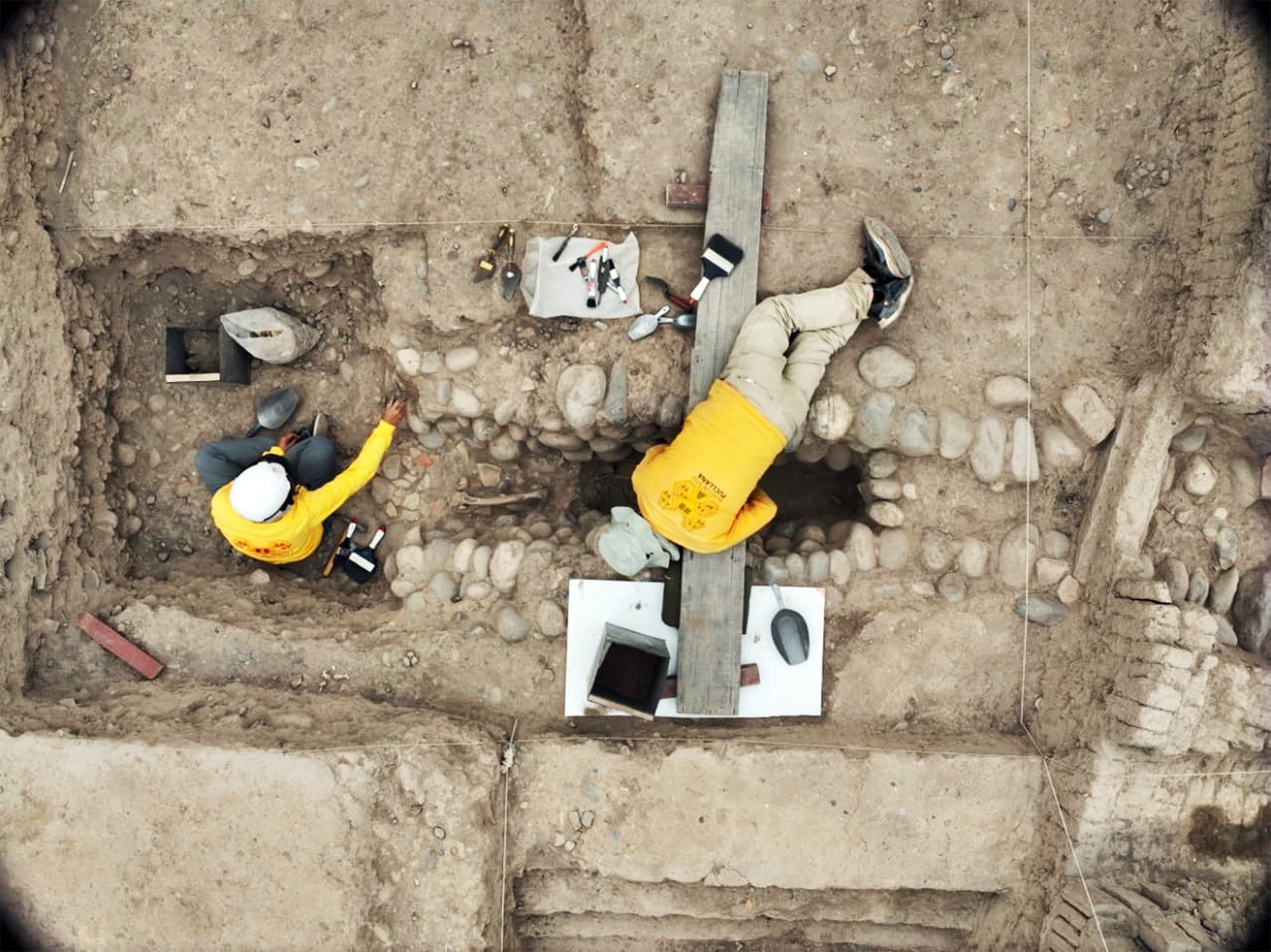
Archaeologists excavate the stone-lined ceremonial complex at Huaca Pucllana in Lima. Investigations revealed an underground canal associated with ritual deposits and the remains of an adult individual who may have been placed there as an offering during the ceremonial closure of the structure over 1300 years ago. (Municipalidad de Miraflores)
Cormorant Remains Mark the Ritual Closure of the Canal
The presence of these disparate elements indicates that organized, intricate ceremonies took place in the space and reveals the complex relationship ancient inhabitants of Pucllana maintained with their natural environment, particularly the sea and its resources. One of the most unusual archaeological finds was a cormorant, a coastal waterbird and accomplished diver, whose remains were used in closing the mouth of the canal. Its presence alongside fish bones, shells, and other ritual deposits further emphasizes the site's connection with marine resources. It reinforces the archaeologists' interpretation of the canal closure as a ceremonial act.
- 1,000-Year-Old Long-Haired Mummy Unearthed in Peru
- The Traditional Offering Ceremony of the Andes: How to Maintain Balance Between the Material and Spiritual Worlds
Physical Analysis May Reveal the Identity of the “Channel Lord”
Observation and analysis conducted on the pelvis and occipital crest of the human remains, provisionally nicknamed the “Channel Lord” (Señor del Canal), suggest that the individual was an adult male. The identification is pending confirmation through specialized studies by a physical anthropologist. Future analysis will determine, with far greater precision, the sex and age at the time of the individual's passing, as well as possible pathologies, trauma, health conditions, and other biological characteristics.
- Archaeologists in Peru Unearth Eight Colonial Era Skeletons
- Adobe Brick Building Used In Peru As Early As 5,000 Years Ago
Archaeologists Deepen Understanding of Lima Culture’s Traditions
The discoveries demonstrate that the ancient canal acquired an important ceremonial role beyond whatever practical functions it may originally have served. The carefully placed human offering, animal remains, and cormorant deposited at the canal’s mouth suggest that the canal's closure formed part of a formal ceremony in which water, marine resources, animals, and possibly human deposition carried ritual significance. As further analysis of the “Channel Lord” and the ritual objects continues, archaeologists will deepen their understanding of Lima culture's religious traditions and its use of ritual offerings, sacred landscapes, and relationship with the Pacific coast.
Top Image: Archaeological reconstruction of the ceremonial complex at Huaca Pucllana showing the position of the possible human offering within the stone-lined canal. The approximately 1,300-year-old individual was deliberately positioned during what archaeologists interpret as a ritual closure of the underground water channel. Source: Municipalidad de Miraflores
By Ramsey Hardin
References
Associated Press. 2026. Archaeologists unveil skeletal remains believed to be ritual offering in Peru. Available at:https://apnews.com/article/ac44172ab29425029ca7b3ecf5819691
Barreto, M. I., Ccencho H., J., Chuchón A., H., and Silvera L., H. 2010. Sacrificios humanos en Lima asociados a la última etapa constructiva de la Huaca Pucllana. Arqueología y Sociedad 22: 55–72. Universidad Nacional Mayor de San Marcos. Available at: https://revistasinvestigacion.unmsm.edu.pe/index.php/Arqueo/article/view/12288
WELT. 2026. 1.400 Jahre alte Überreste bei Ausgrabungen in Peru entdeckt. Available at:WELT report on the Huaca Pucllana discovery
Yaipen, M. 2017. Definición de una nueva fase constructiva en la Huaca Pucllana. Arqueología y Sociedad. Universidad Nacional Mayor de San Marcos. Available at:ResearchGate publication page