
Heracles Gate Emerges on a Monumental Route
The excavations were carried out along Street B from the northwest corner of the Side gymnasium to the East Gate, one of the main approaches to the old city. On the north side of the street, the archaeologists documented an east-west stoa built in the 2nd century AD. This had rooms arranged behind it and surviving jambs and thresholds marking the Roman frontage.
There were three monumental entrances along the street portico: the West Gate, the Heracles Gate and the North Bath Gate. Mehmet Nuri Ersoy, the Minister of Culture and Tourism, said of the find:
"We unearthed one of the magnificent gates of history in Side. The excavations we completed on B Street, which is approximately 390 meters long, revealed important traces of the transformation of Side from Roman to Late Antiquity.” (Translated from Ministry statement)
- A Herculean Effort: Can You Name the 12 Labors of Hercules?
- My Name Is Heracles, And I Have Father Issues
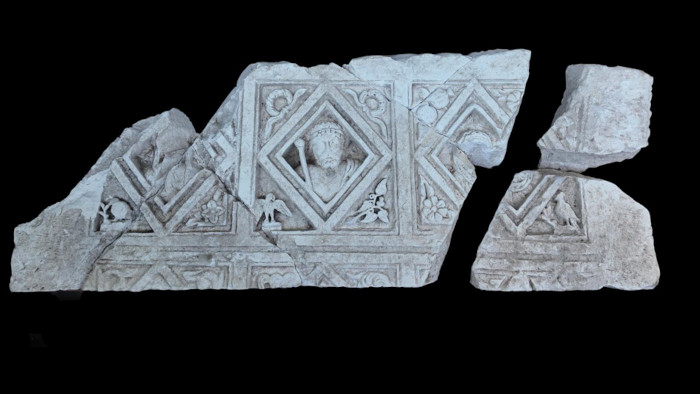
An assembly of decorated stone fragments from the Heracles Gate. (Turkish Ministry of Culture and Tourism)
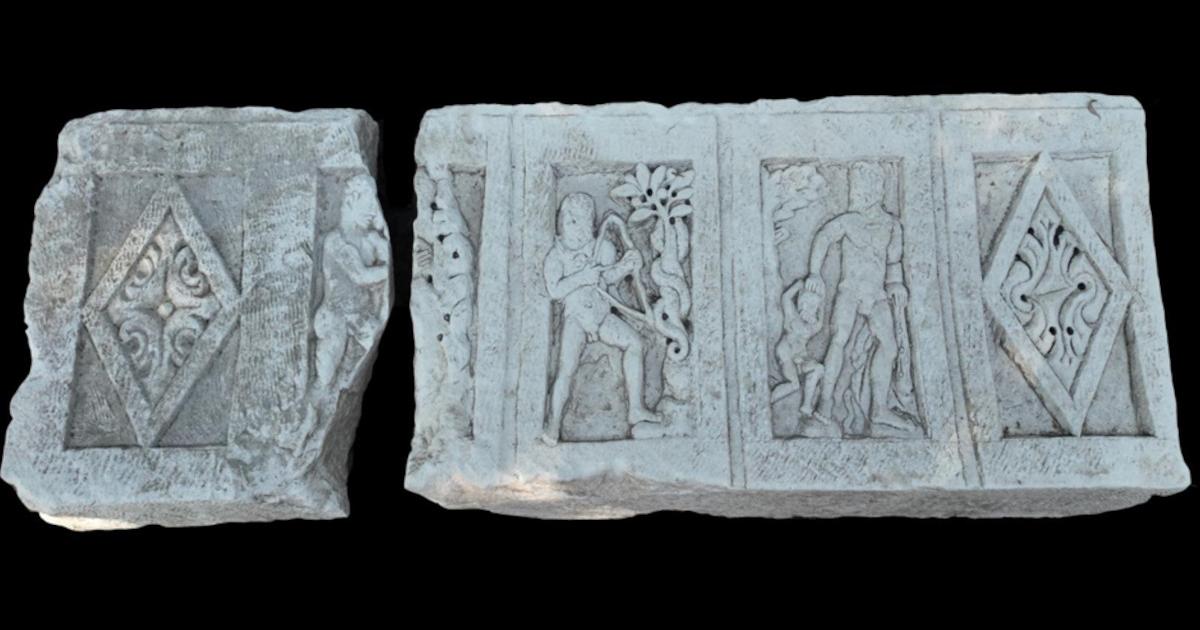
The Heracles Gate is characterized by relief panels depicting the Twelve Labors of Hercules, the set of near-impossible trials imposed on the Greek hero. Other coffers have images of Athena, Zeus, Artemis, Hygieia and Tyche, placing scenes of his feats alongside images of major deities from the Greek pantheon. The Metropolitan Museum of Art’s account tells how Heracles, driven by guilt after killing his family sought advice from the gods, and some accounts say Apollo instructed Heracles to atone by serving King Eurystheus.
- Heracles and the Mares of Diomedes: Greek Hero VS Man-Eating Beasts
- The Colossal Hand of Hercules, So Where is the Rest of Him?
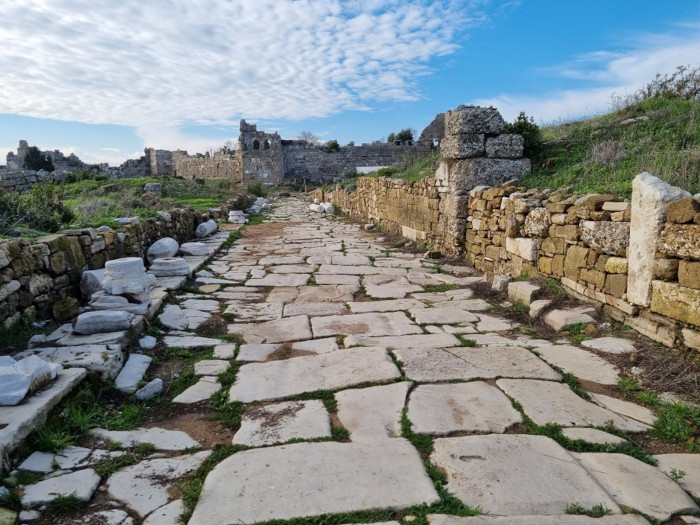
A surviving stone-paved street among the ruins of ancient Side. (Maksym Kozlenko CC BY-SA 4.0)
Older Reliefs Reused in a Changing City
The reliefs were not carved for the entryway in which they were discovered. Archaeologists have dated them to the early third century AD and determined that they were installed later ‘spolia’ – the reuse of older architectural or sculptural material in a new building. Their second life has made the Heracles Gate a physical archive, combining features of Roman-period craftsmanship with a Late Antique modification. A report by La Brújula Verde highlights this remarkable continuity of mythical imagery in a later structure.
Street B changed drastically during the fifth century AD, when a large area to the north of the road became integrated into the Episcopal Palace complex of Side. Some entrances which used to lead into the stoa have been blocked, and new, monumental openings have been created through its remains. Thus, the pathway that was used by visitors reaching via the East Gate became transformed from a working road into an impressive urban axis.
These pagan reliefs showing Heracles (who was later said to have ascended to the gods) were incorporated into an architectural setting reshaped beside an expanding Christian community.
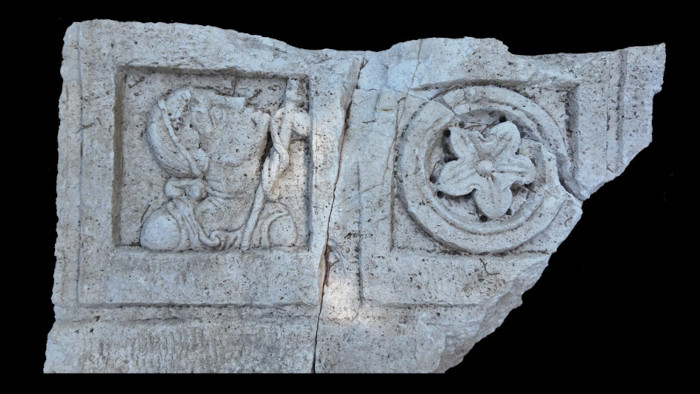
Carved figural and floral coffers recovered from the Heracles Gate. (Turkish Ministry of Culture and Tourism
Side’s Long History Written into Stone
Side was the leading port of ancient Pamphylia, founded by Aeolian Greeks on the Mediterranean coast west of the Manavgat River, according to Encyclopaedia Britannica. Alexander the Great occupied the city in 333 BC, and centuries later its harbor supported commerce, piracy and a major slave market before Side flourished under Rome. Archaeological work began in 1947 and discovered a theater, temples of Athena and Apollo, and baths, among other finds, explains Archaeology Magazine. Excavation head Feriştah Alanyalı of Anadolu University, explained that Side was characterized as, “an important maritime city, but at the same time it is an agricultural city because of the alluvial soils brought by the Melas River.”
The freshly uncovered street reveals Side’s multi-layered history along a single route, which includes the Roman colonnade, carvings from the 3rd century, as well as gates and the Episcopal Palace from the 5th century. According to the Ministry, this project is included in Turkey's Legacy to the Future Project that combines excavation, conservation, and public display activities at significant archaeological sites, with the aim of safeguarding archaeological heritage.
Top image: Early third-century relief fragments reused in the Heracles Gate at ancient Side. Source: Turkish Ministry of Culture and Tourism
By Gary Manners
References
Archaeology Magazine. 3 June 2026. Road Leading to Ancient City of Side Excavated. Available at: https://archaeology.org/news/2026/06/03/road-leading-to-ancient-city-of-side-excavated-in-anatolia/
Carvajal, G. 27 August 2026. Heracles Gate with Reliefs of His 12 Labors Found in the Ancient Greek City of Side in Anatolia. Available at: https://www.labrujulaverde.com/en/2026/08/heracles-gate-with-reliefs-of-his-12-labors-found-in-the-ancient-greek-city-of-side-in-anatolia/
Hemingway, C. January 2008. The Labors of Herakles. The Metropolitan Museum of Art. Available at: https://www.metmuseum.org/essays/the-labors-of-herakles
Moeed, A. 27 August 2026. Ancient Gate Depicting the Twelve Labours of Heracles Unearthed in Turkey. Available at: https://greekreporter.com/2026/08/27/heracles-gate-twelve-labours-turkey/
Republic of Türkiye Ministry of Culture and Tourism. 26 August 2026. Side’de 390 Metrelik Anıtsal Antik Cadde Gün Yüzüne Çıktı. Available at: https://basin.ktb.gov.tr/TR-472439/sidede-390-metrelik-anitsal-antik-cadde-gun-yuzune-cikti.html
Sheetz, K. 4 July 2026. Side. Encyclopaedia Britannica. Available at: https://www.britannica.com/place/Side-Turkey