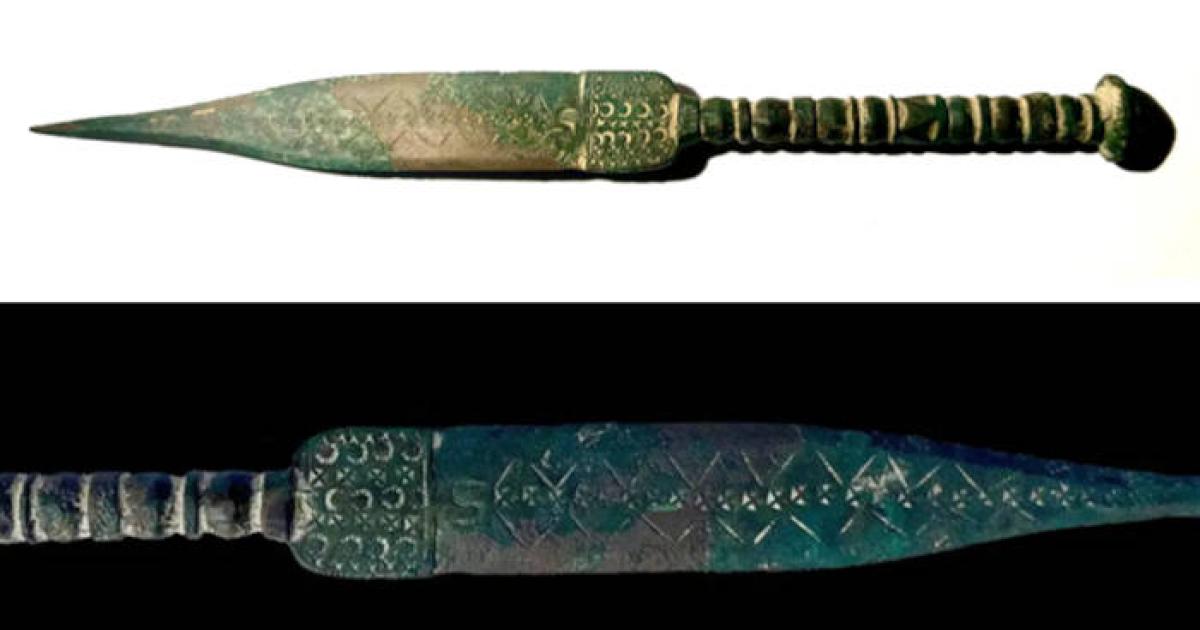

Metal detectorists scanning a Baltic Sea beach in Poland have discovered a spectacular Hallstatt period dagger dating back approximately 2,800 years. The intricately decorated weapon, found embedded in clay that had fallen from a cliff after a storm, represents one of the finest examples of Iron Age metalwork ever discovered in the region.
Jacek Ukowski, president of the St. Cordula Association for the Saving of Monuments, made the extraordinary find while exploring the West Pomeranian coastline with fellow metal detectorist Katarzyna Herdzik.
"This is my most valuable discovery," Ukowski told Polish Press Agency. "It was accidental. The cliff had collapsed, and a lump of clay must have fallen from above. I walked into that spot with my metal detector because it started to ring."
- 4000-year-old Copper Dagger Found in Polish Forest
- Bronze Age Daggers Were Tools to Butcher Animals, Not Just Weapons

Left; The dagger held up at the location where it was found. Right; The dagger in situ at the find site. (Museum of the History of Kamień Land)
A Masterpiece of Ancient Metalwork
The dagger measures 24.2 centimeters (approximately 10 inches) in length and is ornately decorated along both the handle and blade. According to Grzegorz Kurka, director of the Museum of the History of Kamień Land who examined the artifact, the craftsmanship is exceptional. "A true work of art! In terms of workmanship, it is very high quality, beautifully ornamented," Kurka explained. "Each engraved element is different. When it comes to finds in Poland, I have not encountered such a dagger."
The blade features intricate designs including linear crescents and crosses resembling stars. Running down the center of the blade is decoration that may symbolize constellations, complemented by diagonal lines. The handle terminates in a pointed pommel and is decorated with alternating ornamental patterns extending to the blade. These celestial motifs suggest the dagger may have held ritual significance, possibly connected to solar cult practices common during the Hallstatt period.
- The Powerful Hallstatt Culture: Foundation of the Proto-Celts
- 2800-year-old Hallstatt Swords Rewrite Bronze to Iron Age Transition
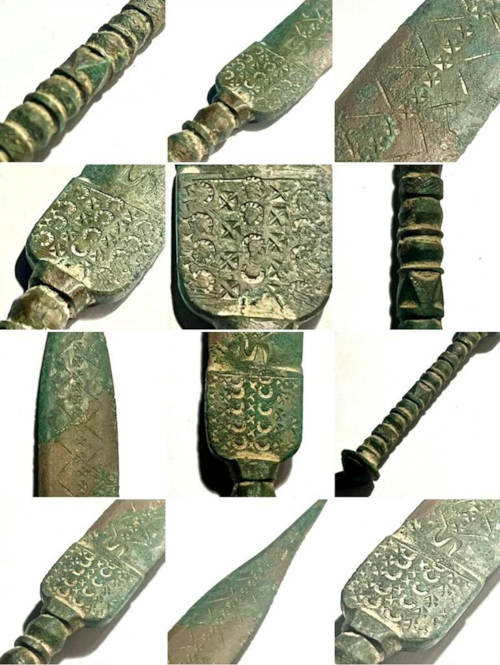
Detailed view showing the intricate celestial patterns on the Hallstatt dagger. (Museum of the History of Kamień Land)
Ritual Weapon or Warrior's Pride?
The Hallstatt period, named after the Austrian village where a major archaeological site was discovered, represents the early Iron Age in Central Europe, spanning approximately 800 to 450 BCE. This era is renowned for its advanced metalworking techniques and rich warrior culture. The period marks a crucial transition when iron gradually replaced bronze as the primary material for tools and weapons.
Kurka noted that the dagger's decorative elements, particularly the celestial symbols, may indicate connections to solar worship and suggest it served ceremonial purposes. However, the weapon could also have belonged to a wealthy warrior, serving both practical and symbolic functions. The museum plans to conduct metallurgical analysis to determine the alloy composition and study wear patterns to establish whether the dagger saw combat use or remained a ritual object.
"We want to carry out metallurgical tests to determine the alloy composition, what level of copper and tin it contains," Kurka stated. "And studies of wear traces - whether it was an object used in combat, or used for cult, ritual purposes."
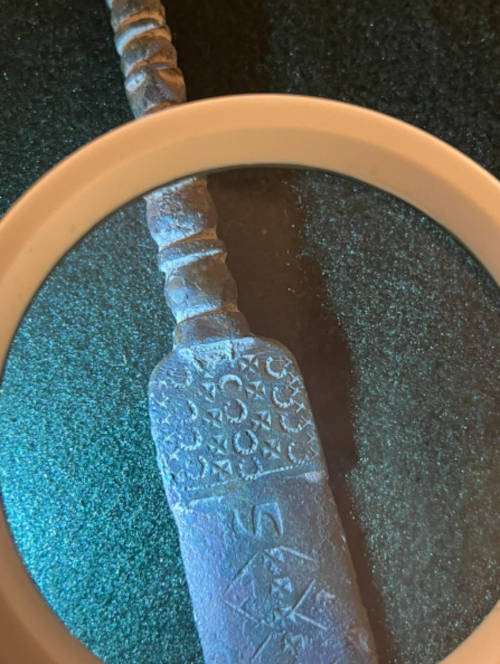
Detailed imaging showing the intricate celestial patterns on the Hallstatt dagger. (Museum of the History of Kamień Land)
Import from Southern Europe?
The exceptional quality of the craftsmanship has led Kurka to speculate about the dagger's origins. "Perhaps it is an import and was cast in one of the workshops in southern Europe," he suggested. The level of detail and sophisticated metalworking techniques evident in the piece may indicate it was produced in a renowned metallurgical center, possibly in what is now Italy, Austria, or the Balkans, before making its way north through ancient trade networks.
The dagger has been preserved in excellent condition, allowing detailed examination of its decorative elements. The exact location of the find remains undisclosed to protect the site from unauthorized treasure hunters, though it is confirmed to be somewhere along the western portion of Poland's Baltic coast.
The discovery adds to Poland's growing catalog of significant archaeological finds and provides valuable insights into the connections between northern and southern European cultures during the Iron Age. The Provincial Conservator of Monuments in Szczecin will ultimately decide which museum receives custody of this remarkable artifact, though the Museum of the History of Kamień Land hopes to retain it for further study and public display.
Top image: The ornately decorated 2,800-year-old Hallstatt period dagger found embedded in clay on a Polish Baltic beach, featuring intricate celestial symbols including crescents and star-like crosses. Source: Museum of the History of Kamień Land via Archaeology Magazine
By Gary Manners
References
Nauka w Polsce. 2025. Zachodniopomorskie: sztylet sprzed 3 tysięcy lat znaleziony na plaży. Available at: https://naukawpolsce.pl/aktualnosci/news%2C107304%2Czachodniopomorskie-sztylet-sprzed-3-tysiecy-lat-znaleziony-na-plazy.html
Archaeology Magazine. 2025. Stunning Iron Age Dagger Found on Polish Beach. Available at: https://archaeology.org/news/2025/04/04/stunning-iron-age-dagger-found-on-polish-beach/
Smithsonian Magazine. 2025. Metal Detectorists Unearth Ancient Dagger Decorated With Tiny Stars, Crescent Moons and Geometric Patterns. Available at: https://www.smithsonianmag.com/smart-news/metal-detectorists-unearth-ancient-dagger-decorated-with-tiny-stars-crescent-moons-and-geometric-patterns-180986369/